

A mate rolled into a Sydney cars-and-coffee meet in a tidy Mk3 Golf a while back, and half the crowd smiled before he'd even shut the door. Not because it was the rarest thing there, but because it felt familiar. Like a proper slice of the Australian nineties that had somehow survived school runs, beach air, and too many cheap stereos.
The Golf That Grew Up The Mk3 Arrives Down Under
The Volkswagen Golf Mk3 was the Golf that stopped feeling like a simple, cheeky hatch and started feeling like a grown-up small car. You can see it in the shape straight away. The Mk2's sharper lines gave way to softer, rounder surfacing, and on Australian roads that mattered. It looked more refined parked outside a terrace in Sydney, but it still had enough of that compact Volkswagen stance to look right at home in a suburban driveway or lined up on grass at a club day.
Volkswagen launched the Mk3 in August 1991, and it wasn't some fringe experiment. Volkswagen's own history notes that 4.83 million Mk3s were built, and that the generation coincided with the build of the 15 millionth Golf, which tells you exactly why the shape still rings bells for so many enthusiasts today, including here in Australia where it became a fixture in the imported VW market of the era (Volkswagen UK Golf Mk3 history).
Why it clicked in Australia
The Mk3 landed at just the right time. Australian buyers were warming to small European hatchbacks that felt a bit more substantial, a bit more polished, and less tinny than earlier budget cars. The Golf already had the badge recognition. The Mk3 added a more mature look and a cabin vibe that felt like Volkswagen was chasing everyday comfort, not just economy.
At local meets, that's still the charm. A clean Mk3 isn't trying too hard. It bridges old-school VW culture and newer water-cooled fandom nicely. Park one beside a Beetle, a Kombi and a later GTI, and it makes sense of the whole family line.
It's the Golf you buy when you want a classic Volkswagen feel without needing everyone to understand why a boxy old hatch matters.
There's also a strong nostalgia link for collectors. If your shelf already has later GTI pieces, something like this Golf GTI Mk 6 collectible makes a neat visual reminder of where the hot hatch story kept heading after the Mk3 helped move the Golf into a more modern era.
The feel of a survivor
Talk to owners at Volksfest or the VW Nationals and you'll hear the same sort of yarn. Someone's parents had one. Someone learnt to drive in one. Someone still regrets selling a VR6. The Mk3 carries that sort of memory well. It's common enough to be relatable, but old enough now to feel special.
Decoding the Lineup Aussie Models and Engines
If you're standing in front of a Volkswagen Golf Mk3 at an Aussie meet and trying to work out what you're looking at, the easiest thing to remember is this. We got a broader, more interesting spread than many people realise.
Volkswagen positioned the Mk3 as a bit of a pioneer. It was the first Golf with front airbags from 1992, the first Golf to house the VR6 six-cylinder engine, and Volkswagen also identifies the generation as the first Golf with the TDI diesel in 1993, side airbags in 1996, and standard ABS across all Golf models from September 1996 (Volkswagen Newsroom on the Golf Mk3).
What you're likely to see locally
Australian enthusiasts tend to bump into a mix of sensible daily-driver specs and a few halo cars.
| VW Golf Mk3 Australian Model Snapshot | |||
|---|---|---|---|
| Model | Typical Engine | Key Feature | Best For |
| CL | 1.4 or 1.8 | Simple entry point, less complicated ownership feel | Newcomers wanting a base car |
| GL | 1.8 | A bit more equipment and everyday comfort | Drivers after a relaxed weekend classic |
| GTI | 1.8L or 2.0L | Sporting badge, stronger enthusiast following | Buyers chasing the sweet spot |
| VR6 | 2.8L | Six-cylinder character and top-tier presence | Enthusiasts wanting the headline car |
| Diesel variants | 1.9 diesel | Economy-minded period option | Fans of unusual surviving examples |
Independent enthusiast coverage notes that the Australian-market Mk3 range included 1.4, 1.8, 2.0 GTI, 2.8 VR6 and 1.9 diesel variants, while broader Mk3 technical coverage places the generation's overall output spread from 27 hp to 190 hp across global versions (Classics World Mk3 buyer's guide).
The ones enthusiasts talk about
The GTI is usually where the conversation gets warm. It's got enough sporting flavour to feel special, but it doesn't always carry the same complexity or expectation as a VR6.
Then there's the VR6. Even people who aren't deep into Mk3 lore know that badge. It gave the Mk3 an identity that separated it from being just a softer, safer Golf. It became the car people remembered from magazine covers, late-night freeway runs, and that one bloke in the club who always had a proper grin after a tunnel pull.
Practical rule: If you want the broadest mix of usability, familiarity, and club support, start your search with the GTI. If you want theatre, start listening for a VR6.
The Ownership Reality Common Issues and Fixes
A Volkswagen Golf Mk3 can be a lovely thing to own in Australia, but only if you're honest about what age does to any nineties hatch. Ignore the weak spots and you'll buy someone else's deferred maintenance. Learn them properly and the car becomes far less intimidating.
Rust is the big Australian filter
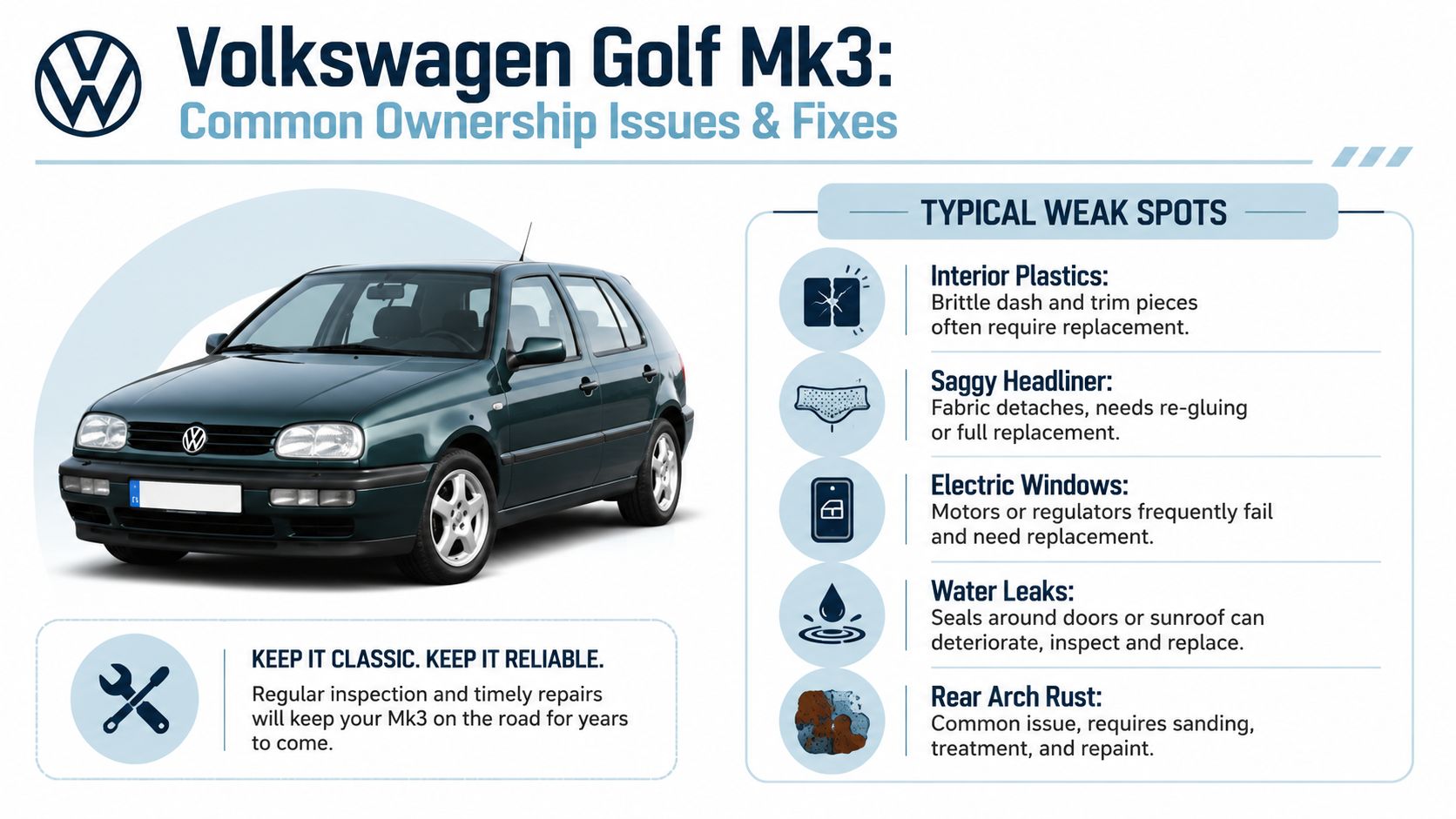
The biggest thing I'd tell any local buyer is to get low, get your hands dirty, and inspect the shell with patience. Generic overseas advice often mentions rust, but here the climate changes the urgency. Heritage Parts Centre notes known Mk3 corrosion areas including the front wings, sills, tailgate and windscreen surround, and the Australian angle matters because coastal salt exposure and trapped moisture make rust move faster than many newcomers expect (Heritage Parts Centre Golf Mk3 buying guide).
That means a shiny red car in photos can still hide trouble under trims, around seals, or in moisture traps. Beachside storage, humid garages, and old repair work all matter.
The usual age-related irritations
The Mk3 also cops the normal old-car grumbles:
- Interior trim fatigue often shows up as brittle plastics and worn switchgear.
- Headliner sag is common and annoying rather than catastrophic.
- Electrical gremlins can pop up around windows, locks, and cabin convenience items.
- Water leaks need attention early, because moisture inside the cabin rarely stays a small issue for long.
None of that should scare you off. It just changes how you inspect the car.
Buy body condition first. Mechanical faults usually announce themselves. Hidden rust often waits until you've already fallen in love.
What a sensible owner does
A smart Mk3 owner in Australia usually follows a simple pattern.
- Check the drains and seals before the wet season, especially if the car lives outside.
- Remove trapped moisture fast if carpets ever feel damp.
- Treat bubbling paint seriously around the windscreen, arches and tailgate.
- Keep expectations realistic. You're not maintaining a new hatch. You're preserving a classic.
If you enjoy seeing how the Golf evolved after the Mk3 era, a later-generation piece like the Volkswagen Golf Mk 7 collectible makes a fun side-by-side reference point on the shelf while your real project sits in the shed.
Your Project Car Perfecting and Personalising Your Golf
The Mk3's appeal as a project car comes from something simple. It still feels attainable. You don't need concours ambitions to enjoy one, and you don't need to chase the kind of attention an early Mk1 or Mk2 now attracts. That makes it a friendly entry point for Australian enthusiasts who want to restore, lightly modify, or just tidy up a usable classic.
RL Project Parts notes that the Mk3 has often been overlooked beside the Mk2, but interest has grown as earlier Golfs became expensive. It also argues that, for Australian enthusiasts, a well-maintained GTI often gives the best balance of classic fun, parts availability, and reasonable running costs for a weekend car (RL Project Parts Mk3 owner's guide).
Choosing the right base car
A CL or GL can make sense if you love the shape and want a straightforward VW to improve gradually. You're less likely to feel guilty about subtle changes, and you can put your budget into bodywork and mechanical sorting.
A GTI is often the sweet spot. It already has the identity most buyers want, and when you finish one properly it still feels true to itself.
A VR6 is the romantic choice. It's the one people remember and the one that tends to spark the longest conversations at meets. But romance and project budgeting don't always get along.
What works well on a Mk3
Good Mk3 projects usually stay close to the era and the platform's strengths.
- Wheels and stance can transform the car without changing its character.
- Interior refresh work often gives more satisfaction than flashy mods. A clean cabin makes the whole car feel loved again.
- Sympathetic restoration suits the Mk3 especially well. Fresh trims, tidy paint, sorted electrics and period-correct details go a long way.
- Variant choice matters. If you want to drive often, the GTI is often easier to justify. If you want an event car with a bigger story, the VR6 keeps calling.
The best Mk3 projects don't look forced. They look like someone cared enough to finish the details.
That's why many owners personalise in layers. First the rust. Then the cabin. Then wheels, suspension, and all the little bits that make the car feel like yours.
From the Road to the Shelf The Joy of Collecting
A bloke rolled into a Cars and Coffee in Parramatta a few winters back in a tidy Mk3 GL, dark green, factory wheel trims still on it, interior as clean as a church hall. He parked, grabbed his flat white, and then opened the hatch to pull out a little display case. Inside sat a diecast Mk3 in almost the same colour, plus an old dealer brochure with that very '90s VW photography we all remember. More people drifted over to that shelf-in-a-box than to half the modified cars on the row. That told me something. Mk3 ownership rarely stops at the driveway.
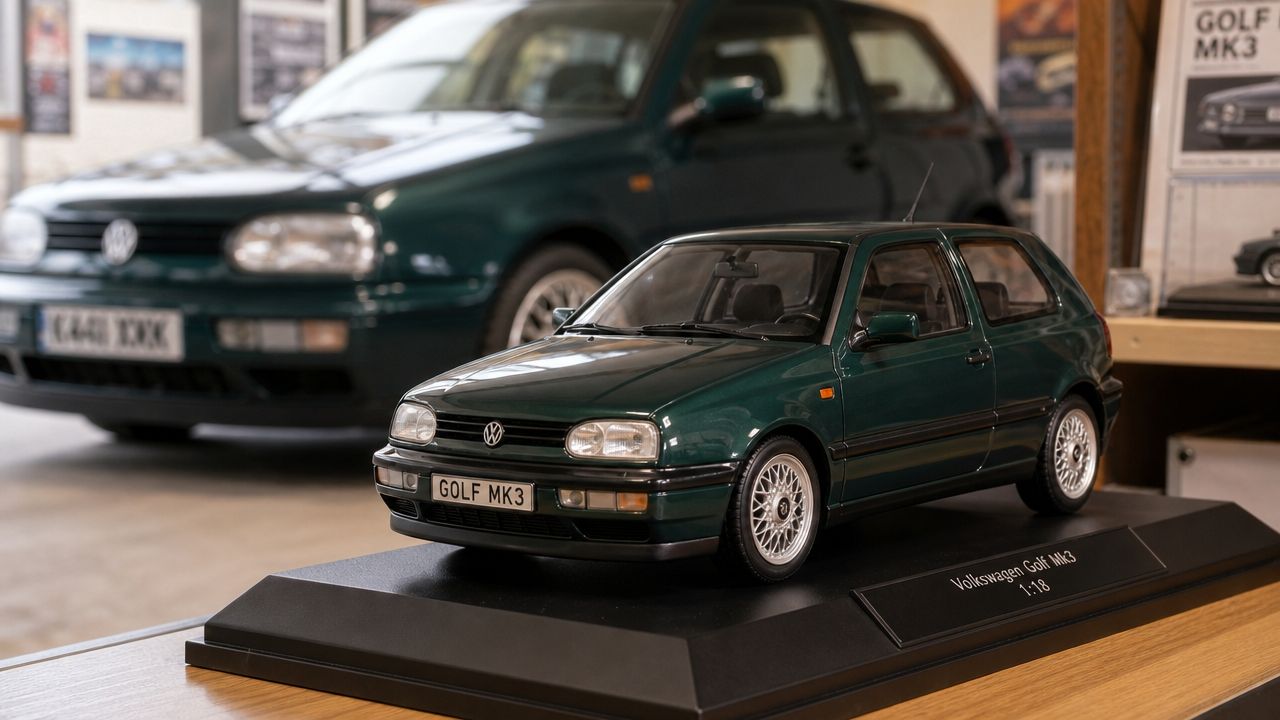
The Mk3 suits collecting because its story feels close to home in Australia. Plenty of us knew one as a family hatch, a uni car, a first VW, or the water-cooled shape that started showing up at local meets before the scene got polished and expensive. In Sydney, Melbourne, Brisbane and down the coast, these cars lived ordinary lives first. That gives the memorabilia real warmth. A shelf piece is not only about rarity. It is about memory.
Why the shelf matters
A good collectible holds onto the parts of ownership that disappear with time. The exact shade of your old car. The dealer literature you threw out during a house move. The keyring from a long-gone service department. Even the dream of the VR6 that slipped away to another buyer in Newcastle while you were still arranging a trailer.
The broader VW collecting world opens up nicely from the Mk3. Many Aussie owners start with Golf pieces, then add older air-cooled icons or a later GTI to show how their taste changed over the years. For readers who enjoy licensed VW pieces, Volkswagen Memorabilia's shop carries Volkswagen-themed diecast and collectibles, including the sort of Kombi and Beetle items that sit naturally beside Golf memorabilia in a home display.
There is practical value in it too. Old brochures, dealer folders and period accessories can help you chase the right trim, wheel, or interior detail while sorting a project. A shelf can be sentimental and useful at the same time, especially alongside a stash of VW parts sources in Australia that keeps the project car on the road.
Building a display with character
The best Mk3 displays feel personal, not crowded.
- Match your own car with the closest colour, wheel style, and trim you can find.
- Build an Australian story with local dealer material, old rego items, show passes, or photos from VW meets by the beach.
- Mix eras carefully so the Mk3 stays the hero, with one or two supporting pieces from the Beetle, Kombi, or later GTI world.
- Use memorabilia as a memory board for cars sold, cars missed, and cars still on the wish list.
A small shelf often says more than a packed cabinet. One Mk3 model, a period brochure, and a photo from a club run through the Royal National Park can carry more feeling than twenty random collectibles lined up in perfect rows.
There's a lovely little reminder of that wider enthusiasm in moving form too.
That is the charm of Mk3 collecting. The car on the road gives you the smells, sounds and little mechanical rituals. The bits on the shelf keep the story alive on the days you cannot drive it, and in the years after one particular Golf has left the garage.
An Aussie Buyer's Checklist Finding a Good One
If you're heading out to inspect a Volkswagen Golf Mk3 in Australia, go in with a cool head and a sharp torch. Charm matters, but structure matters more. A tidy Mk3 GTI can still be a practical classic because the commonly cited spec pairs 115 hp from the 2.0-litre engine with a compact 4020 mm length, though fuel economy of about 24 mpg combined means buyers now choose it more for driving feel than thrift (Wikipedia overview of the Volkswagen Golf Mk3).
The inspection walk-around
Start outside and stay methodical.
Check the rust-prone zones first
Look carefully at the front wings, sills, tailgate edges, wheel arches, and around the windscreen. If the seller keeps steering you away from one corner of the car, spend more time there.Read the paint with your eyes and fingertips
Mismatched colour, uneven reflections, or thick paint edges can suggest past repairs. That doesn't automatically kill the deal, but you want honesty and evidence of proper work.Inspect trims and moisture traps
Old plastic trim can hide dirt, moisture and the start of corrosion. Lift seals gently where appropriate and look for bubbling or staining.
Cabin and mechanical checks
Inside the car, the Mk3 tells on itself quickly.
- Test every switch. Windows, locks, fans and lights should all be tried.
- Smell the cabin. Damp odour can point to leaks and hidden water ingress.
- Check seat wear and trim condition. A scruffy interior doesn't always mean a bad car, but it often hints at a casual owner.
- Watch the headliner. If it's sagging, budget time and effort for a proper fix.
Under the bonnet, aim for signs of care rather than miracle cleanliness. You want consistency. Old hoses, rushed wiring, and random aftermarket shortcuts usually mean more sorting later.
Take your time on the body and cabin. Most buyers rush because they want to hear it run. The expensive surprises often sit still.
The road test and paperwork
On the drive, listen for suspension knocks, feel for straight braking, and note whether the car feels settled or tired. A good Mk3 should still feel compact and easy to place on the road.
Then check the paperwork.
- Look for service history that shows regular attention rather than long blank gaps.
- Ask about import or compliance details if the car's history seems unusual.
- Think about intended use. Daily occasional classic, weekend toy, or long-term project all point to different buys.
- Use local parts reality as part of the decision. If you're planning a restoration, browsing VW parts options in Australia can help you understand what ownership support looks like before you commit.
A good Mk3 isn't just the cheapest one you can find. It's the one with the straightest story.
If the Volkswagen Golf Mk3 has you feeling nostalgic for the broader VW world, have a wander through Volkswagen Memorabilia. It's a handy local spot to find licensed VW-themed diecast, Kombi and Beetle collectibles, and shelf-worthy memorabilia that suits a garage office, display cabinet, or gift for the Volkswagen fan in your life.