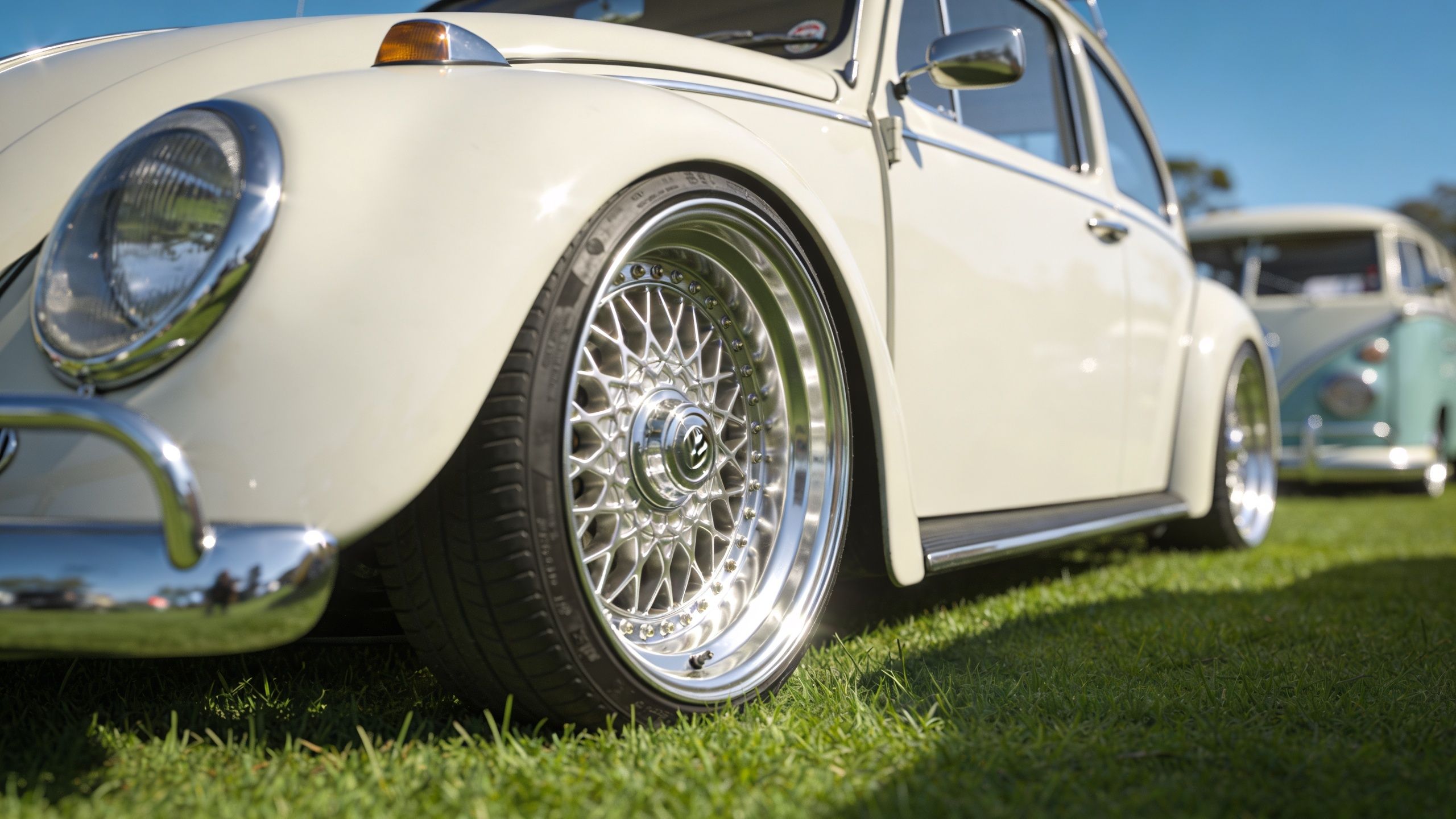
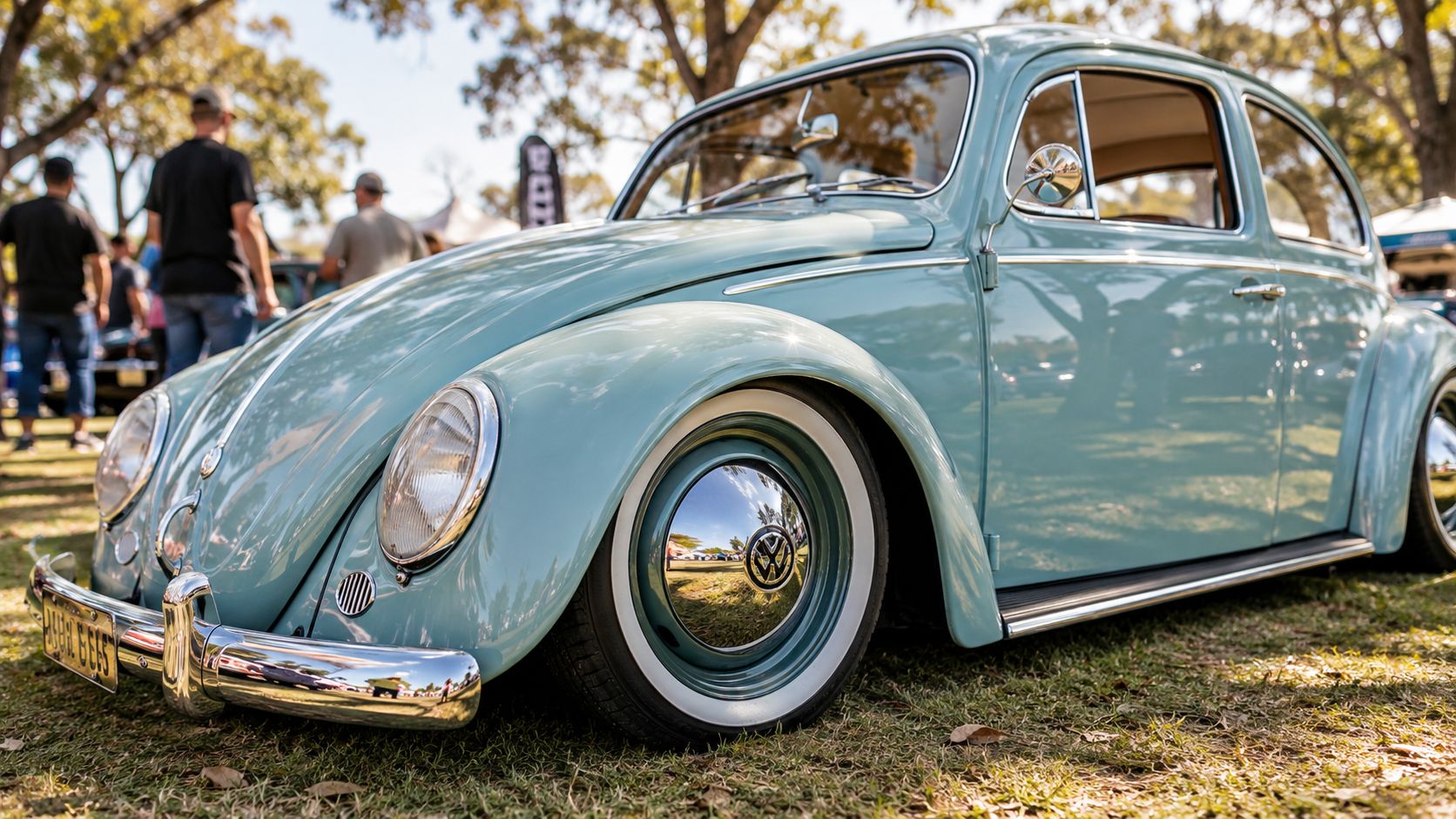
At a summer VW show in Australia, the Beetle that stops people in their tracks usually isn't the loudest one. It's the one sitting just right on its wheels, with the hubcaps polished, the stance honest, and the details looking like they belong there. That's where vw beetle wheels go from simple hardware to part of the car's whole personality.
A Beetle can wear the wrong wheels and still roll into the shed. It won't look right, it won't steer right, and if the fitment is off, it may not even behave safely at highway speed. The good news is that once you understand the basics, the whole topic starts to make sense quickly.
Why VW Beetle Wheels Matter More Than You Think
At a sunny Aussie car show, the Beetle that gets the slow walk-around is usually the one with wheels that suit the body. A stock-looking set of steel rims and tidy hubcaps can make a car feel properly period-correct, while the wrong offset or a too-modern alloy can throw the whole shape out. On a Beetle, the wheels don't just finish the look, they define it.
The reason that matters is bigger than style. Volkswagen's own history shows the Beetle wasn't a short-run model with a tiny parts window, it became one of the longest-running single-generation cars ever built, with 21,529,464 first-generation Beetles produced between 1938 and 2003. Volkswagen also says the Beetle took the overall sales record from the Ford Model T in 1972, and finished its final Puebla, Mexico production run on 30 July 2003 after a 65-year production span. Volkswagen Beetle production history
That long life explains why Beetle wheel choices can feel like a family tree instead of a single spec sheet. Some owners chase exact factory appearance, others want a subtle stance change, and plenty just want something that drives straight and clears the guards. If you've ever seen one Beetle look tidy and another look awkward on almost the same body, the difference is usually the wheels.
Practical rule: on a Beetle, wheel choice changes the car's character faster than almost any other bolt-on part.
There's also a collector side to it. Australian owners, restorers, and memorabilia fans often gravitate to Beetles because the model's long production life preserved parts continuity, which helps explain why wheel-related restoration demand stayed active well after production ended in Europe and then Mexico. That same continuity is why the humble hubcap can become a talking point at a club picnic.
Understanding the Critical Bolt Pattern Split
The first thing to check on any classic Beetle wheel is the bolt pattern. If you get this wrong, nothing else matters, because the wheel won't mount correctly. Classic Volkswagen Beetles used two main lug patterns, 5×205 on models up to 1966, and 4×130 from 1967 onward. Heritage Parts Centre Beetle alloy wheel guide
Early and late Beetles belong to different fitment families
Early cars are known for the 5×205 pattern, often called the “wide 5”. Later Beetles moved to 4×130, which opened the door to a different pool of factory and aftermarket wheels. For Australian owners, that split is the single most important thing to know before buying rims, hubcaps, or restoration parts.
Here's a quick reference for the classic era:
| Model Years | Bolt Pattern | Common Name | Hub Bore | Notes |
|---|---|---|---|---|
| Up to 1966 | 5×205 | Wide 5 | Not specified in the verified data | Early Beetles use the wide 5 layout |
| 1967 to end of production | 4×130 | Four bolt | 57.1 mm on later models | Non-OEM wheels often need hubcentric rings |
The hub bore matters because a wheel can bolt on and still fit badly. For later-model Beetles, the 57.1 mm bore is common, and non-OEM wheels often need hubcentric rings so the hub carries the load instead of the studs. Australian Heritage Parts Centre notes that the wrong PCD or a non-hubcentric fit can lead to steering vibration, uneven clamp load, and wheel runout at highway speeds. Heritage Parts Centre AU wheel guide
Why the split matters in the real world
A lot of confusion starts when buyers shop by badge instead of chassis era. A “VW Beetle wheel” listing sounds simple, but the actual fit depends on whether the car is an early wide-5 car or a later four-bolt car. That's why period-correct hubcaps and original-style wheels often need era-specific checking, not just a glance at the car's shape.
A Beetle wheel that looks right in a photo can still be completely wrong on your chassis.
That's also why many owners keep original wheels if they can. Once you've identified the bolt pattern family, the rest of the decision gets much easier, whether you're hunting parts at a swap meet or sorting a restoration in the garage.
Offset and Width Explained in Plain English
Offset sounds technical, but the idea's simple. It tells you where the wheel sits relative to the hub, and on a Beetle that position affects guard clearance, steering feel, and whether the tyre sits tucked in or sticks out too far. Classic Beetle wheels are typically in the ET25 to ET45 range, with common widths around 4.5 to 6 inches. Just Kampers Beetle wheel fitment guide
Why factory-style sizing works
Volkswagen built the Beetle around relatively narrow wheels, and wheel-size reference data for a 1970 Beetle shows OE combinations such as 4Jx15 ET20 and 4.5Jx15 ET34. Those specs show the original idea clearly, modest positive offset, conservative width, and a tyre position that stays inside the fender line while still allowing steering lock and suspension movement. Wheel-size Beetle fitment data
That's why the classic 15-inch factory-style wheel is still such a familiar sight. Heritage Parts Centre notes most stock Beetle wheels are 5Jx15, with positive offset usually around +25 to +34 ET. Heritage Parts Centre wheel fit guide
Once you move outside that envelope, the car starts talking back. Go too wide and you can get inner suspension contact or outer fender rubbing. Change offset too far and you alter scrub radius and steering effort, which can make the car feel heavier or more nervous on the road.
Good fitment is a geometry problem, not just a looks problem.
What to check before you fall in love with a rim
A wheel's diameter alone doesn't tell the story. You need to look at width, offset, backspacing, and tyre section width together, because those numbers work as a set. A Beetle on a pretty rim with the wrong backspacing can look fine parked up and still rub hard on the first full-lock turn.
For club cars and street Beetles, a careful measured approach beats guesswork every time. If the wheel fits the arch but scrubs the steering, or clears the front but kisses the rear guard under load, the spec wasn't matched to the car. That's why the old VW crowd talks about fitment with the same respect as paintwork.
Popular Wheel Styles for Every Beetle Vision
The nicest thing about Beetle wheels is how much personality they carry. A set of plain steel wheels with clean hubcaps says one thing, while alloy rims with a sharper profile say something else entirely. The car hasn't changed, but the mood has.
OEM steel wheels and polished hubcaps
For concours-style restorations, the factory steel wheel is still the cleanest answer. It keeps the car visually honest, especially when paired with tidy hubcaps and sensible tyres. On a Beetle, that simple setup suits the body lines better than many owners expect, because the car was designed around that restrained look.
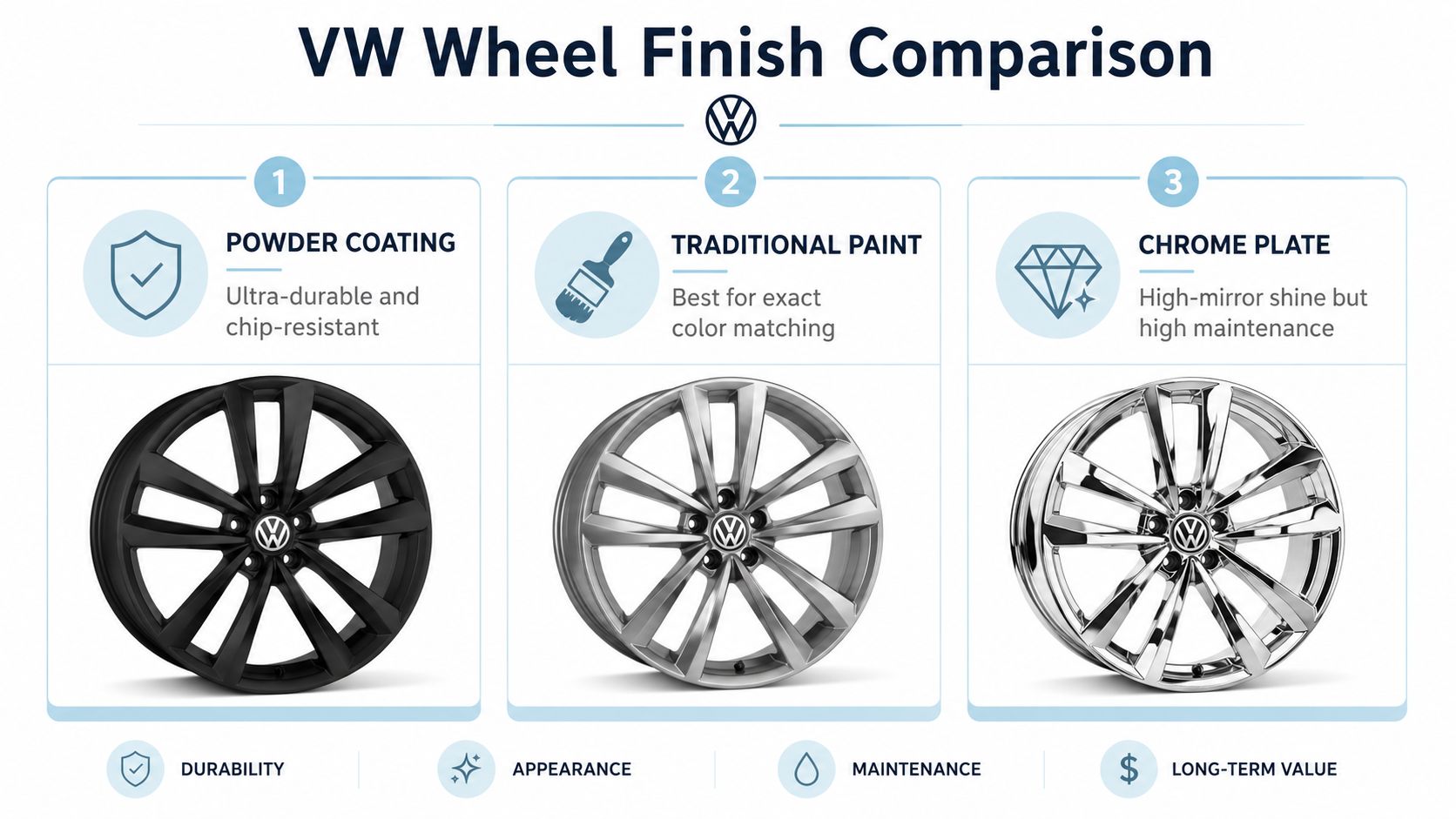
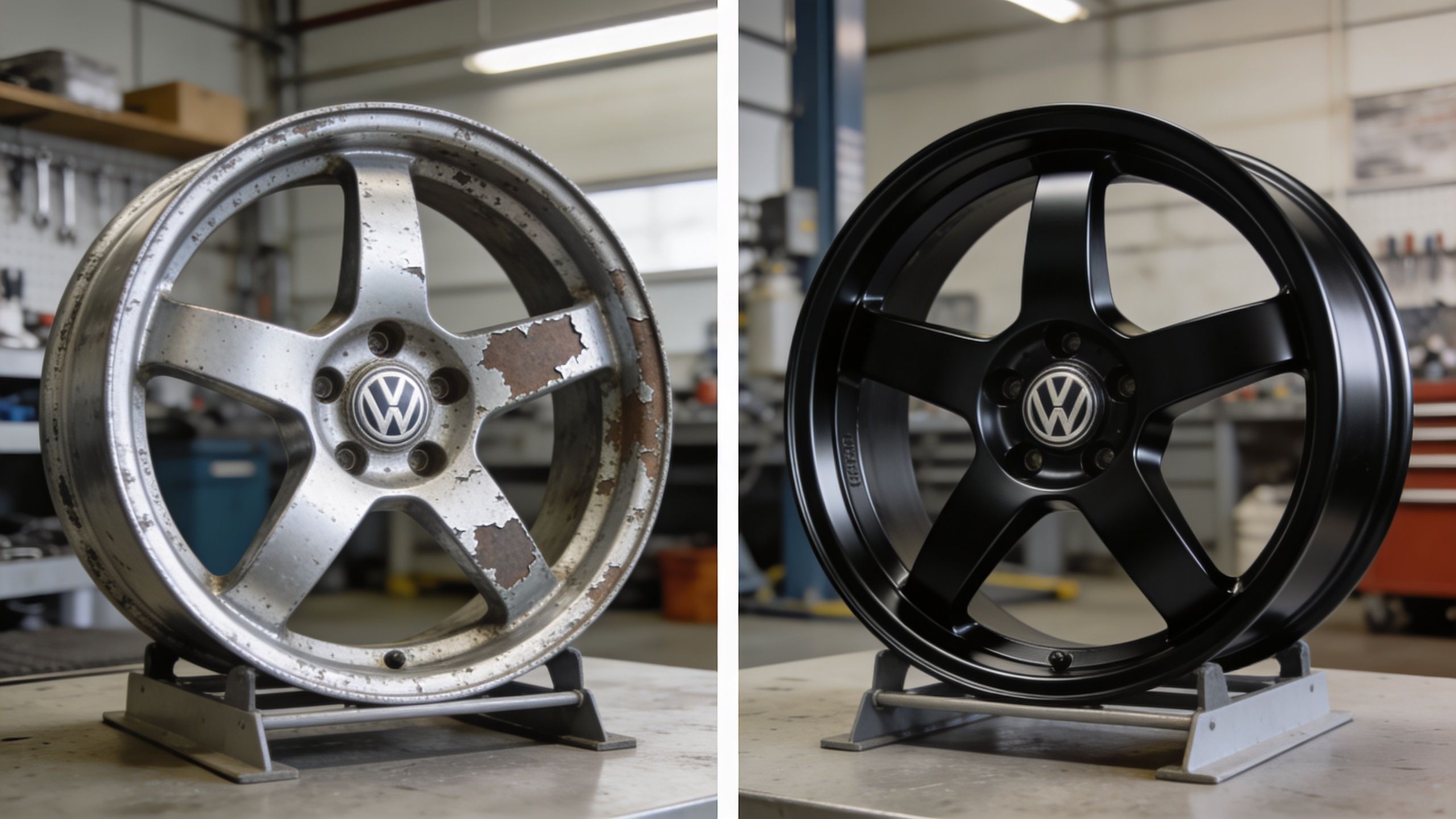
If you're considering refurbishing original rims, proper finishing matters. A refreshed factory wheel set can transform a driver-grade Beetle without forcing the car into a modified look, and a professional refinish can lift a tired car while keeping it period-aware. VW rim powder coating ideas
Aftermarket and period-inspired choices
Cal-Look builds often lean toward wider steelies or subtle alloys, while 70s-inspired cars sometimes suit slot mags or other retro patterns. Porsche-style Fuchs-inspired alloys also have a following because they sit neatly in the overlap between classic VW culture and German sports-car styling. The best choice depends on whether the car's story is restoration, street use, or a deliberate period tribute.
A few style cues help owners narrow the field:
- Stock steel and hubcaps, best for original presentation and show-day authenticity.
- Widened steel wheels, popular for a tougher stance without abandoning the old-school vibe.
- Slot mags, a strong choice for 70s-flavoured builds that want a bit more visual muscle.
- Fuchs-style alloys, chosen when the owner wants a cleaner, more performance-leaning German look.
All of those choices still need correct fitment. A beautiful rim that lands outside the Beetle's practical offset window will cause more grief than joy, especially if the car gets driven often.
The right wheel style respects the Beetle's shape instead of fighting it.
If you want to keep the look authentic, start from the car's era and build outward. If you want a more customised result, keep the stance controlled so the wheel choice still looks like it belongs under a Beetle body.
Measuring and Installing Your New Wheels
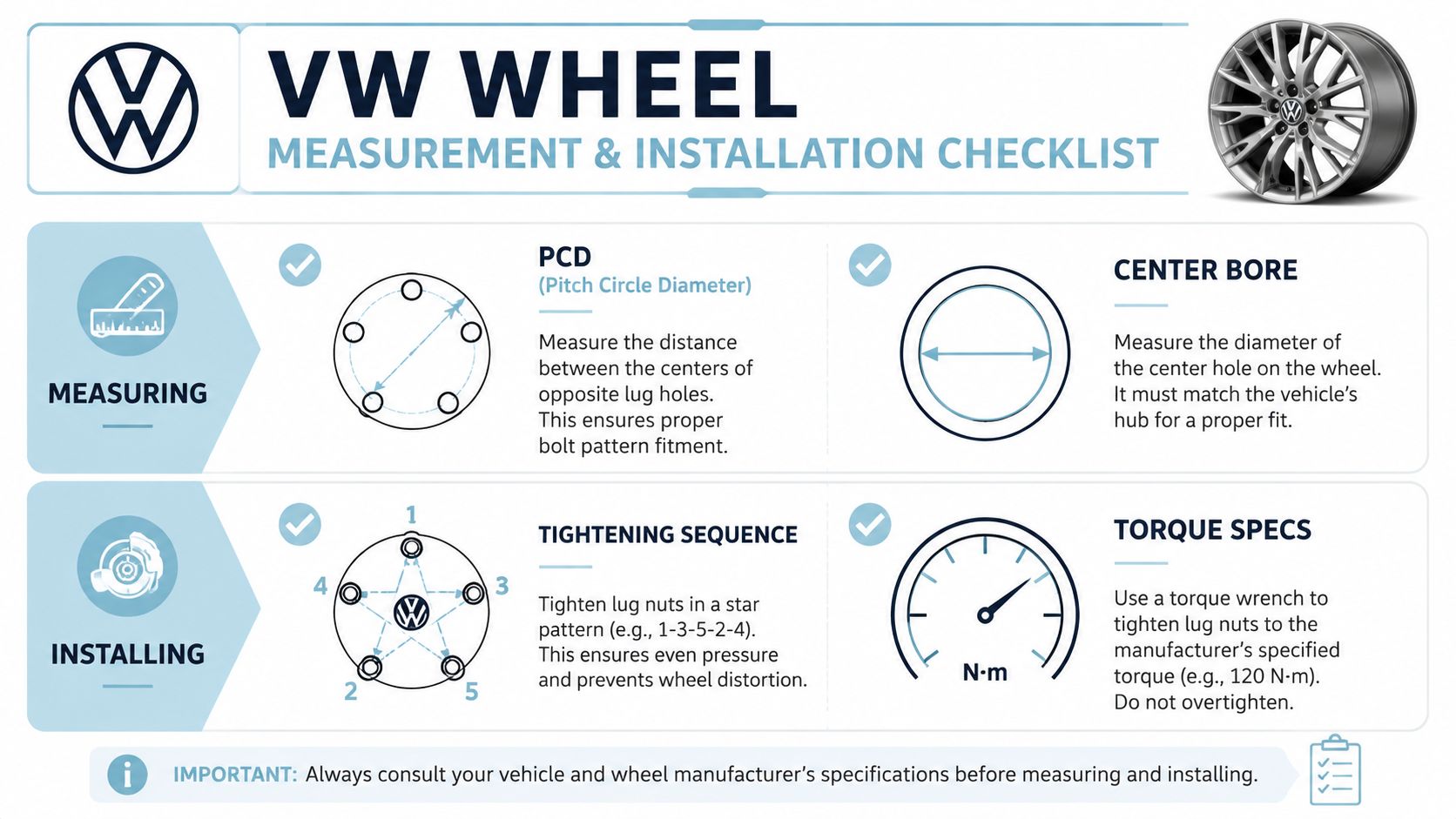
Before you buy anything, measure what's on the car now. Start with the bolt pattern, then check the centre bore, then measure width and offset. If the current wheel already fits well, it gives you a baseline that's worth more than a guess from a catalogue photo.
A simple workshop method
The two identifiers that trip people up most are PCD and centre bore. Australian Heritage Parts Centre states that Beetles up to 1966 use 5 x 205, while cars from 1967 onward use 4 x 130. For later Beetles, the 57.1 mm hub bore is commonly referenced, and non-OEM wheels may need hubcentric rings. Heritage Parts Centre AU wheel guide
Once the wheel is in hand, check the face, the backspacing, and the tyre size together. If you're changing only the rim diameter but ignoring the tyre section width, you're still flying blind. That's where people get caught out by rubbing that only appears when the suspension compresses or the steering reaches full lock.
A sensible fitting process looks like this:
- Confirm the bolt pattern, because a wheel that doesn't match the hub family is dead on arrival.
- Measure the centre bore, so you know whether hubcentric support is needed.
- Compare width and offset, then test the wheel against actual clearance on the car.
- Check tyre section width, because the tyre can be the part that rubs first.
- Trial-fit before driving, especially if the wheel is non-OEM or the offset differs from stock.
Install with safety in mind
Use the correct tightening sequence and torque procedure, and don't assume a wheel that spins on the studs is mounted correctly. If the wheel is aftermarket, hubcentric rings can be the difference between a clean fit and a shimmy you'll feel through the steering wheel. For any wheel and tyre change that alters offset, track width, load rating, or tyre choice together, Australian compliance rules can come into play, so the legal side matters as much as the mechanical side.
Practical rule: if the wheel looks close but not quite right, stop and measure again before the first drive.
When the basics are measured properly, wheel installation becomes calm work instead of guesswork. That's especially true on a Beetle, where small changes can have a surprisingly big effect on how the car drives.
From Real Cars to Diecast Displays
The fun part of learning Beetle wheel specs is that the knowledge doesn't stop at the shed door. Once you know what a factory wheel should look like, you start spotting accuracy in scale models too. That makes a Volkswagen Beetle model far more satisfying, because the wheels, hubcaps, and stance suddenly tell the same story as the full-size car.
Licensed diecast Beetles and Kombis earn their keep when the details are right. Collectors notice whether a model's wheel style suits the era, whether the hubcap shape feels believable, and whether the car sits like a real Volkswagen rather than a generic toy. That's why people chasing VW memorabilia collectibles often care about wheel fidelity almost as much as paint colour.
A good display doesn't need dozens of pieces. A classic Beetle on one shelf, a later model on another, and a Kombi Samba Bus nearby can show the progression of Volkswagen design in a way that feels authentic. If you've got a VW Kombi diecast Australia collectors' shelf, pairing it with a Beetle model that matches the same era language makes the whole setup stronger.
The best collections usually mix display logic with memory. One car can represent a family restoration, another can stand in for a car show favourite, and a third can be the model you always wanted as a kid. When those models come from a trusted Australian source, you're also more likely to get the kind of licensed pieces that serious collectors prefer. Volkswagen model cars
A scale model feels more valuable when it matches the real car's proportions and wheel story.
For anyone building a shelf, the easiest starting point is a themed pair. Match a classic Beetle with a Samba Bus, or line up a stock-style car beside a more customised version, and let the wheels show the difference in era and attitude. That's the quiet pleasure of collecting, the details are small, but they make the whole scene feel true.
Your Next Steps in the VW Community
Beetle wheels are one of those topics that pull together the whole VW hobby. They connect restoration, safety, styling, and collecting in a way that makes sense whether you're standing under a car at Volksfest or unpacking a model from the box at home. Once you know the bolt pattern, offset, and era cues, you stop guessing and start choosing well.
That's the heart of the Aussie VW scene. People love the cars, but they also love the shared knowledge, the club banter, the swap-meet finds, and the satisfaction of getting the details right. Whether you're chasing a tidy factory look or building a small display of licensed Volkswagen pieces, the right wheel knowledge adds another layer of enjoyment.
So keep learning, keep comparing notes with other enthusiasts, and keep going to the events where these cars still get celebrated properly. Volksfest, VW Nationals, and local club meets are full of owners who've already made the mistakes, fixed them, and are happy to tell the story over a cuppa and a close look at the hubcaps.
If you're ready to keep the Volkswagen passion going at home, Volkswagen Memorabilia brings together VW-themed gifts, diecast models, and display pieces that suit Beetle and Kombi lovers alike. Visit Volkswagen Memorabilia to browse pieces that fit the same heritage-minded spirit as the cars themselves, and add something special to your shelf, garage, or gift list.