

The first time I dragged home an old VW, it looked more hopeful than healthy. Faded paint, a cabin full of warm vinyl smell, and that unmistakable promise that one day it would be rolling down the coast again.
That's the thing about old Volkswagens. Hunting for VW replacement parts isn't just maintenance. It's part of the romance, part detective work, part treasure hunt, and part love letter to a machine that has outlived trends, fashions, and more than a few family stories.
The Dream in the Driveway Starting Your VW Journey
A classic Beetle or Kombi rarely arrives in perfect nick. More often, it turns up with a few borrowed bits, a few mysteries, and a lot of character. Maybe the doors shut with that familiar metallic click, but the seals are tired. Maybe the engine runs, but the tinware doesn't quite match. Maybe someone fitted parts from another market years ago because they wanted to keep it on the road.
That's not failure. That's the start of the VW journey.
For plenty of Australian enthusiasts, the joy sits right in that middle ground between “barn find” and “fully sorted cruiser”. You clean the dust off the badge, make a list, and slowly realise that every part tells a story. A worn steering wheel says this car was driven. A patched seat says somebody loved it enough to repair it. An oddball indicator assembly says some previous owner got creative on a Sunday afternoon.
Old Volkswagens invite you in. They don't ask for perfection first.
What restoration really feels like
Restoring an old Dub isn't always glamorous. Some days it's just comparing rubber trims, chasing thread sizes, or trying to work out why a bracket is close, but not quite right. Still, those are the moments that teach you the car.
The search for VW replacement parts becomes more enjoyable when you treat it as a process of getting to know your car, rather than a rush to finish it. That matters for classic Beetles, Kombis, and early Golfs especially, because Australian-delivered cars can have their own quirks, and many have been repaired over the years with whatever was available at the time.
A better mindset for parts hunting
A good restoration mindset usually looks like this:
- Start with safety items first. Brakes, steering, tyres, and anything that affects control deserve careful attention.
- Accept that originality and practicality sometimes pull in different directions. A showroom-style restoration has different needs from a beach-run Kombi that still gets used.
- Keep notes as you go. Part numbers, build details, and photos of removed parts will save you headaches later.
When you approach VW replacement parts this way, the job feels less like a chore and more like bringing a legend back into focus.
Decoding Your Dub Finding the Right Part Numbers
The most common mistake in any VW restoration is buying too early. Before you spend a cent, you need to identify the exact part. That sounds obvious, but many owners come unstuck on this point, especially with older Australian-delivered cars that may have mixed-market parts fitted over time.
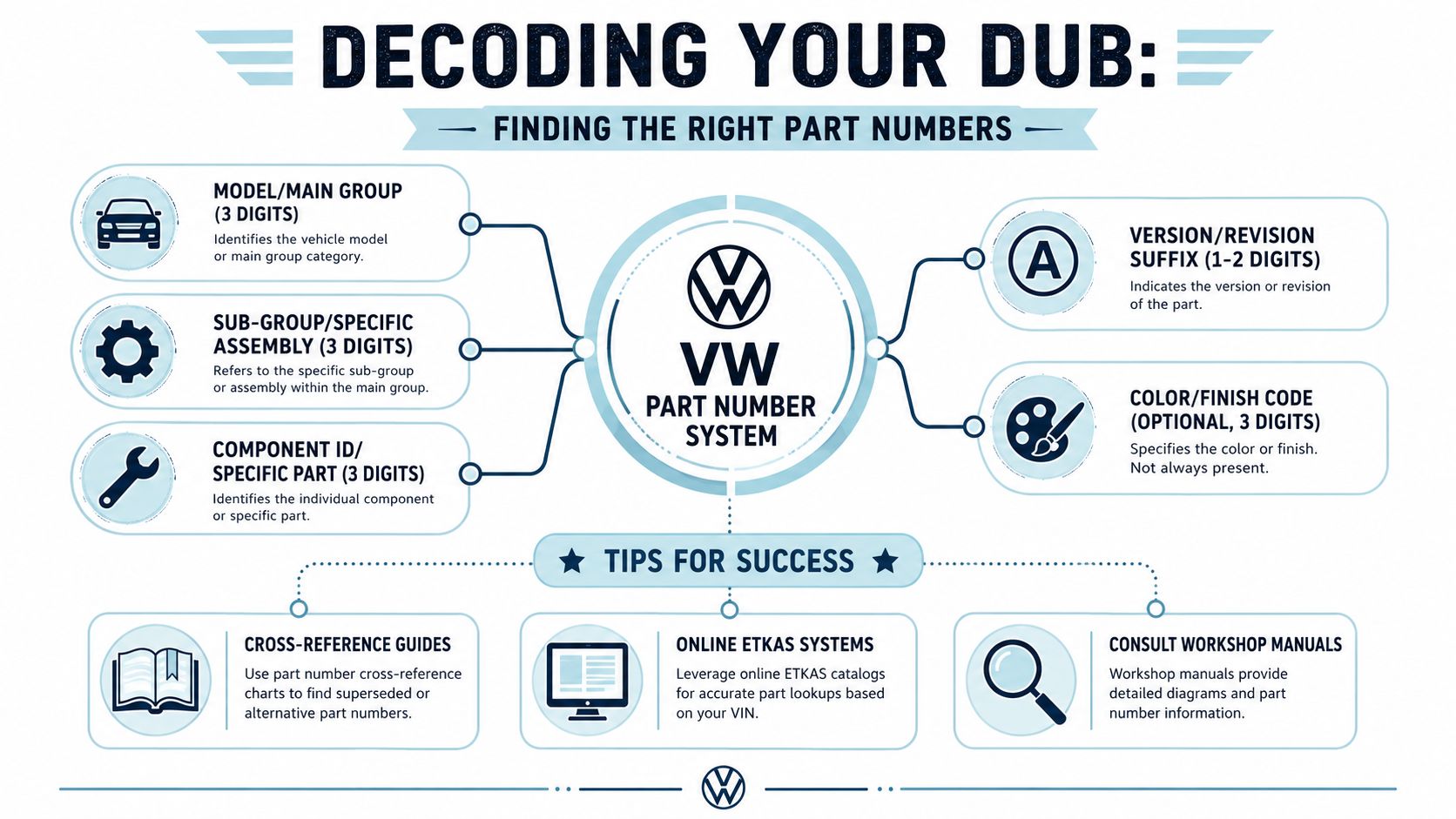
Volkswagen's parts identification system has been in use since the 1930s, and modern VW part numbers can be decoded through ETKA, the official electronic parts catalogue for the VAG group. Independent buyers and businesses can also use partslink24, an online ETKA equivalent available for about £30 per month, which can identify the exact parts fitted to a vehicle by VIN. That matters locally because VIN-based lookup is the standard way to verify fitment for imported and mixed-fleet VW models in Australia, as explained in this guide to VW part numbers and ETKA access.
Why older Australian VWs confuse people
A lot of catalogues list parts by model and year, which sounds helpful until you discover that older VW ownership is rarely that tidy. Existing Australian content rarely explains how to match parts to older Australian-delivered models using VIN-based lookup systems that non-technicians can use. Many catalogues assume you already know the correct chassis code, such as Type 1 or T2, and don't clearly translate Australian VIN prefixes or build dates into the right part path, which creates a practical gap for enthusiasts, as noted in this discussion of the Australian VW fitment knowledge gap.
That's why “it's a 1970s Beetle” often isn't enough information. You need to know what the car is, not just what the seller called it.
A simple way to narrow it down
Use this order when you're identifying VW replacement parts:
- Read the plate first. Check the VIN plate, chassis stamping, and any build tags you can still find.
- Match the chassis family. Type 1, T2, and later Golf generations matter because VW grouped parts around platforms and assemblies.
- Inspect the old part itself. Many original components still carry factory markings or part numbers.
- Check build-date changes. Mid-year changes can catch you out, especially on trim, lights, switches, and running gear.
- Cross-check before buying. If the catalogue entry and the removed part disagree, pause and verify.
Practical rule: Never order from model name alone if the car has had decades of repairs, imports, or owner modifications.
A model-specific reference can also help when you're sorting Beetle-era parts. If you're working through identification for classic Bug components, the Volkswagen Beetle parts guide is a handy starting point for familiar terminology and common categories.
What a part number is really telling you
Think of a VW part number as a map, not just a label. It usually points to the model family, the assembly group, the specific component, and sometimes a later revision. That's why one small letter change at the end can mean a part looks similar but won't fit properly.
For old VWs, that detail saves money and frustration. It's the difference between bolting something on in ten minutes and discovering your “correct” part is just close enough to waste a whole Saturday.
Genuine vs Aftermarket Choosing Your Parts Philosophy
Every VW owner ends up here sooner or later. Do you hold out for genuine parts, or do you fit aftermarket where it makes sense? There isn't one perfect answer, but there is a sensible way to think about it.
Volkswagen's official position is clear. Recycled, salvaged, aftermarket, and reconditioned parts are not authorised for repair of Volkswagen vehicles, including safety-related components, according to Volkswagen's recycled-parts policy statement.pdf). For classic owners, that doesn't magically make every aftermarket part bad, but it does underline why exact OEM part numbers and careful supplier choice matter.
When genuine parts make the most sense
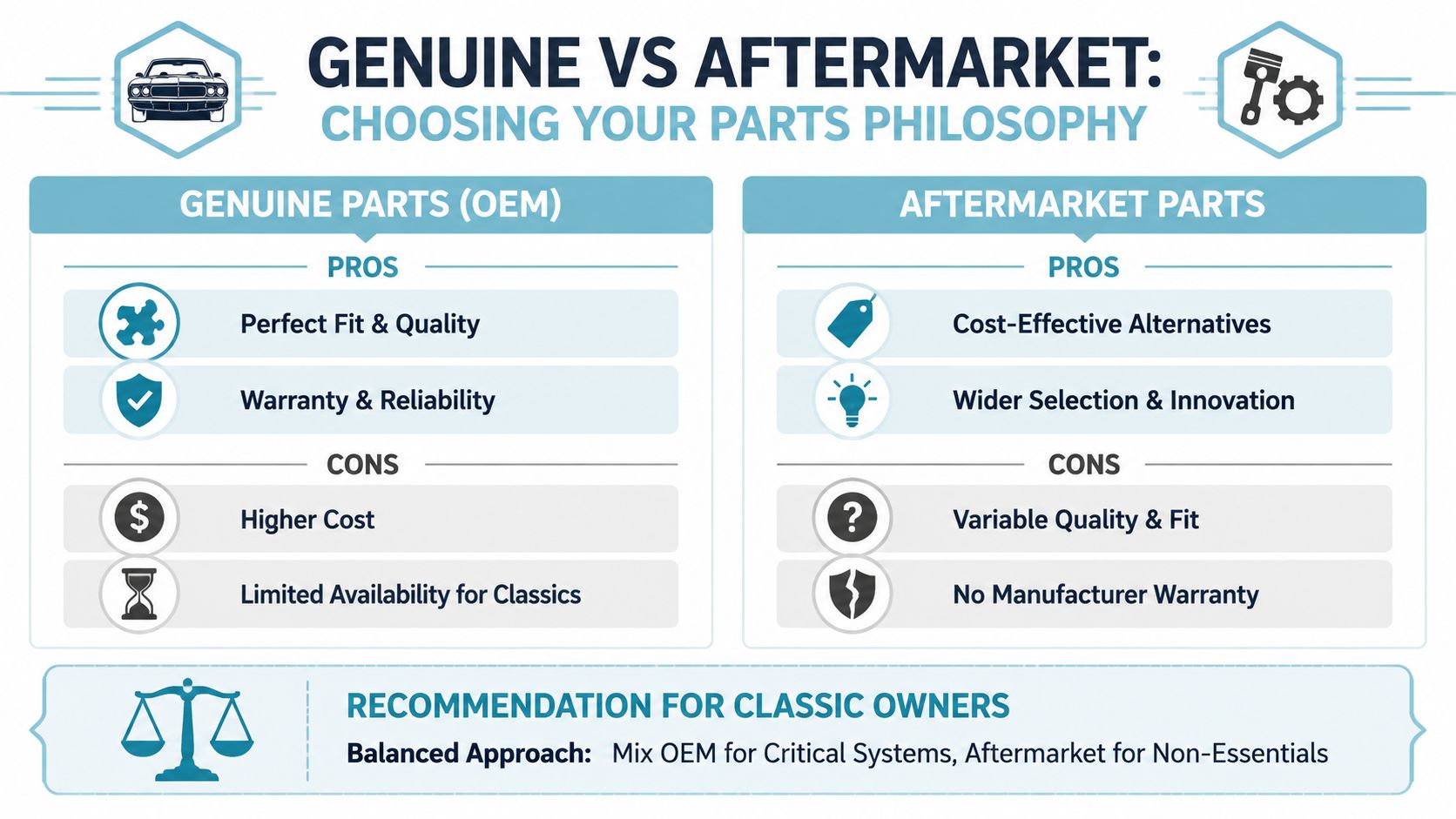
If you're working on braking components, steering pieces, engine internals, or anything load-bearing, genuine parts have a strong case. Fitment tends to be more predictable, and for a factory-faithful restoration they help preserve the character of the car.
They also matter when originality is part of the joy. If you're restoring a Beetle to look and feel as close as possible to how it left the showroom, genuine trim, badges, lenses, and switchgear carry a certain satisfaction that's hard to fake.
When aftermarket can be a smart move
Not every aftermarket part is a compromise. Some are practical. For non-critical items like mats, cosmetic trim, or certain service parts, a reputable aftermarket supplier can keep your project moving without draining the restoration fund.
Use a balanced filter:
- Choose OEM for critical systems. Safety and precision matter most here.
- Use trusted aftermarket for non-essential parts. Especially when genuine stock is scarce for classics.
- Avoid mystery listings. If the seller can't explain fitment, provenance, or manufacturer details, keep scrolling.
If you're comparing options locally, the Volkswagen parts Australia collection reflects the kind of broad category language many enthusiasts use when they begin researching what they need.
Buy the best part you can verify, not the cheapest part you can click on.
Your Aussie Sourcing Map Where to Buy VW Parts
Buying VW replacement parts in Australia often means using more than one channel. The best results usually come from mixing specialist suppliers, local wreckers, club contacts, and your own records of what has already worked on the car.
The four places enthusiasts keep returning to
Specialist VW suppliers are usually the easiest place to start. They understand the language of chassis families, revisions, and superseded parts. That alone can save a lot of back-and-forth.
Local wreckers can still be gold. They're especially useful for hard trim, brackets, glass hardware, and those strange little original pieces that never seem important until you need one. The trick is to arrive prepared with photos, measurements, and your old part in hand if possible.
Clubs and enthusiast circles remain one of the best sources for obscure knowledge. Someone has already solved the problem you're facing. They may know which parts interchange, which repro items fit poorly, or which supplier still has old stock on the shelf.
Online marketplaces are the wild west. Sometimes they're brilliant. Sometimes they're a box of disappointment.
How to spot trouble before you buy
Independent parts-qualification guidance for Volkswagen recommends checking for factory-marked components and warns that suspiciously low pricing, poor packaging, and branding errors are common signs of counterfeit parts. Those faults can lead to fitment issues and compromise installation integrity, according to this Volkswagen genuine-parts identification guide.
Use a quick screening checklist:
- Inspect markings. Factory marks and clean finishing are reassuring signs.
- Study the packaging. Smudges, sloppy print, and branding mistakes should put you on alert.
- Question bargain pricing. A part that's far cheaper than expected deserves extra scrutiny.
- Check fit surfaces and threads. Burrs, rough edges, or poor machining can create installation problems.
The VW parts Australia page shows the kinds of searches many local buyers make when they're beginning their sourcing run and trying to sort broad needs into the right category.
A useful walkaround on used parts and workshop buying habits sits below.
A practical Aussie strategy
Don't rely on one seller for everything. Source safety items conservatively, hunt rare trim patiently, and use community knowledge whenever the catalogue gets muddy.
That's often how a solid restoration comes together in Australia. Not in one giant order, but through steady, careful buying. One correct hinge, one proper lens, one hard-to-find badge at a time.
From the Road to the Shelf Celebrating the VW Legacy
For a lot of us, the affection doesn't stop once the garage door closes. The same lines that make a Kombi charming on the road also make it beautiful on a shelf, on a desk, or in a display cabinet near the workshop bench.
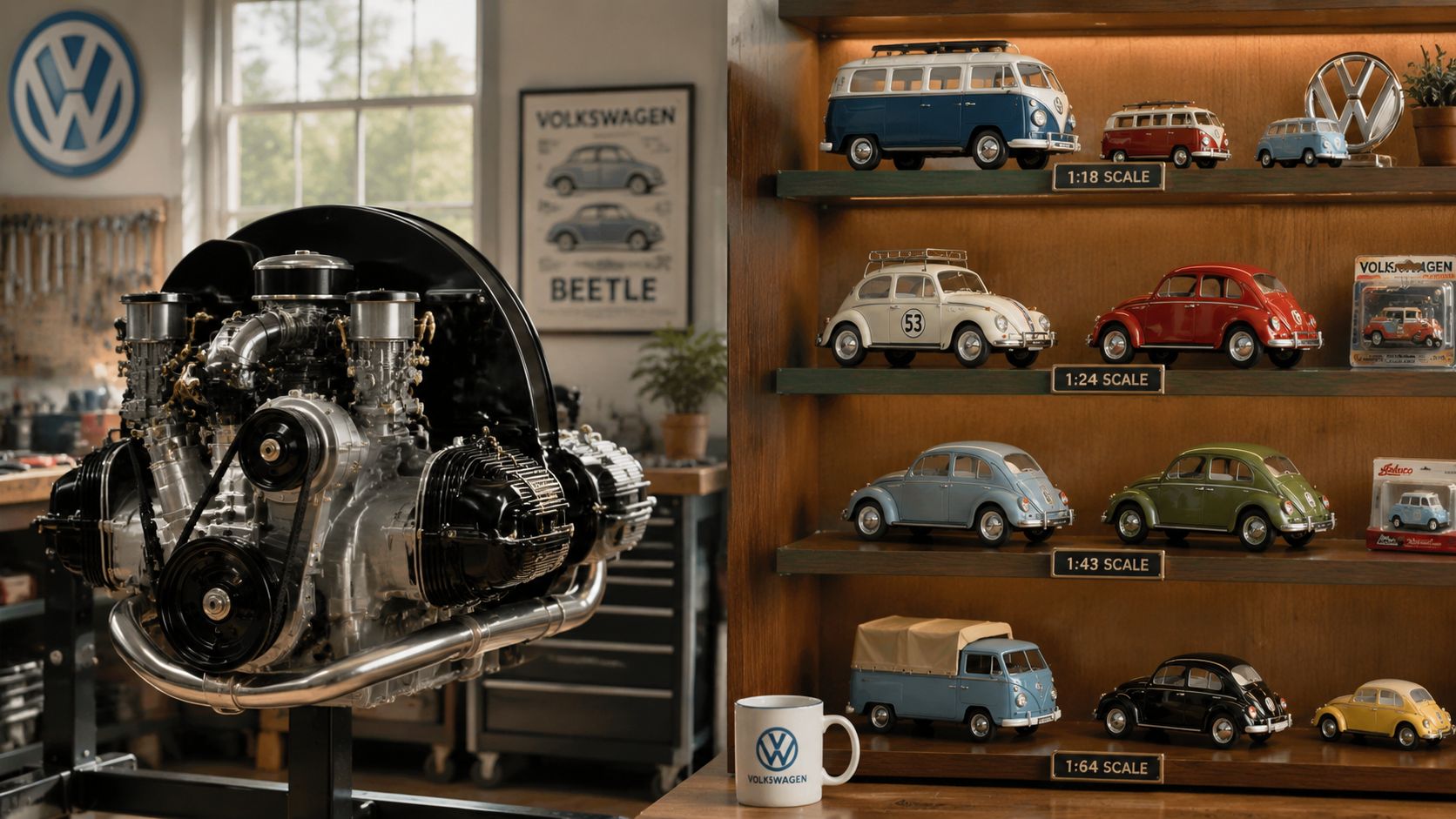
A good diecast model does something clever. It captures the shape and spirit of the actual vehicle without the oily hands, late-night parts searches, or long waits for that final trim clip. If you've ever restored a Beetle or hunted VW replacement parts for a Kombi, a quality scale model feels less like décor and more like a tribute.
Why collectors and restorers overlap so naturally
Restorers tend to notice details. Window lines. Wheel style. Roof treatment. Interior layout. That's exactly why so many VW enthusiasts drift into collecting licensed models. They appreciate accuracy.
A well-made Volkswagen Beetle model or a carefully finished Samba Bus lets you celebrate the vehicle's design even when your real project is still up on stands. It's also a lovely way to remember the cars you once owned, the ones you learned to drive in, or the Kombi your family piled into for beach trips years ago.
Some VWs live in the driveway. Others live in memory. A good model gives both a place to stay.
For many enthusiasts, collecting becomes a companion hobby to restoration. One keeps your hands busy. The other keeps the story visible.
A Guide to Collecting VW Diecast Models
If you're new to collecting, start with the model that stirs something in you. Maybe it's a split-window Kombi, a flower-power Beetle, or a tidy little bus in surf colours. If you love the shape, you'll enjoy the display far more than if you buy purely by spec.
Picking the right scale
Different scales suit different spaces and personalities.
- 1:18 models usually suit collectors who love presence and detail. They make a strong centrepiece in a study, workshop, or living room shelf.
- 1:24 models hit a sweet spot for many buyers. They offer visible detail without demanding too much room.
- Smaller scales are great if you want a grouped display of several generations, colours, or body styles.
What to look for in a quality model
A strong licensed model usually gets the basics right first. The proportions look correct. The paint feels right for the era. The interior doesn't look like an afterthought.
Look for features such as:
- Official licensing. This is a good sign that the model respects the original design.
- Clean finishing. Paint lines, trim detail, and glazing should look crisp.
- Era-appropriate styling. Wheels, roof windows, and body treatment should match the version being represented.
If you're browsing for VW Kombi diecast Australia options or a Volkswagen Beetle model, local stock makes the process much easier. An Australian importer offers the practical advantage of local availability and fast shipping, which is especially handy for gifts or when you're building a themed display without waiting on overseas fulfilment.
A nice way to begin is with one signature piece and one playful companion. A tidy Samba Bus paired with a bright Beetle can tell the whole VW story in miniature. It's also why collectors often search phrases like buy diecast Kombi, VW memorabilia collectibles, and Volkswagen diecast models for sale when they're narrowing down their next shelf favourite.
Frequently Asked Questions for VW Fans
| Question | Answer |
|---|---|
| How do I avoid buying the wrong VW replacement parts? | Start with the VIN, chassis family, and any markings on the old part. Don't rely on model name alone, especially with older cars that may have mixed parts. |
| Are aftermarket VW parts always a bad idea? | No. The key is choosing reputable suppliers and being much stricter with safety-critical parts than with cosmetic or non-essential items. |
| What's the best first diecast model to buy? | Pick the VW you already love. A Beetle or Kombi with personal meaning will always feel more special than a random “collector's” choice. |
| Is local Australian stock worth it for collectors? | Yes. It usually means simpler ordering, easier support, and faster delivery for gifts or display projects. |
If you love the world behind VW replacement parts, the road stories, and the shapes that never go out of style, have a look at Volkswagen Memorabilia. It's a lovely Australian spot to find officially licensed VW-themed gifts, classic Beetle and Kombi diecast models, and display pieces that keep the spirit of these cars alive long after the engine cools.