

You're on the sofa, the evening air has turned cool, and the room feels one small change away from looking finished. You open a search tab for a boho throw blanket, scroll past a dozen tasselled options, and still can't decide whether your space needs warm terracotta, faded blue, or something quiet in oatmeal.
The right throw can do more than keep your knees warm. It softens a hard-edged room, adds colour without repainting, and brings a relaxed coastal-meets-vintage mood that suits Australian homes beautifully. The trick is choosing one that works with your climate, furniture and existing textures, rather than buying the loudest pattern on the page. For a few easy ways to build that laid-back look, browse these boho style room ideas.
Why Australians Are Draping Boho Throws on Everything Right Now
Australian homes often need warmth without heavy layers. A boho throw blanket handles that job neatly, adding softness to a sofa arm, cane chair or bed without permanent changes. It suits rentals, open-plan rooms and homes where the climate shifts between bright afternoons and cooler evenings.
This style also works because it is easy to move around. Keep a cotton throw on the lounge, carry it to the verandah, then fold it over a chair when guests arrive. Choose texture and colour that look useful, not staged. For more relaxed coastal-vintage combinations, use these boho style room ideas as a practical starting point.
Australia's home textiles market was estimated at USD 2.37 billion in 2026, up from USD 2.24 billion in 2025, and is projected to reach USD 3.11 billion by 2031, with a projected 5.62% CAGR from 2026 to 2031, according to Mordor Intelligence's Australia home textiles market overview. Cotton held 40.78% of the market in 2025, while bed linen led application demand with 38.02% revenue share. For shoppers, those figures support a cotton-first approach to comfortable, natural-looking layers.
The palette that feels right here
Australian boho styling works best with sandy cream, weathered timber, ocean blue and sun-faded red. Combine those tones with practical furniture instead of matching every piece. The result has the easy nostalgia of a beachside road trip, with a subtle VW Kombi-inspired vintage mood carried through throws, cushions and small decor.
Blankets are also becoming a stronger comfort and décor category. One Australian market overview forecasts blanket growth of more than 7.41% CAGR from 2026 to 2031, while another estimates the Australia blankets and quilts market at USD 421.4 million in 2024, projecting USD 821.2 million by 2033 at a 6.9% CAGR from 2025 to 2033. These figures come from Bonafide Research's Australia blanket market overview, pointing to throws as useful comfort pieces with genuine decorative value.
What Actually Makes a Throw Boho
Boho isn't just "anything with tassels". A convincing boho throw blanket usually combines three visible cues: tactile edging, an eclectic pattern and a warm or sun-softened colour story.
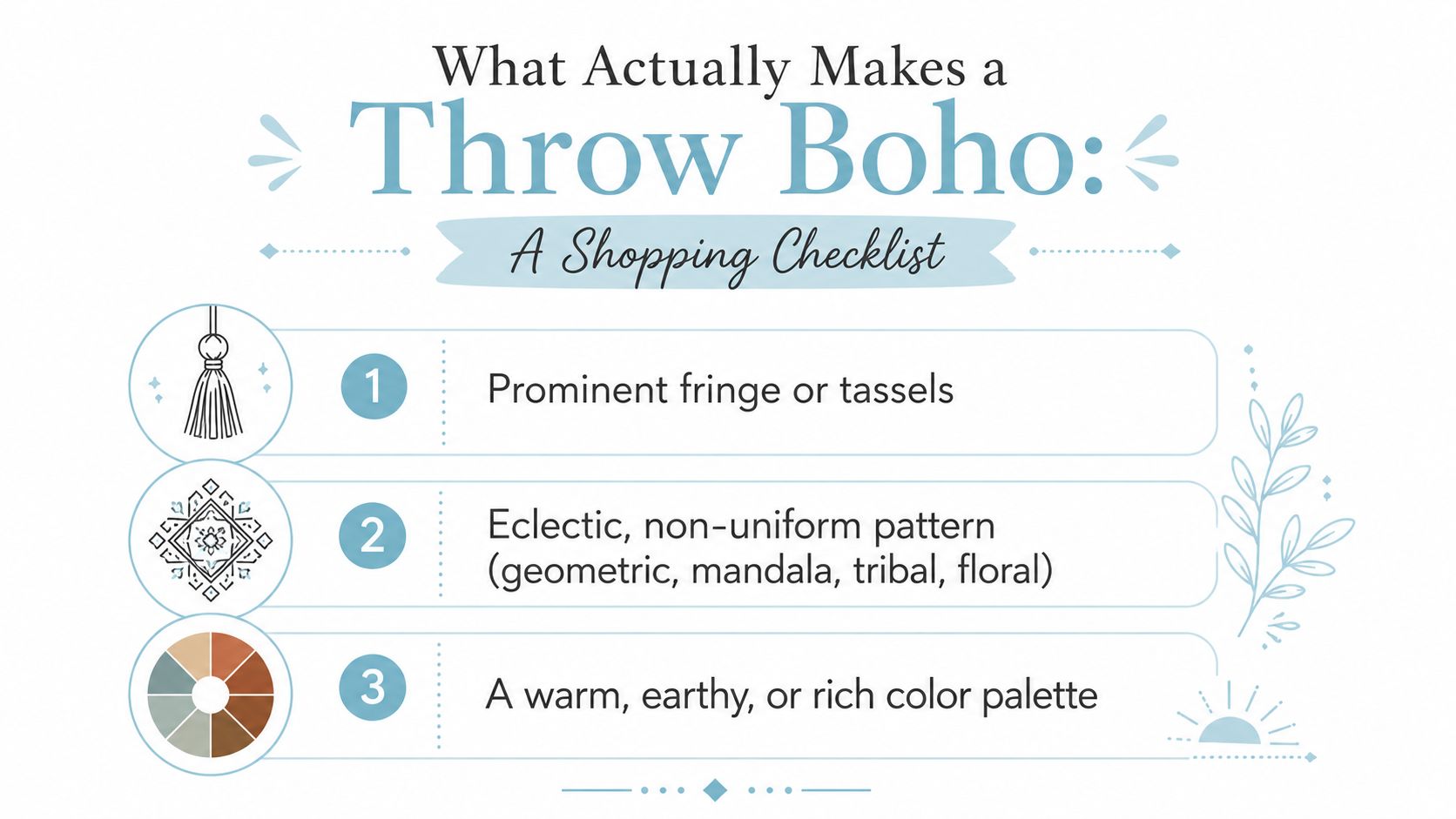
Use the three-cue test
- Fringe or tassels: Look for a deliberate, visible finish rather than a barely-there stitched edge. Fringe gives a plain weave movement and makes casual draping look intentional.
- Eclectic pattern: Geometric, mandala, tribal and floral motifs all work, especially when the design isn't perfectly uniform. A small repeating pattern can feel calmer than a giant central medallion.
- Warm colour: Terracotta, ochre, rust, clay, camel, cream and faded navy are reliable choices. Rich colour can work too, but it needs breathing room around it.
Think of texture like travel memories on a shelf. One woven basket, a weathered timber object and a patterned textile feel collected. Add fringe, boucle, rattan, heavy pattern and several ornaments at once, and the room starts telling too many stories.
Know what boho isn't
A plain charcoal knit is practical, but it reads minimalist. A crisp white and blue cotton throw with restrained stripes leans coastal Hamptons. A boho option sits between those poles, with enough pattern and hand-finished detail to feel relaxed, personal and slightly nomadic.
Check the product photograph at a distance. If you notice only a solid block of colour, it may be a basic lounge blanket. If you notice fringe, uneven visual rhythm and earthy colour working together, you're much closer to the look.
Picking Materials That Survive Australian Weather
A throw that makes you overheat in Darwin or shiver in Hobart has missed the brief. Choose the fibre for the room's actual conditions, including hot summers, cool evenings and strong indoor air-conditioning.
Cotton is the best all-rounder for much of Australia. It breathes, handles everyday use and suits coastal rooms because its natural texture looks good slightly rumpled. Cotton-linen blends feel drier and airier, though linen creases more easily. Cotton-acrylic blends are practical, hold their colour and need less fuss, but they do not breathe as well as natural fibres.
Wool and wool blends earn their place in cooler homes or on sofas used for proper winter warmth. Wool-rich designs feel substantial and cosy. A wool-cotton blend softens that weight for homes with changing temperatures. In tropical and subtropical areas, keep wool for occasional use instead of making it the everyday sofa layer.
Match weight to the room
GSM, or grams per square metre, reveals fabric density more reliably than a product photograph. A lightweight weave suits warm rooms and outdoor entertaining. Medium weight works through the year, especially where hot afternoons give way to air-conditioned evenings. Dense, heavy construction belongs in cold bedrooms and winter lounging.
Lightweight chenille gives you softness and relaxed drape, but inspect the weave. Raised yarns can snag on rough furniture and pet claws. Recycled fibres also suit hard-working family rooms when the fabric feels comfortable and the seller clearly explains the blend.
A throw should support the room's climate as well as its style. Cotton-led coastal schemes usually look fresher with a lightly crinkled weave, timber, rattan and washed colours than with a dense synthetic pile. For a VW Kombi-inspired vintage mood, use a faded cotton throw with a small geometric pattern, then repeat its colours in a cushion or compact woven basket. The reference should feel collected, not like a themed display.
Sustainability wording needs a close read. Australian market analysis says cues including organic cotton, recycled polyester, low-impact dyes and transparent sourcing appear in over 30% of new throw launches, compared with about 10% in 2021, as reported by IndexBox's Australian modern throw blanket analysis. Use that figure as a reason to check the fibre content and sourcing details, not as proof that every product with green wording is comparable.
| Material | Feel | Best for AU climate | Care difficulty |
|---|---|---|---|
| Cotton | Breathable, soft, easy-going | Warm homes, coastal rooms, everyday use | Low to moderate |
| Cotton-linen blend | Dry, airy, naturally relaxed | Hot summers and breezy interiors | Moderate |
| Cotton-acrylic blend | Light, smooth and practical | Air-conditioned rooms and frequent use | Low |
| Wool or wool blend | Warm, springy and substantial | Cool nights and colder southern homes | Moderate to high |
| Recycled synthetic blend | Often smooth and resilient | Busy households and occasional outdoor use | Low to moderate |
| Lightweight chenille | Plush, soft and drapey | Sheltered interiors and decorative layering | Moderate |
Practical rule: For most Australian living rooms, start with lightweight or medium cotton. Add wool only when the climate and your actual habits justify it.
Sizes That Actually Fit Your Furniture
Throw sizing makes more sense beside furniture than on a product page. A small blanket is roughly 100 x 150 cm, a medium option is about 130 x 180 cm, and a large throw is around 150 x 200 cm. Those are useful guides, not rigid rules, because fringe, thickness and drape change how much fabric you need.
| Approximate size | Best placement | How to style it |
|---|---|---|
| 100 x 150 cm | Single chair, armrest or reading nook | Fold lengthways and place it where someone can grab it |
| 130 x 180 cm | Sofa end or generous armchair | Let one corner fall naturally, keeping the rest off the floor |
| 150 x 200 cm | Queen bed foot or broad sofa | Fold into a long band for a tidy, hotel-style finish |
A medium throw usually gives the most useful sofa drape. Place the centre over the back or arm, then allow one side to hang lower. Don't spread it evenly across every cushion, because that can make the room look staged and hides the furniture you chose carefully.
For a coastal room, an oversized lightweight cotton piece often photographs beautifully because it falls in soft, irregular folds. A heavy throw in a smaller size can look bulky, particularly over a narrow chair. Before adding to cart, measure the furniture width and decide whether you want coverage, warmth or a colour accent. More guidance on bed placement is available in this throw blanket for bed guide.
Three Easy Ways to Style a Boho Throw at Home
Start with one hero colour, one texture, one pattern, one natural element and one plant. That five-part rule stops boho styling from becoming a pile of competing details.
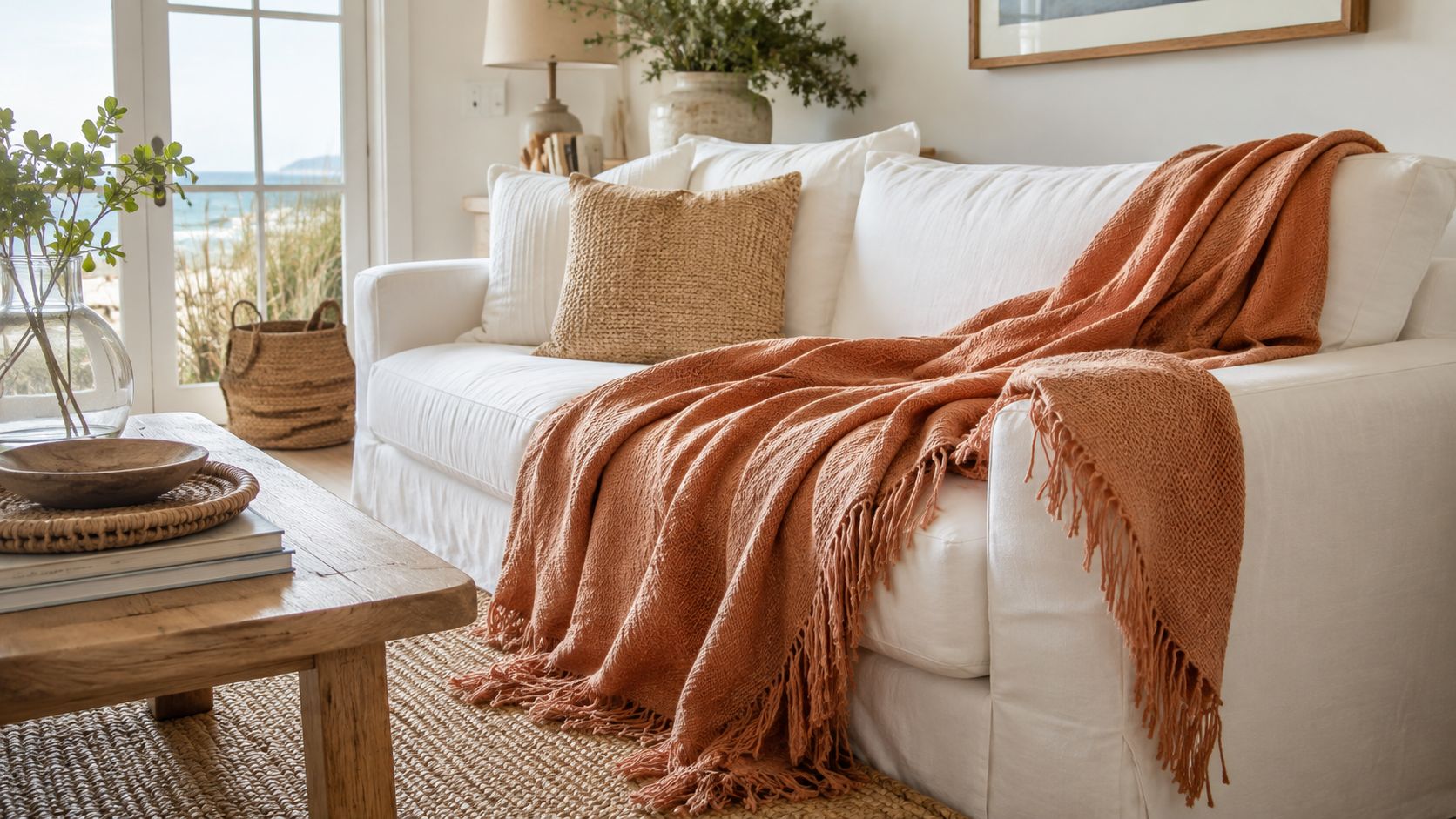
Coastal living room
Use terracotta as the hero colour against white or sand-coloured linen. Add a woven cushion for texture, choose a restrained geometric pattern, bring in a rattan tray or timber stool, and finish with a leafy plant.
The throw should sit at one end of the sofa, not cover the whole thing. This keeps the coastal base light while allowing the boho detail to do the work. If the pattern is strong, keep the cushion quieter.
Vintage-inspired nook
Build the corner around a faded red or mustard throw, a cane chair, a small patterned cushion, warm timber and one hardy indoor plant. The palette recalls old travel posters and sun-baked surf culture, including the cheerful character of a vintage Kombi, without relying on novelty décor.
Use the chair as the hero rather than adding colour to every nearby object. A single throw with a soft fringe is enough to make a reading nook feel collected.
A small wall piece can reinforce the mood without crowding the seat. These boho wall art ideas can help you keep the surrounding display simple.
Layered bedroom
Choose one warm base colour, then combine a patterned throw with a quieter textured blanket. Place the boho layer across the foot of the bed, add one natural material such as timber or seagrass, and use a plant to break up the fabric.
Don't match every pattern. Let one design lead, let the other support it, and keep the sheets calm enough for both to breathe.
Caring for Your Throw Without Ruining the Tassels
Care labels aren't decorative paperwork. In Australia, household textile throws must follow the Consumer Goods (Care Labelling) Information Standard 2023, which requires a permanent, securely attached label. From 5 March 2024, labels can use English instructions, international care symbols, or both, as explained in the ACCC care-labelling guide.
The label should cover five categories: washing, bleaching, drying, ironing and professional care. Those categories matter because fringe, woven patterns, blended fibres and decorative dyes can react differently to heat, agitation and chemicals.
Wash according to construction
Cotton and durable blends may tolerate a gentle machine cycle, ideally inside a laundry bag with mild detergent. Hand-washing is the safer choice for loose weaves, heavy fringe and delicate dye work. Wool-rich throws need particular restraint because heat and agitation can encourage felting and dimensional change.
Never assume “cotton” tells you everything. The weave, finish and blend affect shrinkage and shape, which is why Australian requirements align with AS/NZS 1957:1998 and ISO 3758:2012, according to the mandatory care-labelling standard guidance.
Protect the shape and edge
Dry flat when the label allows it, especially for heavier or stretchy textiles. Hanging a wet throw from one edge can pull the body out of shape and leave the tassels uneven. Keep bleach away unless the label explicitly permits it, and don't iron across fringe.
For storage, fold rather than hang. Wool blends benefit from a clean, dry cupboard and sensible moth protection such as cedar, while cotton should be stored completely dry to avoid musty smells.
Customisation Tricks and a Smart Buying Checklist
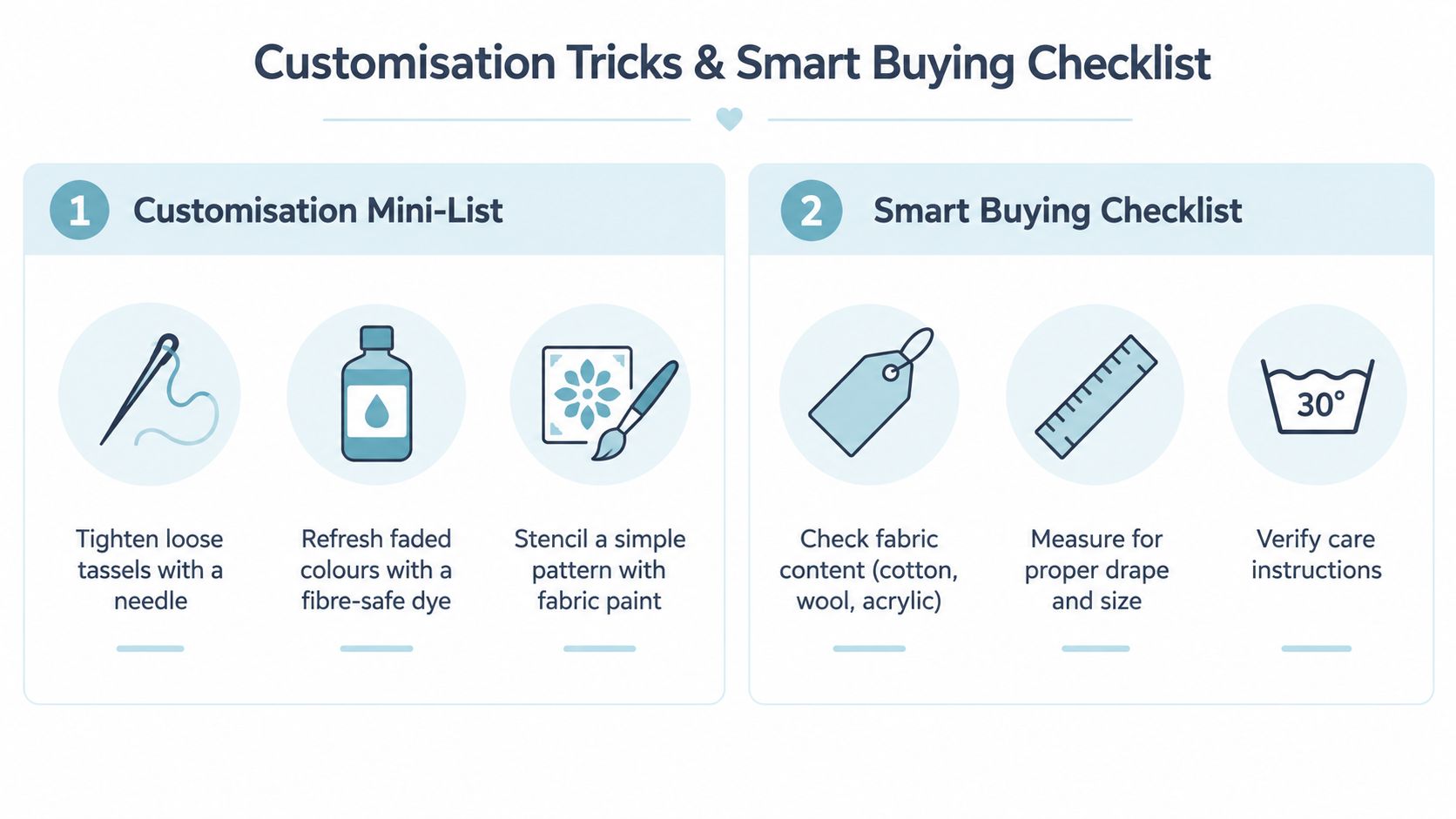
A good throw can be adjusted without turning it into a craft project. Secure a loose tassel with a needle and matching thread, refresh a tired shade with a fibre-safe dye, or stencil a small border with fabric paint. Test any dye or paint on an unseen section first, and don't alter a valuable textile before checking its care instructions.
Quick buying check
- Inspect weave and weight: Look for a construction that matches your room, not just a flattering photograph.
- Read the fibre blend: Cotton, wool, acrylic and recycled fibres each bring different warmth, drape and care needs.
- Measure the destination: A chair, sofa end and queen bed need different proportions.
- Find the care label: Clear washing, drying and finishing instructions signal a more considered product.
- Question sustainability claims: Look for specific fibre, dye and sourcing information instead of broad eco language.
A throw should support your room's mood, not force a full makeover. If your space already has rattan, timber and patterned cushions, choose a calmer weave. If the room is mostly white linen and pale walls, a sun-faded red or mustard layer can give it the spark it's missing.
Common Boho Throw Mistakes and Where to Shop in Australia
More texture does not automatically create a boho room. Put a chunky weave beside tassels, boucle cushions, a shaggy rug and busy wall art, and the result feels crowded rather than relaxed. Make one texture the feature, then keep the others quieter.
Cotton throws also vary widely. Fibre quality, weave density and GSM affect breathability, drape, washing and shape retention. For warm Australian weather, choose a thin, open cotton weave over a dense blanket, even if both labels say “cotton”.
Keep throws in rotation through summer. Australian homes use winter-weight wool, sherpa and heated options, as well as lightweight cotton and blended styles, partly because air-conditioning can leave indoor rooms cool. Overseas supply plays a substantial role in the local market, while demand for premium natural fibres is growing faster than demand for synthetics.
The common styling mistake is treating every surface as an invitation for pattern. In a relaxed coastal or VW Kombi-inspired vintage room, let the throw lead. Add a cushion, small metal sign or other decor detail that repeats its colour, then leave breathing space around the arrangement.
Visit Volkswagen Memorabilia for coastal home décor and VW-inspired pieces that pair naturally with a relaxed boho throw blanket. Browse the shop for vintage character, beachside colour and thoughtful gifts, then choose a small detail that makes your room feel collected rather than cluttered.