


Exceptional Australian-delivered 23-window Samba buses have sold for around A$202,000, while condition-adjusted Australian market bands typically sit between A$85,000 and A$135,000, and ordinary restored Kombis can start well below A$30,000. That's the shape of the VW Samba Bus price conversation in Australia. Not every split-screen bus with nice paint is a six-figure Samba, and that's exactly where many buyers get tripped up.
At VW shows around Australia, you'll hear the same thing every few rows. Someone points at a lovely two-tone bus and says, “That'd be worth a fortune.” Sometimes they're right. Often, they're mixing up a standard Kombi, a Microbus, a deluxe conversion, and a genuine 23-window Samba.
That confusion matters, because VW Samba Bus price isn't one number. It's a ladder. Rarity, originality, provenance, and specification all change where a bus lands. The Australian market adds another wrinkle too. Local delivery, right-hand-drive history, and the thin supply of genuine top-tier examples can shift values in ways overseas guides often gloss over.
What a VW Samba Bus Actually Costs in Australia
One Australian Samba sale hit A$202,000 at auction. That figure grabs attention fast, but it can also skew expectations if you treat it as the standard rather than the exception.
For a local buyer, VW Samba Bus price works more like a property market than a fixed price tag. The penthouse sale makes the news. The broader market still runs on condition, paperwork, originality, and how many comparable vehicles are available here in right-hand-drive form. That matters in Australia, where genuine top-spec split-window buses are thin on the ground and overseas asking prices do not always translate neatly to local deals.
A strong reference point for the realistic end of the market comes from Trade Unique Cars, which lists a Kombi Samba (1960-66) at A$85,000 in condition 2 and A$135,000 in condition 1, while a Kombi Microbus (1957-61) sits lower at A$55,000 and A$95,000 respectively (Trade Unique Cars market watch). That gap is the useful bit. It shows why Australian buyers need to separate a genuine Samba from a well-restored non-Samba bus before getting carried away by glossy photos or auction chatter.
A practical Australian pricing guide
| Buyer tier | Typical AU position | What to verify before you call it fair value |
|---|---|---|
| Tidy non-Samba split bus | Often below true Samba money by a wide margin | Confirm it is not being advertised with loose “Samba-style” language, and check whether the trim, windows, and roof features are factory-correct or later additions |
| Genuine Samba in the normal collector market | Usually sits in the realistic Australian buying zone for authentic examples | Check chassis and M-code details, restoration receipts, rust repairs, and whether the bus presents as a genuine deluxe model rather than a tribute build |
| Top-tier Australian-delivered or standout provenance car | Can stretch far beyond the normal band when rarity and story line up | Verify local-delivery history, old registration or ownership records, auction-grade presentation, and whether originality is driving the premium rather than hype |
That table is the budgeting shortcut many Australian enthusiasts need. The headline sale tells you how high the ceiling can go. The condition guide helps you work out where the floor and middle of the room are.
What “Samba” should mean in a sale listing
A genuine Samba is the deluxe version buyers chase, not just a split-screen bus in cheerful two-tone paint. If you are standing at a show field and comparing buses row by row, the difference is a bit like comparing a proper factory GT car with a tidy replica. Both can look terrific. Only one carries the full collector premium.
So if a seller says “Samba”, ask for the evidence, not just the vibe.
Practical rule: If the seller cannot clearly show why the bus is a genuine Samba rather than a Samba-style build, treat the price as optimistic until the history and specification stack up.
Why the Samba Bus Stands Apart from Other Kombis
The Samba has always been the show pony of the Type 2 family. Even parked beside a beautiful panel van or a clean Microbus, it has more theatre. More glass. More trim. More of that carefree holiday feel that made generations of VW people smile.
You can spot the appeal straight away. A genuine Samba carries the deluxe visual package enthusiasts chase. Think split safari windscreen, panoramic side windows along the cabin, the big opening sunroof, two-tone paint, and bright trim that gives the whole bus a lighter, more celebratory character than a workaday Kombi.
It isn't just a bus. It's the top-spec story
Collectors pay a premium because a Samba sits at the fancy end of the early VW bus range. Standard Kombis were practical. Sambas were aspirational. They captured the same engineering bones, but wrapped them in a more glamorous body style that was meant to carry families, tourists, and dreamers in style.
That story still matters in Australia. Local VW history helps explain why. Club VW Australia notes that Volkswagen sold 4.5 million Kombis worldwide since 1950, that the Kombi dominated Australia's light-commercial market in the 1960s and 1970s, and that it held over 60% of the one-tonne market in 1975 (Club VW Australia history). The broader Kombi legend is huge here. The Samba sits at the glamorous, scarce tip of that legend.
Australian scarcity changes the mood
Australian-delivered examples carry extra cachet because local buyers know how thin the pool is. That's why the little details matter so much. Delivery history. Factory trim. Right-hand-drive correctness. Old registration records. The difference between “looks like a Samba” and “is a Samba” can be enormous.
For a fun nod to the shape and spirit that made these buses icons, have a look at this green Samba model feature. Even in miniature, the Samba's extra windows and cheerful stance jump out straight away.
The Australian Value Ladder by Condition
A Samba's value in Australia works more like a staircase than a single sticker price. The guide bands mentioned earlier are useful, but they only make sense once you know what separates a very good bus from a top-shelf one when you are standing beside it at a show or auction.
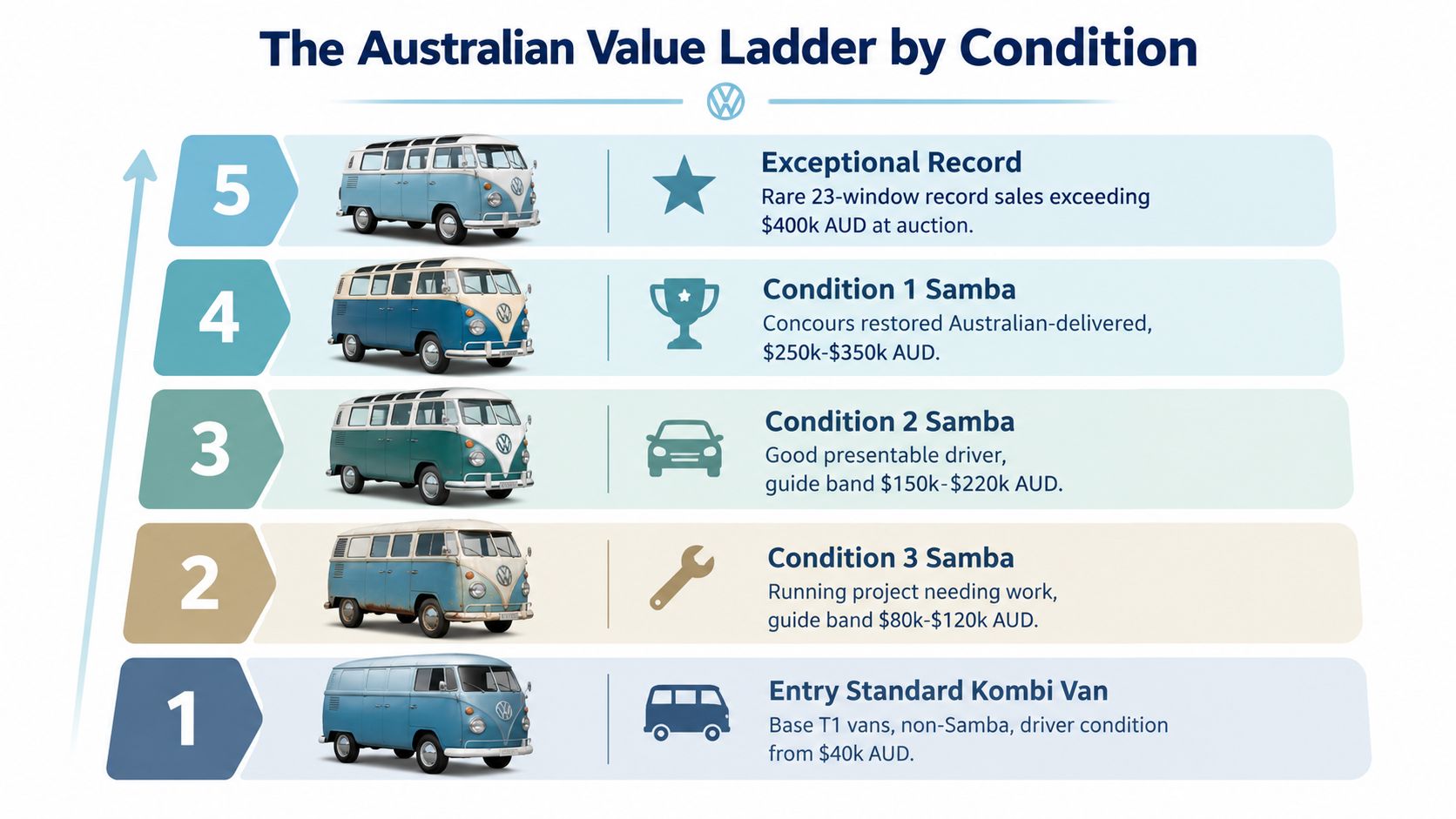
Entry point versus true Samba money
Plenty of Australian buyers get tripped up. A split-window Kombi can look charming, tidy, and expensive, yet still sit well below genuine Samba territory because the market is paying for more than shape alone. It is paying for the deluxe body, the rarity, and the confidence that the bus is what it claims to be.
That means the question in this section is not the number itself. It is what condition 1 and condition 2 look like in the metal.
A practical reading of the ladder
Condition 2 is the honest sweet spot for many enthusiasts. These buses usually present well from ten paces, drive properly, and have the sort of finish that makes owners happy to park on the grass at a club day without apologising for anything. Panel gaps should look tidy and consistent. Doors should shut cleanly rather than needing a shove. Brightwork should suit the age and style of the bus, even if a concours judge could still find a few things to pick at.
Condition 1 is a different level of scrutiny. The paint, trim, hardware, and fit all need to feel deliberate and correct, not just fresh. Window seals sit neatly. Interior materials look right for the period. The underside does not tell a rougher story than the topside. A bus at this end of the ladder stands up to close inspection from people who know where early Volkswagens usually hide their sins.
A good way to judge the gap is to compare it to buying a coastal weatherboard cottage. From the street, both houses can look lovely. Under the floorboards, one may be solid old timber and careful restoration, while the other is patchwork held together for sale day. Sambas are exactly like that.
Here's what experienced Australian buyers usually check first:
Panel fit and body lines
Look along the flanks, around the cargo doors, and across the nose. Wavy reflections, uneven gaps, or thick seams often point to old rust repairs or replacement panels that were made to look better in photos than in person.Underside honesty
Get underneath if you can. Chassis rails, jacking points, outriggers, and floors matter because repairs there are expensive and easy to hide with fresh underbody coating.Trim correctness
Deluxe trim, badges, lights, and interior pieces should make sense for the year and specification. A shiny bus with mixed-era parts can still be enjoyable, but collectors will price in the compromise.Roof and window details
On a Samba, the extra glass and roof structure are part of the appeal. Check the sunroof opening, window fit, seals, and headliner finish carefully. Sloppy work here stands out quickly.
Buy the bus whose details stay convincing after ten minutes of close inspection, not just the one that wins the first glance.
When a bus rises above the guide
Top auction results still matter because they show what happens when condition, rarity, and buyer confidence all line up on the same day. The well-known Shannons example is useful for that reason. Its pre-sale estimate sat at A$120,000 to A$140,000, before bidding pushed beyond expectations (Shannons pre-sale estimate report).
For an Australian buyer or seller, that is the lesson. Headline results set the mood, but condition decides where an actual bus belongs on the ladder. In a small local market, where genuine Sambas are thin on the ground, that judgement can shift the outcome by a very large margin.
What Really Moves the Price Up or Down
Two buses can look broadly similar in photos and still sit worlds apart in value once you inspect them properly. That's where the VW Samba Bus price puzzle lives.
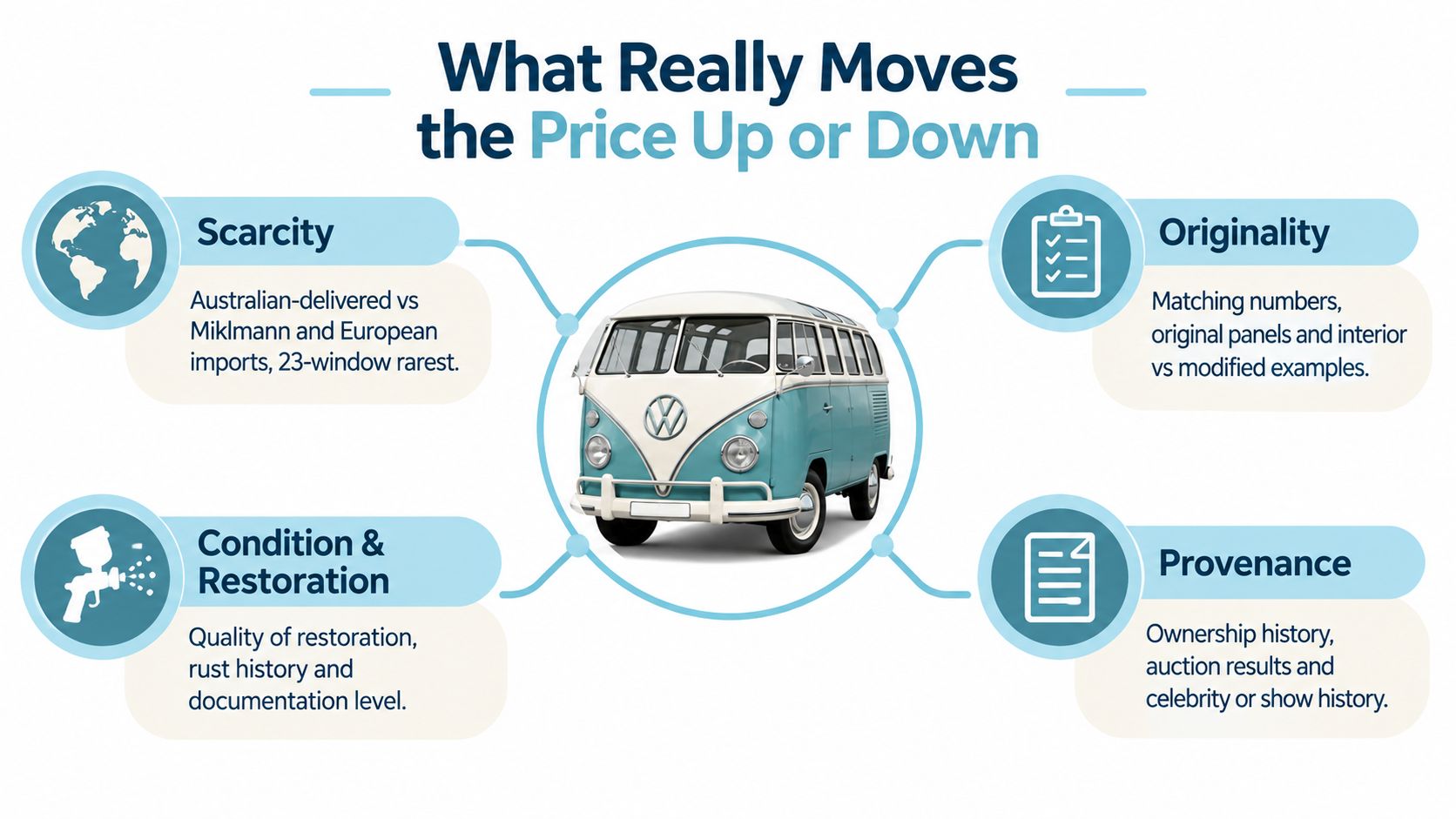
Four multipliers that matter
Scarcity
Australian supply is thin, and that matters. Coverage of rare VW values in this part of the world has highlighted asking prices such as A$140,000 for a 1953 Barndoor 23 Window Deluxe and A$240,000 for a 1954 RHD Barndoor Deluxe, which reinforces how scarce genuine top-end buses remain in this market (Driven Car Guide coverage). Buyers often pay more when the bus has the right local-market story attached.Originality
Original panels, original-style trim, and factory-correct details matter far more than shiny paint alone. A bus can be beautifully restored and still lose enthusiast confidence if too many key pieces have been substituted or modernised.Condition and restoration quality
Rust repairs, panel fit, underside integrity, interior correctness, and finish quality all shape confidence. A neat restoration done with care can support value. A quick cosmetic job often can't.Provenance
Old paperwork, long-term ownership, restoration files, and known auction history help a bus feel “safe” to serious buyers. If someone can show where the vehicle has been and how it's been cared for, the conversation changes immediately.
After the reading, this walkaround video is worth a look because it helps train your eye for the details that make these buses so desirable.
What pushes a bus down
A bus can lose value quickly if the fundamentals aren't right.
- Rust and structural issues can turn a charming project into an expensive lesson.
- Non-original colour schemes may look fun but won't always please collectors.
- Missing or incorrect trim chips away at authenticity.
- Unclear identity is a major warning sign, especially with Samba-style conversions.
A genuine Samba with honest flaws usually interests enthusiasts more than a glossy bus with a fuzzy backstory.
Samba Bus Diecast Models Versus the Full-Size Bus
Auction headlines can make a Samba feel distant, but the model-car side of the hobby brings that same roofline, window count, and colour charm onto an ordinary shelf. For plenty of Australian VW fans, that is not a compromise. It is a different way to enjoy the shape without stepping into restoration bills, storage worries, or a thin local market.
The easiest way to understand it is to treat the two categories like two versions of the same song. The full-size bus gives you the whole live performance. A diecast gives you the melody in miniature. Both can be collectible, but the money logic is very different.
| Category | Typical AU Price | What collectors usually focus on |
|---|---|---|
| Full-size Samba Bus | As noted earlier, values sit in condition-based bands rather than one fixed headline number | Original features, overall presentation, documentation, and how convincingly the bus fits the Australian market |
| Other classic Kombis | Usually lower than genuine Samba territory | Usability, body condition, presentation, and whether it is a standard bus rather than a top-spec window bus |
| Licensed diecast Samba | Varies by scale, maker, finish, and packaging | Box condition, detail quality, paint accuracy, and brand reputation |
That last row matters more than newcomers often expect.
A diecast Samba does not need to mimic full-size prices to make sense as a collectible. A scarce colour, tidy box, or well-executed licensed release can be the difference between a model you glance at and one you keep picking up for a closer look. It works a bit like judging a real bus from ten paces, then walking closer to inspect the details. Proportions, trim lines, two-tone paint breaks, and window layout all start to matter.
Collectors usually sort diecast pieces using a few simple checks:
Scale
Smaller scales suit a row of buses on a study shelf. Larger scales show off the skylight windows, split-screen front, and interior detail more clearly.Packaging
Serious model collectors care about the box because it affects completeness, presentation, and resale appeal.Brand and licensing
Official VW-licensed models often get the shape and badging right, which makes them more satisfying for enthusiasts who know these buses well.Colour and era feel
Period-looking paint combinations and correct brightwork tend to feel more faithful to what makes a Samba special.
If you want a quick feel for what enthusiasts in Australia buy and display, this range of VW bus diecast models in Australia is a useful place to start. It helps bridge the gap between the six-figure chatter around headline Sambas and the much more approachable collecting lane that still celebrates the same design.
Where to Buy, Sell, or Appraise a Samba in Australia
Buying or selling one of these buses in Australia takes patience. The market is thin, and that's why rushed decisions tend to cost money.
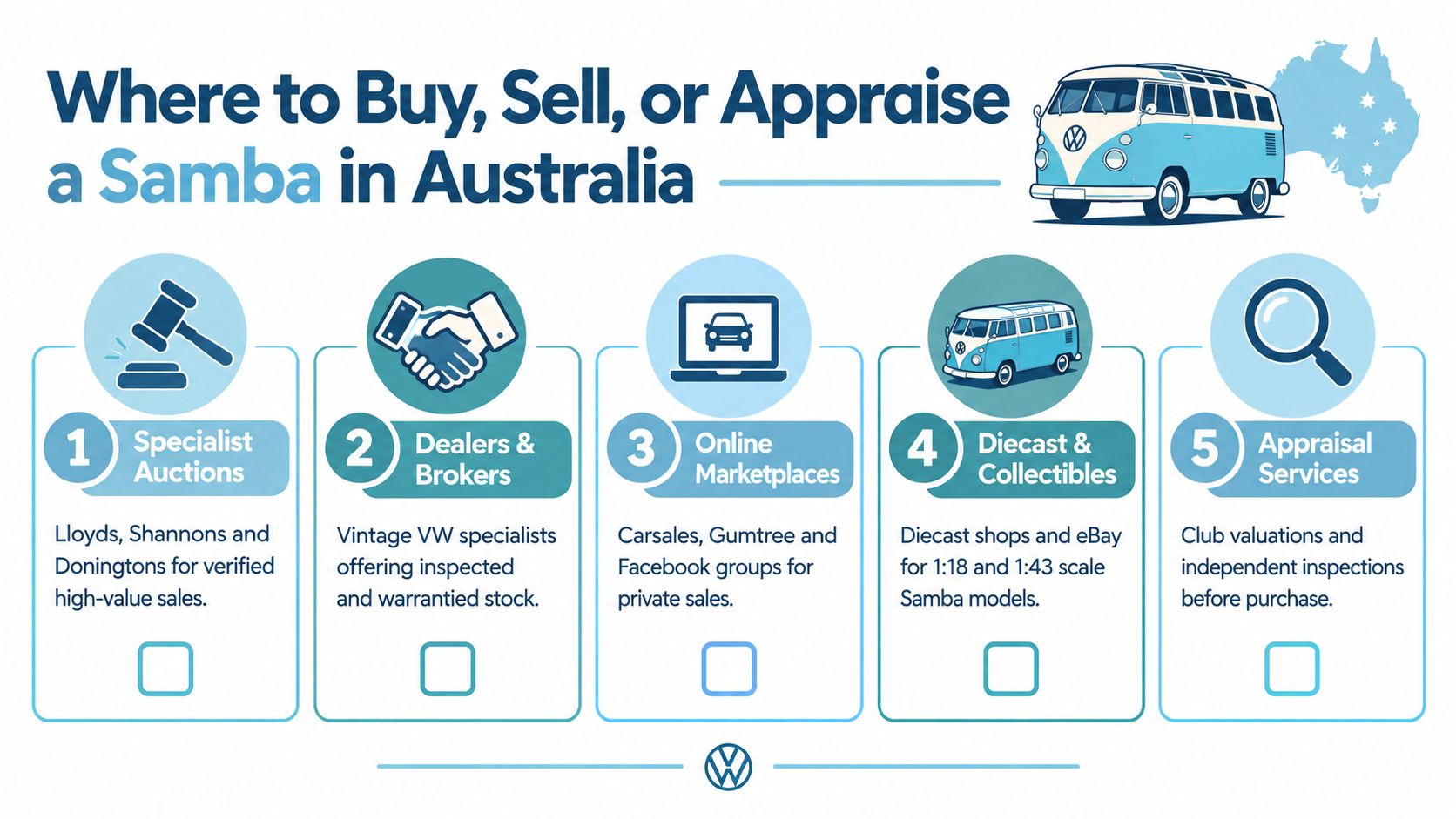
Best places to look
Specialist auction houses are still one of the clearest windows into public values. Shannons is the obvious Australian reference point for early VW auction history, and classic-focused auction houses regularly give buyers a way to compare presentation, catalogue language, and final results.
VW clubs matter too. Club circles often know which buses are well regarded, which restorations were done properly, and which sellers have a strong name in the scene. If you spend time at club events, you'll often hear about a bus before it ever reaches a public listing.
Smart buying habits
Before money changes hands, slow down and check the bones.
Independent inspection
Use a mechanic who understands old Volkswagens, not just old cars in general.Paper trail
Ask for restoration invoices, old registration documents, and any identification records the seller has retained.Clear transaction method
Cleared funds and written terms make life calmer for both sides.Registration and identity checks
Make sure the bus's paperwork, numbers, and claimed specification all align.
The best Samba purchase often happens after a very unglamorous afternoon of crawling underneath it with a torch.
For people shopping the broader van side of the hobby, this Kombi for sale guide is a useful starting point for seeing how these vehicles are commonly presented to Australian buyers.
A quick note on historical context
Part of the charm here is how ordinary these vehicles once seemed. Australian coverage of Kombi pricing in the 1970s recorded the basic 1600 Kombi at $4,513, the 1800 Kombi at $4,912, and the 1800 Microbus at $5,396 (Club VW historical pricing). It's a lovely reminder that today's cherished classics began life as usable family and work vehicles, not museum pieces.
Bringing the Samba Story Home to Your Collection
Auction headlines can make Samba ownership feel like a six-figure club. For plenty of Australian VW fans, the smarter comparison is between the dream car on the show field and the version of that story you can live with, whether that is a real bus, a project, or a licensed model on the shelf.
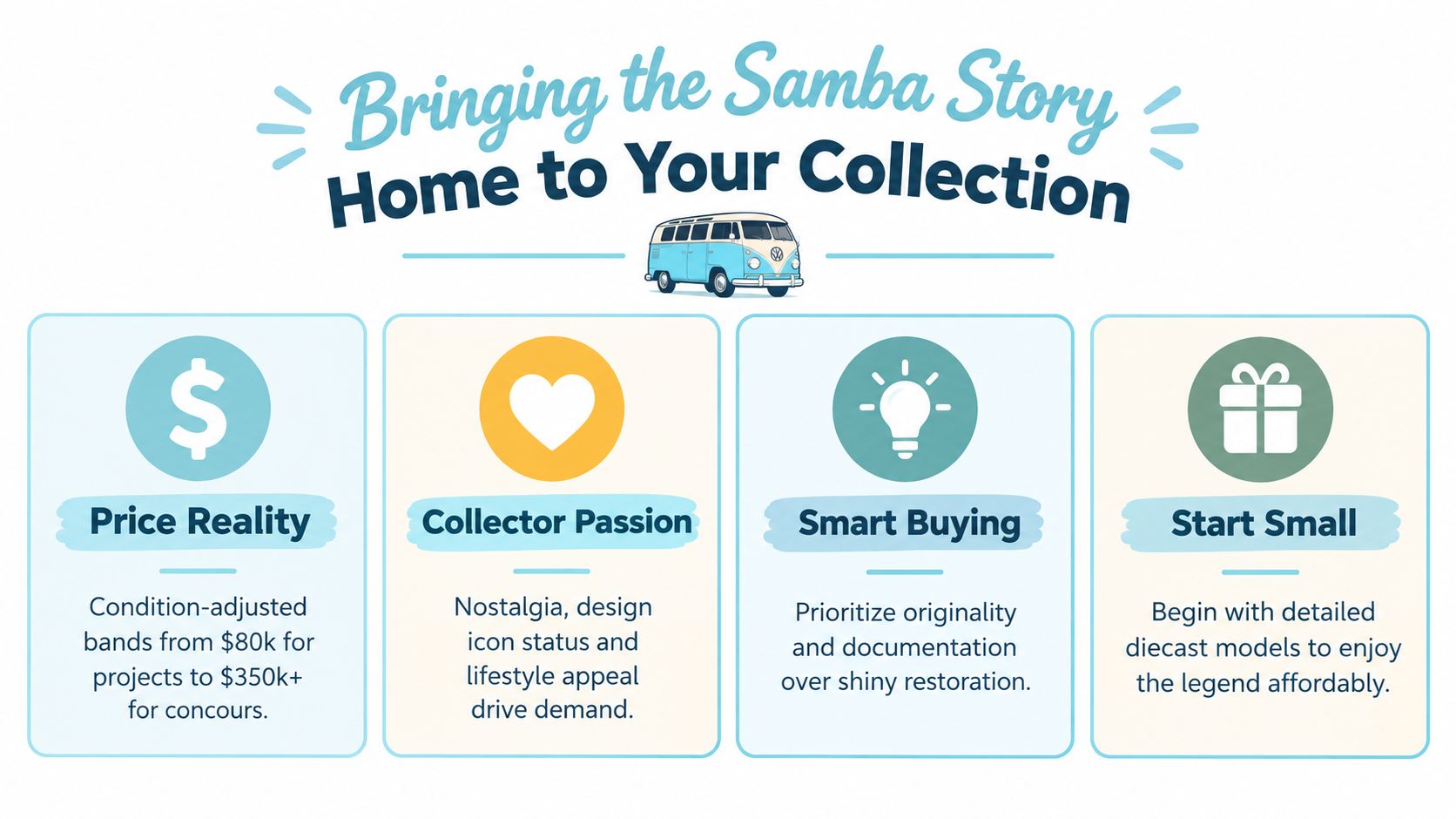
A Samba keeps its pull because it does two jobs at once. It is a collectible with serious scarcity in Australia, especially in correct right-hand-drive and well-documented form. It is also a mood machine. Park one at a coastal meet and even people who do not know the model code will stop for the skylight windows, the roofline, and that unmistakable holiday feel.
That gap between global headline prices and local reality matters. The wild sales get the attention, and fair enough, because they are fun to talk about over a coffee and a sausage sizzle. But an Australian buyer usually needs a calmer question. What version of the Samba story fits my budget, space, and appetite for maintenance?
For some, the answer is the full-size bus. For others, it is a carefully chosen diecast that scratches the same itch without the storage bill, rust repairs, or parts hunt. That is not a lesser choice. It is the collecting equivalent of owning the framed concert poster when the original stage guitar is out of reach.
A more reachable way to collect
If you want the character of a Samba in your life without chasing a rare bus across the country, these habits make the hobby more satisfying:
Buy the best version of your chosen format
A tidy, licensed diecast with crisp detailing often gives more long-term enjoyment than a cheap model with vague proportions and generic badging.Collect with a theme
Australian-delivery colours, surf-era displays, or a split-screen lineup with Beetles beside it gives the collection a story instead of just filling shelf space.Keep the packaging and paperwork
Model collectors care about complete presentation in much the same way vehicle buyers care about books, invoices, and old rego history.Match ambition to upkeep
A real Samba needs space, specialist knowledge, and ongoing spend. A model needs careful storage and a dust-free display. Both reward owners who are realistic from the start.
FAQ
How can I tell if a Samba diecast model is properly licensed and accurate
Check the box and base first. Officially licensed models usually state Volkswagen licensing clearly, and better examples list the scale, manufacturer, and model name rather than just “classic van.” Then compare the window count, roof window layout, trim, and proportions with photos of genuine Sambas. If the skylights look oversized, the beltline is off, or the badging is vague, treat it as a decorative piece rather than a collector-grade replica.
Why does Australian delivery matter so much
Collectors here often pay closer attention to local history, right-hand-drive correctness, and documented provenance because strong examples are thin on the ground in Australia. Two buses can look similar from ten metres away, but local-market history can separate them sharply once serious buyers start checking details.
Is diecast a serious collecting category
Yes. Plenty of VW enthusiasts collect models with the same care others bring to full-size cars. The attraction is simple. You get the design, the nostalgia, and the display value without workshop bills or insurance paperwork.
Should I buy based on shiny paint alone
Start underneath the shine. Fresh paint can hide expensive problems, whether you are looking at a bus or a model with a respray-style finish. Identity, correctness, restoration quality, and supporting paperwork are what hold up once the excitement settles.
If you'd like the Samba look without chasing auction paddles and restoration invoices, Volkswagen Memorabilia has a warm, well-curated range of licensed VW diecast models, Kombi favourites, Beetle pieces, and giftable collectibles for Australian enthusiasts. It's a lovely place to find a shelf-worthy Samba, a Volkswagen Beetle model, or a thoughtful VW-themed present, with local stock and easy browsing for anyone wanting to buy diecast Kombi and other Volkswagen diecast models for sale.