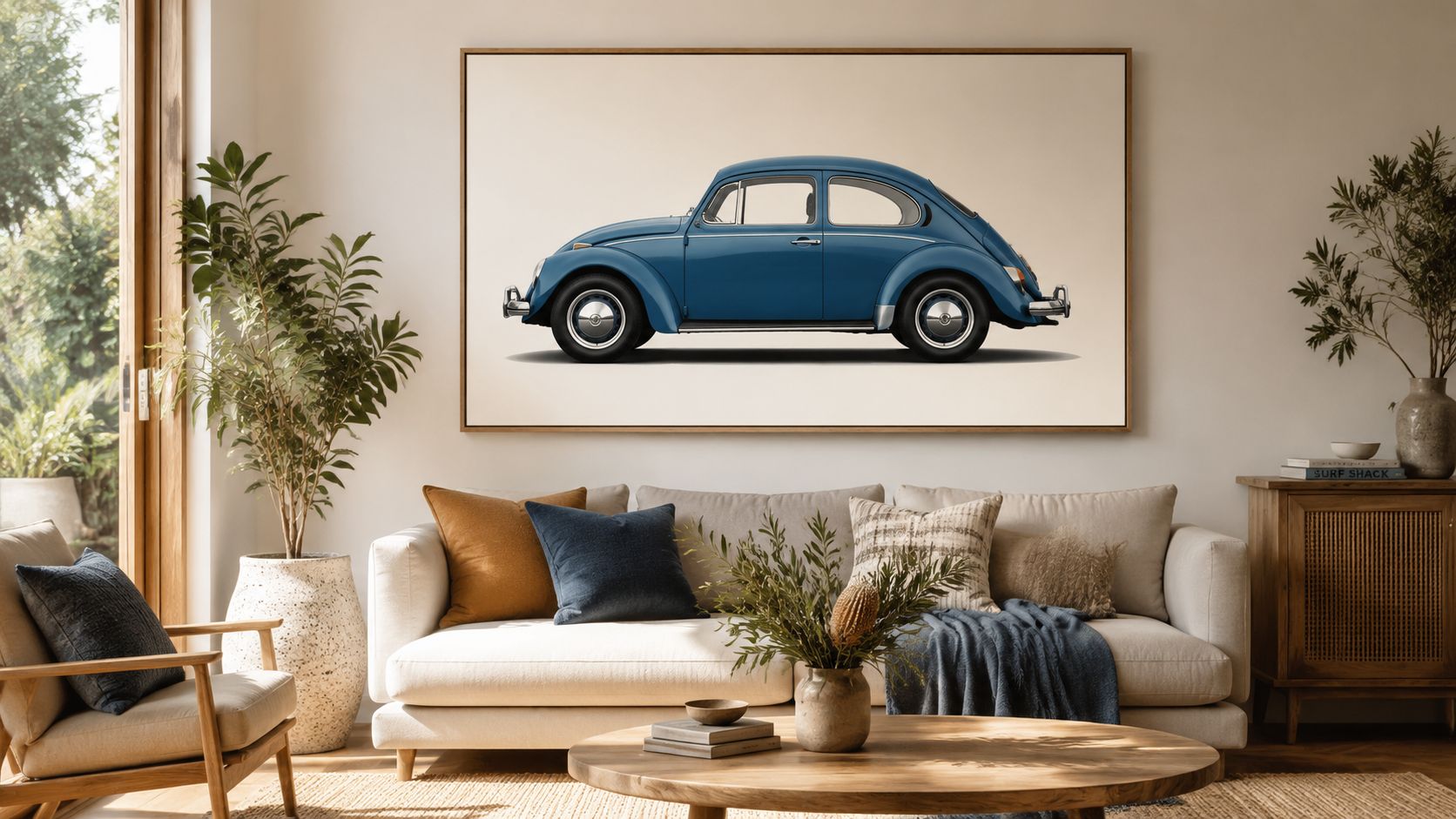

You're standing in a bright coastal lounge, holding a timber artwork against the wall while the afternoon sun picks out every grain. It looks almost perfect beside the linen sofa and retro cushions, but a few questions quickly follow. Will sea air make it warp? Is the piece too heavy for the plasterboard? And will a warm wooden panel sit comfortably with the colours of a classic Beetle or Kombi?
Wood wall hangings can bring a relaxed Australian home together, provided you choose the material, finish and fixing with equal care. They suit beach houses, rumpus rooms, garages and collectors' displays because timber adds warmth without losing the easygoing character of coastal styling. The same principles apply whether you're choosing a carved panel, a reclaimed board or a Volkswagen-inspired silhouette. These coastal home décor ideas show how natural textures can sit comfortably beside nostalgic pieces.
What Wood Wall Hangings Are and Why They Work in Coastal Homes
A wood wall hanging is a decorative timber object designed to live on a wall rather than serve as furniture. It might be a single slab, a carved relief, a layered geometric panel, a laser-cut outline, a painted shape or an assemblage of reclaimed boards. Some pieces are quiet and textural, while others act as a bold focal point above a sofa, sideboard or display shelf.
That makes them different from framed prints, mirrors, macramé and mass-produced MDF décor. A framed print relies on an image behind glass. Macramé brings softness and movement. A wooden wall hanging gives you grain, depth and physical texture, even when the design is simple.
Coastal rooms often lean towards white walls, pale fabrics, blue accents and reflective surfaces. That palette feels fresh, but it can also become visually cool. Timber warms the room and gives the eye a natural point of rest. Pale pine can support a light beach-house look, while darker reclaimed hardwood suits a more nostalgic, mid-century room.
A useful styling test: if the piece looks right only in a product photograph, it may not be right for your room. Hold it against your wall in daylight and check its colour beside your floor, sofa and other timber furniture.
Volkswagen-inspired wall art adds another layer of meaning. A Beetle or Kombi shape can connect a coastal room with road trips, surf culture and family memories, while a retro colour scheme can echo the curves and optimism of classic cars. The practical question is not whether timber looks good. It does. The question is whether the piece has been made, finished and mounted for the conditions where you live.
Main Types of Wood Wall Hangings and How to Style Them
Australian buyers encounter several distinct forms of timber wall décor, and each creates a different feeling.
- Solid-timber panels and boards use a single piece or joined boards. They suit calm coastal rooms, rustic interiors and simple furniture. Look for visible grain, stable construction and a finish that matches the room rather than competing with it.
- Layered geometric or laser-cut silhouettes create shadows and a more graphic appearance. They work well with minimalist furniture, retro colour blocks and wall groupings where you want depth without a bulky object.
- Carved panels bring relief and hand-worked character. They're a natural match for tactile interiors, collected rooms and spaces where the wall art needs to feel like a genuine craft object.
- Reclaimed-wood assemblages show knots, old marks and varied tones. They suit surf-shack, farmhouse and industrial settings, although the timber should be sound, clean and properly prepared.
- Printed or vinyl-on-wood pieces use a timber base with a graphic layer. They can deliver bright Beetle, Kombi or floral imagery, but check the coating, edge treatment and hanging hardware before placing one in a humid area.
Australia has a long-established appetite for handmade and display-oriented objects. In the 1998–99 Household Expenditure Survey, 176,200 Australian households purchased paintings, carvings or sculptures during a three-month reference period, spending A$68.7 million during that period. The Australian Bureau of Statistics annualised that spending at A$274.8 million. The ABS historical arts and craft data also recorded 0.9 million art items and 3.9 million craft items purchased during three months in 1997.
Those figures don't isolate wooden wall hangings, but they do show why artisan provenance, physical craft retail and locally made decorative work matter to Australian buyers. Choose by scale first, then by surface. A busy carved panel can anchor a plain wall, while a small layered silhouette may work better beside a shelf or among framed memories.
VW-inspired shapes fit naturally into the retro category. A Beetle outline brings rounded movement, while a Kombi or Samba Bus introduces a longer horizontal form that works above a console or display cabinet. The best choice is the one that balances the furniture already in the room.
Coastal, Retro and Surf Looks That Suit VW-Inspired Pieces
Three styling directions make wooden VW décor especially easy to place.
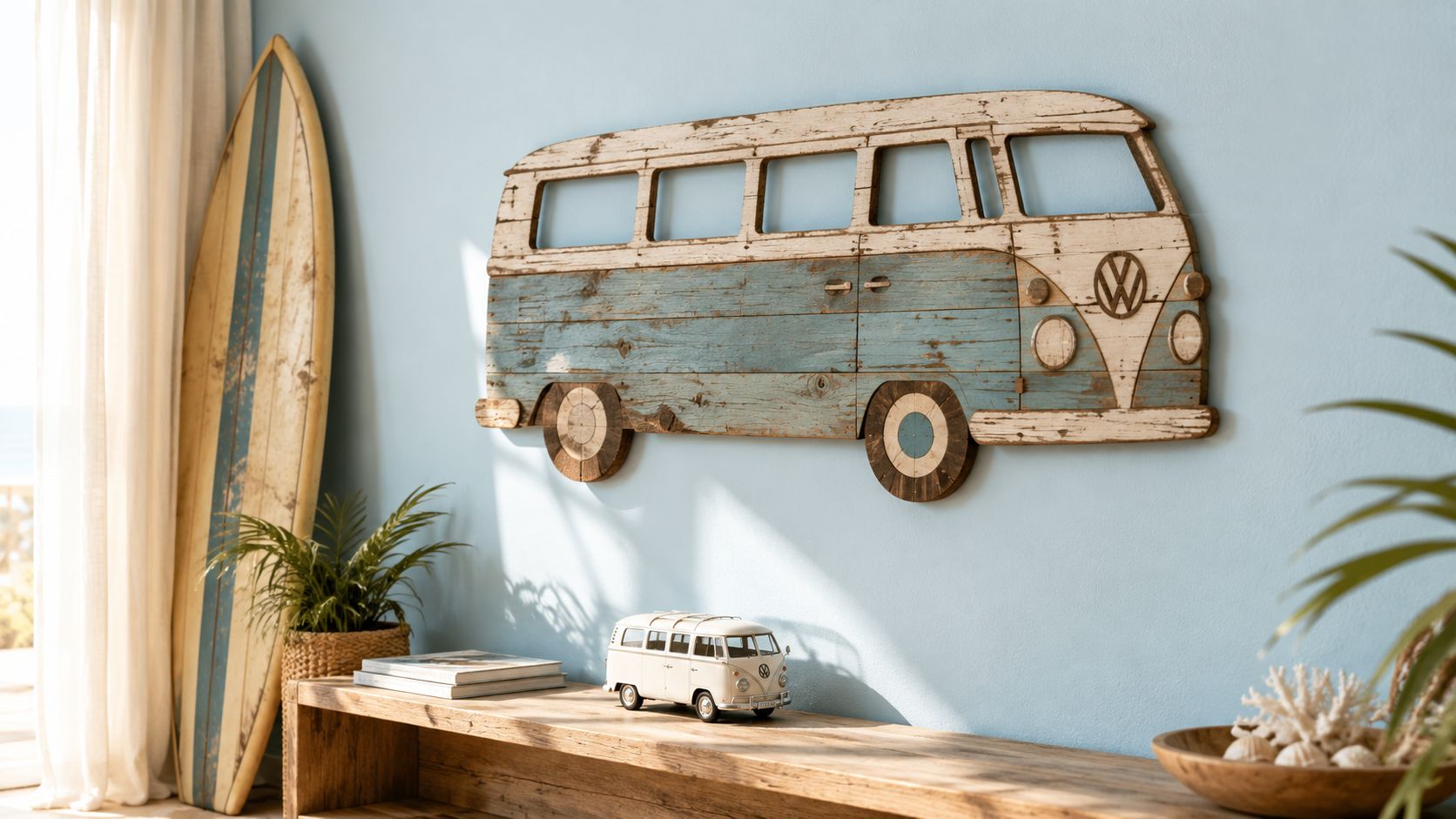
Relaxed coastal relies on pale timber, white walls, woven textures, washed blues and sandy neutrals. A light wood Kombi silhouette can sit above a console with shells, linen and a small collection of beach finds. Keep the surrounding objects quiet so the vehicle shape remains clear.
Retro mid-century welcomes warmer timber, mustard, olive, cream, orange and deep blue. A Beetle-inspired piece can echo the rounded forms of period furniture without turning the room into a themed display. Pair one strong wall hanging with a low cabinet, a simple lamp and carefully chosen vintage accents.
Surf-shack Flower Power is more playful. Think sun-faded colour, floral motifs, seaside memories and a Samba Bus or Kombi that feels ready for the next road trip. A colourful van works particularly well in a rumpus room, garage office or collection space.
The Beetle carries a strong Australian story. The Australian military reportedly brought the first Beetle into the country in 1945, while one of the earliest registered New South Wales examples arrived in 1952 with German migrant Karl Regel and his family. Volkswagen began importing German CKD kits and assembling them in Melbourne from June 1954, and local production at the Martin & King plant in Clayton began in 1959. Local production ended in 1968, while the final Australian-assembled Beetle appeared in 1976. Volkswagen's Australian Beetle history gives those milestones useful context.
The Kombi tells a different but related story. Volkswagen Australia links the model with the surfing boom on Australia's east and west coasts during the 1970s, when Kombis carried people and equipment to the beach. The Australian Kombi story helps explain why a surf van remains such a natural subject for coastal décor.
Use that history when choosing a design. A Beetle referencing the 1960s can suggest local manufacturing and family motoring, while a Kombi can prompt memories of beaches, camping and long drives. Hang a busy piece at eye level, leave breathing space around it and avoid grouping several competing silhouettes on one small wall.
Finishes, Timber Choices and How to Survive Salt Air
A timber piece near the coast needs more than a good-looking surface. Raw wood absorbs and releases moisture, and uneven changes across a panel can create cupping, splitting, open joints or loose hardware. Oil brings out grain and is easy to refresh, wax gives a softer feel, lacquer forms a harder film, while paint and stain change both colour and the way wear appears.
For Australian interiors, timber should generally acclimatise to an expected equilibrium moisture content of approximately 8–14% before installation. WoodSolutions' moisture guide recommends installing timber within ±2% of the expected in-service EMC. The same guide explains that prolonged moisture content above 20% creates conditions favourable to fungal decay and mould.
That doesn't mean every coastal home needs a marine-grade coating. It does mean you should measure a substantial panel with a calibrated moisture meter, allow it to acclimatise indoors and keep it away from damp masonry. Poor ventilation and a cold external wall can create problems even when the room feels comfortable.
Matching the timber to the room
Pine and hoop pine plywood can create a pale, approachable coastal look. Tasmanian oak and meranti bring warmer tones, while paulownia is light and easy to handle but needs careful protection from knocks. Reclaimed hardwoods offer character and density, though their previous use, fasteners and surface condition need checking.
Solid timber can be repaired and refinished, but it may move more noticeably across its grain. Plywood is dimensionally useful because its layers balance movement. MDF gives a smooth surface for painted or printed designs, yet it can be vulnerable if water reaches exposed edges.
Coastal rule: finish the front, back and edges consistently. An attractive face won't prevent movement if the reverse side remains exposed to a very different moisture environment.
Sustainability needs a practical reading. Reclaimed or certified timber can be a sensible choice, but “natural” doesn't automatically mean lower impact. Long service life, repairability, low-toxicity finishes, minimal packaging and the ability to resell often matter more than a rustic appearance. Mixed timber, MDF, adhesive, vinyl and metal hardware can also complicate repair and end-of-life separation. Buyers increasingly want to know what a product contains and where it goes later, a concern reflected in the Housing Industry Association's discussion of material procurement and end-of-life questions. For ongoing care, use the practical guidance in this timber-care resource.
How to Hang Wood Wall Hangings Safely in Australian Homes
The wall substrate determines the fixing method. The artwork's label doesn't tell you whether a hook is safe, and a lightweight-looking panel can still create a tipping force if it projects from the wall or hangs from a narrow point.
Match the fixing to the wall
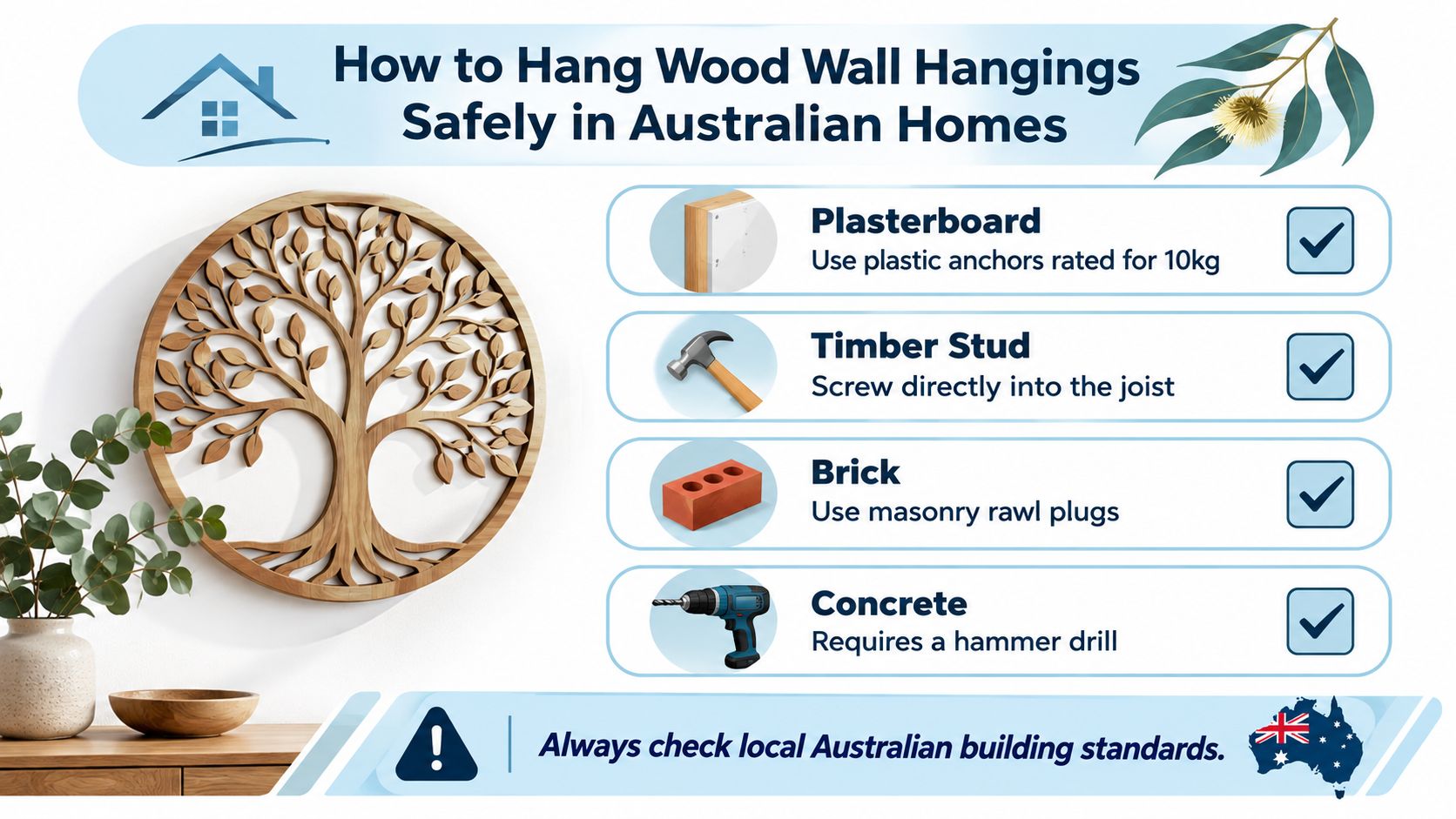
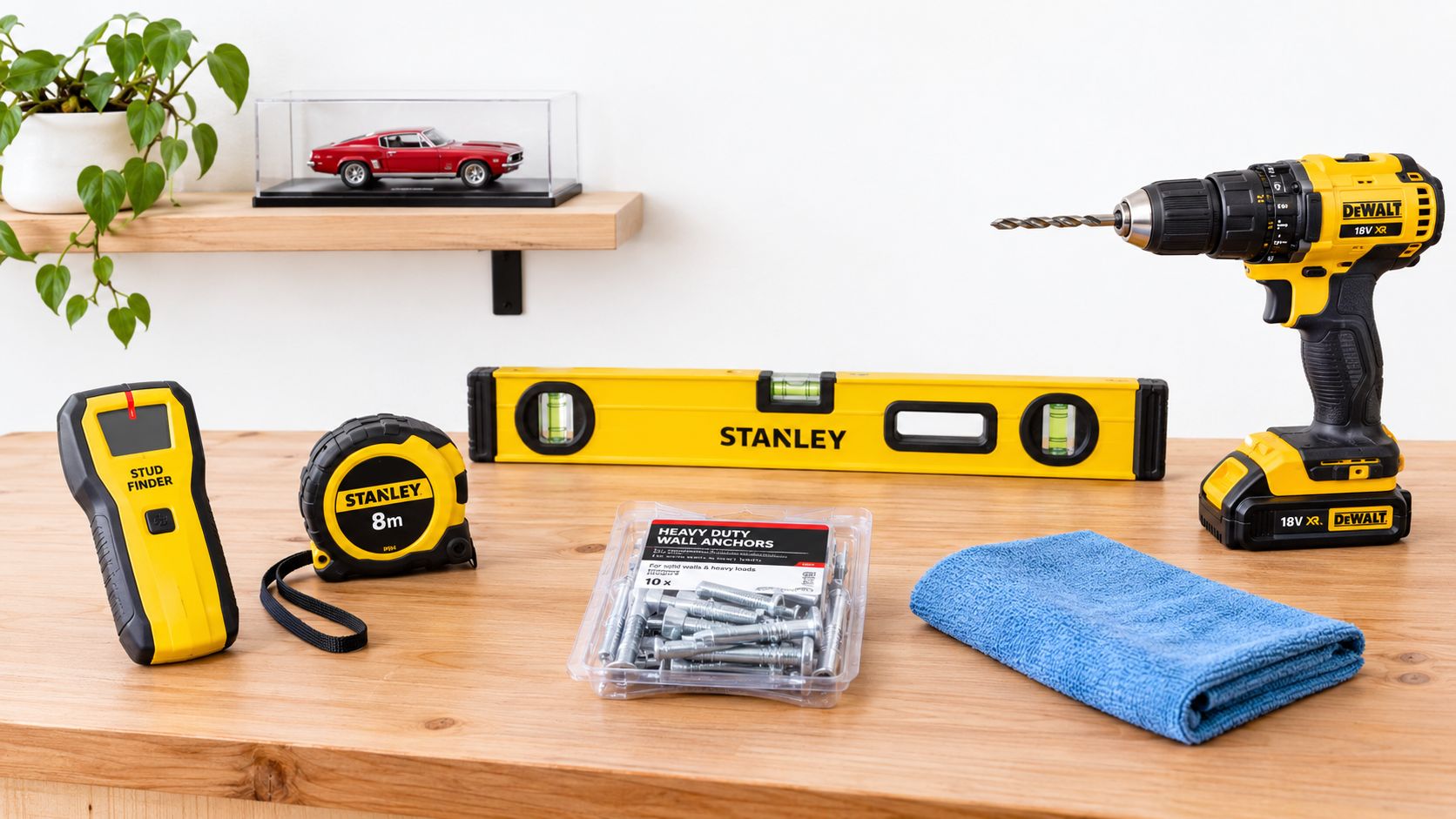
- Plasterboard: locate a stud where possible. If that isn't practical, use an anchor specifically rated for the measured load and the type of plasterboard. Don't rely on an adhesive strip solely because the surface feels smooth.
- Timber stud: a screw into the stud provides a strong fixing point. Use a stud finder, confirm the location and choose a screw long enough to engage solid timber without damaging hidden services.
- Brick: use masonry-compatible anchors and drill with the correct bit. Avoid placing a fixing in a weak mortar joint when sound brick is available.
- Concrete: use a suitable masonry anchor and the right drill setting. A hammer drill may be needed for dense concrete, and a professional is sensible for a large or valuable piece.
Use hardware rated above the item's actual weight, not equal to it. Measure the object, inspect the hanging point and check whether the supplied wire, bracket or D-rings are firmly attached.
A shallow V-shaped hanging wire generally distributes load better than a steep wire arrangement. Keep the hanging points level, test the piece close to the wall and check that doors, children or pets can't catch its lower edge.
Renters need a more cautious decision tree. For a light, compact piece on a clean, smooth surface, a removable hook may be appropriate if its rating exceeds the measured load and the manufacturer permits that use. Adhesive strips aren't universal rental-safe hardware. Dust, texture, humidity, shape and leverage can all reduce their reliability. A heavier piece should go into a stud or suitable anchor, with the landlord's approval where required.
Safety check: if the piece is valuable, unusually heavy, projecting, above a bed or in a public area, professional installation is the sensible option.
For a large fixed wall lining or commercial display, fire requirements become relevant. WoodSolutions reports that testing under AS 5637.1:2015 assessed solid-timber wall and ceiling linings at a minimum thickness of 9 mm, while plywood linings were assessed from 6 mm. The National Construction Code uses Group Numbers from Group 1 to Group 4 for wall-lining fire hazard classification. A finish, adhesive, backing board or composite substrate can change the tested system, so don't describe a small timber artwork as fire-compliant merely because it uses wood. WoodSolutions' technical reports are a useful starting point, but a certifier should verify the complete assembly for regulated work.
For a visual installation guide, follow this wall-art hanging guide.
Common Mistakes and a Quick Reference Table
The most common errors are easy to avoid. Buyers choose a piece by photograph rather than measurements, hang a substantial panel too high, ignore coastal humidity or assume that “light enough to lift” means safe enough to mount. Over-clustering creates another problem. Several busy shapes can compete until none of them feels intentional.
Measure the wall, furniture and object before ordering. Leave visual breathing space, check the back of the piece and ask what the panel is made from. For licensed automotive décor, construction quality and accurate design matter more than novelty alone.
| Material / finish | Best for | Care note |
|---|---|---|
| Raw solid timber | Dry, sheltered interiors | Acclimatise carefully and watch for movement |
| Oiled timber | Warm coastal and retro rooms | Refresh the oil according to the maker's guidance |
| Waxed timber | Low-contact decorative walls | Keep away from persistent damp and direct wetting |
| Lacquered timber | Busy rooms needing a harder surface | Inspect edges and repair chips before moisture reaches the timber |
| Painted timber or MDF | Graphic silhouettes and bright designs | Protect exposed edges and avoid wet areas |
| Reclaimed hardwood | Rustic, surf-shack and collected interiors | Check for sound timber, old fasteners and a stable finish |
| Plywood | Layered geometric or laser-cut pieces | Seal faces and edges consistently |
A well-made piece should tell you its material, dimensions, weight and recommended hanging method. Those details are more useful than a dramatic room photograph.
Choosing and Caring for Your Piece
Start with five checks:
- Measure the wall and the furniture below it.
- Confirm the object's dimensions and actual weight.
- Choose a timber and finish suited to your indoor climate.
- Match the fixing to plasterboard, a stud, brick or concrete.
- Plan gentle dusting, moisture control and occasional hardware checks.
A wooden wall hanging becomes more valuable when it carries a story. It might recall a first Kombi trip, a Beetle restoration, a surf holiday or the cheerful colours of a classic Samba Bus. The community around that history remains strong. The inaugural VW Nationals in 1988 at Hawkesbury Agricultural College drew more than 500 Volkswagens despite torrential rain, while later events attracted over 1,200 cars and crowds exceeding 3,000 VW fans, according to the VW Nationals event history.
Choose once, install properly and care for the piece so it can stay part of the room through changing colour schemes and furniture. That's how a decorative object becomes part of the home rather than another short-lived purchase.
Volkswagen Memorabilia brings together officially licensed VW-themed gifts, diecast models and relaxed coastal décor, including Kombi Samba Bus and Beetle pieces that pair beautifully with wood wall hangings. Visit Volkswagen Memorabilia to find a thoughtful gift or a nostalgic display piece for your lounge, rumpus room, garage or collector's shelf.