

You're standing in front of a crowded diecast wall, or scrolling a long online category page, and every box starts to blur together. One Kombi looks brilliant in the photo, another Beetle has a nicer badge, and somewhere in the mix there's a licensed piece that'll make a VW nut smile for years, plus a lookalike that won't hold up once it's out of the packet. That's the problem with choosing the best diecast car brands in Australia, the good ones aren't just prettier, they're more consistent, better licensed, and usually better value when you care about display quality and resale later.
For Australian VW collectors, the licensing filter matters just as much as the brand name. A properly licensed Volkswagen Beetle model or VW Kombi diecast Australia piece carries the details that make the shape feel right, while the wrong one can look flat, vague, or off in the paint and markings. If you've ever hunted for a buy diecast Kombi gift or tried to build a shelf of VW memorabilia collectibles, you already know that brand reputation, scale choice, and finish quality all pull together.
The brands that matter most in the local scene tend to sit in two camps. At the entry end, you get the mass-market names that collectors recognise straight away. At the other end, you get the display-grade makers that collectors trust when they want a model to look good under close inspection, not just from across the room.
Walking Into a Diecast Shop and Feeling Overwhelmed
A first visit to a diecast aisle can feel like opening a VW show swap-meet crate and finding thirty versions of the same van. One box says 1:18, another says 1:43, a third promises opening doors, and the labels start competing with the nostalgia. Before long, the shelf stops looking like a shopping trip and starts looking like a test of patience. That's usually the moment collectors realise they're not just buying a miniature car, they're buying a mix of scale, finish, licensing, and brand discipline.
For Australian buyers, the strongest brands are the ones that make the decision easier. Hot Wheels and Matchbox are often the doorway in, because they're visible, familiar, and easy to recognise in mass retail, while collectors hunting a display piece want stronger detail and better scale consistency. Reputable diecast sourcing guides keep circling back to 1:12, 1:18, 1:24, and 1:43 as the core scale bands. That is the practical spread most local buyers use when they compare shelf space, detail, and price tiers.
Why the VW angle changes the choice
VW collecting is different from generic car collecting because the badge matters. A licensed Volkswagen piece with accurate markings, clean paint, and the right proportions feels like memorabilia, not just a toy with a familiar silhouette. That distinction is especially important for Beetles and Kombis, because their shapes are so iconic that any weakness in tooling stands out fast. A soft roofline, a lazy badge, or a sloppy window frame can ruin the whole model.
Practical rule: if the model doesn't look right before you read the box, the box probably won't save it.
The guide below favours pieces that hold up in real homes, on real shelves, and at real Australian shows. It gives you a way to judge the best diecast car brands without falling for box art or nostalgia alone, and it keeps the VW Kombi and Beetle at the centre of the comparison where they belong.
The Six Rules for Judging a Diecast Brand
A diecast brand earns trust through consistency. One good release can be a fluke, but a brand that keeps its proportions, print quality, and licensing in line across different ranges is doing the work collectors notice. I judge brands on six practical rules because that is the fastest way to separate shelf candy from pieces that still look right after a few years on display.
Start with scale and body construction
The scales most collectors keep circling back to are 1:18, 1:24, 1:32, and 1:43. Larger scales usually give you more interior depth, sharper panel lines, and hardware you can see, while smaller ones suit tight shelving or a clean themed row. A sealed 1:43 model can still be excellent, but a 1:24 Samba Bus with opening doors and a detailed cabin gives you more to inspect up close, especially when the body shape carries the whole appeal.
Check licensing before you admire the paint
A properly licensed model should carry the right logos, badges, and markings. That matters fast with VW pieces, because the badge is part of the value, not just the shape. If the licence looks vague, the markings look improvised, or the branding feels like a close enough copy, the model belongs in the maybe pile rather than the buy pile. For Beetles and Kombis, licensing usually tells you more about the collector credibility of a piece than the box art does.
Judge finish, seams, and tooling precision
Collectors should be looking at smooth hinges, tight seams, realistic paint, and tampo work that sits where it should. Better tooling usually means cleaner panel lines, more accurate wheel-arch geometry, and less paint bleed on two-tone liveries. That shows up quickly on Kombi and Samba Bus replicas, because the body is simple enough that even small flaws stand out the moment the model is under good light.
A strong diecast brand does not hide behind nostalgia, it earns trust in the details you can see under light.
Keep value in mind, not just appearance
Price-to-detail ratio is the quiet test many buyers skip. Some models cost more because they are better made, some cost more because they are scarce, and some cost more for no strong reason at all. A 1:24 Majorette Kombi at $15-20 can deliver more detail per dollar than a 1:18 loose-cast at the same price, especially if the larger piece is rough on paint, thin on licensing, or weak on finish. The better brands make the price feel fair because the scale, parts count, and finish quality match what is in the box.
Mass-Market Diecast Brands Worth Your Money
The entry-level tier is where most collectors start, and it's still where a lot of families buy gifts without overthinking it. Hot Wheels and Matchbox lead that conversation because they're widely recognised and easy to spot, especially in mixed retail environments. They're the brands most casual buyers already know, which makes them useful for play, gifting, and simple desk displays.
The familiar names
Hot Wheels is the brand you buy when you want instant recognition and broad availability. Matchbox tends to sit nearby in the same conversation, often appealing to buyers who want a practical, familiar miniature rather than a showcase model. Both are strongest when you're after affordable entry points, mixed packs, or impulse buys that don't demand a big shelf commitment.
Majorette, Welly, and Bburago usually sit a touch higher in perceived detail, depending on the release. They can be a smart middle step for buyers who want a little more realism without jumping into premium pricing. For VW fans, the key question isn't whether the badge is known, it's whether the specific release gives you a convincing Beetle or Kombi shape with decent printing and reliable proportions.
Mass-market diecast brands at a glance
| Brand | Common scales | Typical price band (AU) | VW models available |
|---|---|---|---|
| Hot Wheels | Smaller play scales, often loose mix packs | Entry-level | Occasional VW-inspired castings and themed releases |
| Matchbox | Smaller play scales, often loose mix packs | Entry-level | Occasional VW-inspired castings and themed releases |
| Majorette | Mixed small scales | Entry to mid | VW-style replicas may appear in selected lines |
| Welly | 1:24 and smaller display-friendly options | Entry to mid | Beetle and Kombi-style pieces appear in some ranges |
| Bburago | 1:24 and display-oriented small scales | Entry to mid | VW replicas appear selectively |
These brands make sense when you want something easy to source, easy to gift, and straightforward to display. They're not usually the final stop for a serious VW collector, but they're often the right first stop.
Premium Diecast Brands for Serious Collectors
Once you move into the display-grade tier, the mood changes. Collectors start caring less about brand familiarity and more about mould accuracy, part count, and how the model looks under closer inspection. That's where names like AUTOart, Minichamps, Kyosho, Solido, and Oxford Diecast come into their own.
Where detail starts paying for itself
The premium brands often do their best work in 1:18 and 1:43, because those scales suit either dramatic display presence or tighter shelf planning. AUTOart and Kyosho are especially respected when a buyer wants stronger tooling and more refined surfaces, while Minichamps remains a familiar benchmark for collectors who like accurate proportions and a serious presentation. Solido and Oxford Diecast bring good value for collectors who want convincing models without chasing the highest end of the price ladder.
For VW replicas, premium brands often make more sense than they first appear. A Kombi or Beetle has a clean, familiar shape, so a good premium mould can look especially convincing without needing the visual drama of a modern supercar. In plain terms, you often get more real-world presence per scale centimetre because the design is iconic and the details are easier to read.
Why premium can still be the better buy
The payoff isn't just surface detail. Better licensed models tend to hold up better in the collector market because scarcity limits supply, while strong finish quality keeps the model attractive in the used market. Australian collectors who care about long-term value usually lean toward the brands that control release quality rather than flooding the market with uneven batches.
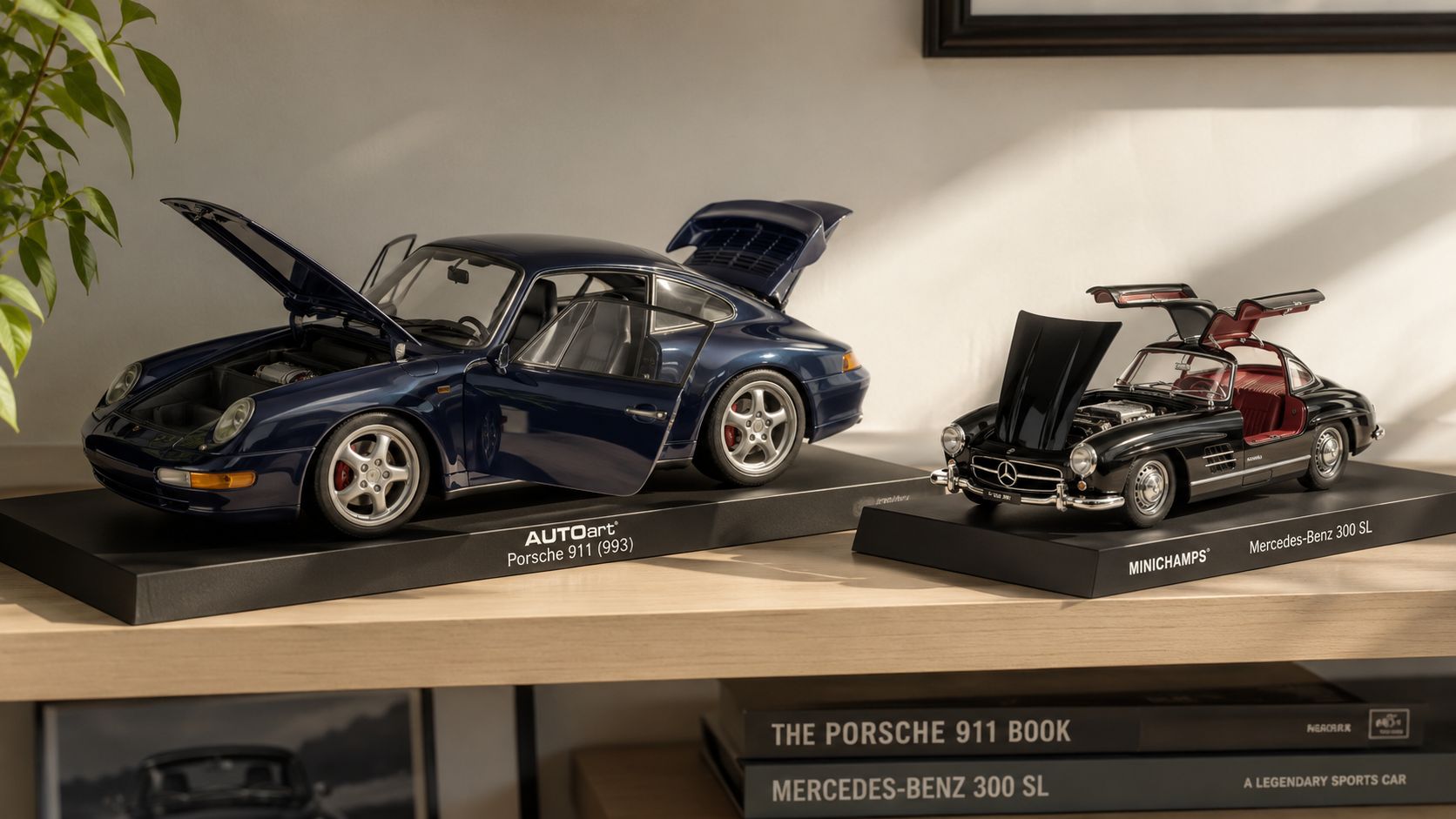
Premium doesn't always mean perfect, but it usually means the brand has spent more time on the bits collectors notice first, badge detail, glazing, seam work, and paint finish. That's why serious VW buyers often end up here.
How the VW Kombi and Beetle Stack Up Across the Brand Ladder
The Volkswagen story gives diecast collecting its emotional centre. The Volkswagen Beetle ran from 1938 to 2003 and total production passed more than 21.5 million vehicles, which explains why the shape lands so hard with collectors across generations (VW Beetle production history). The Volkswagen Type 2, often called the Kombi, Bus, or Transporter, entered production in 1950, and the early split-window versions are prized because they're instantly recognisable on a shelf or at a show (VW Type 2 history).
Where each VW shape tends to sit
A 1962 Kombi Samba Bus usually makes the strongest impression in premium or strong mid-range form, especially when the brand gets the trim and glazing right. A 1967 Beetle can look excellent even in a smaller scale if the proportions are disciplined and the paint is clean. Flower Power variants sit somewhere between nostalgia piece and display model, and they can be a lot of fun when the colour treatment is tasteful rather than loud.
Australian collectors who want locally stocked licensed pieces often look for models like the 1:24 Samba Bus (KT7005WF) and 1:32 Blacktop Kombi (KT5376D). Those sit neatly in the middle of the market, where display appeal and affordability can coexist without asking you to commit to a huge cabinet. If you want a deeper VW-only browse, the VW Beetle models range is a useful reference point for seeing how different Beetle interpretations stack up.
The licensing filter matters even more here because VW badges, trim, and proportions are such a big part of the emotional hit. A licensed model feels like a small piece of VW history, while a generic lookalike just borrows the shape.
What to Look for When Buying a Diecast as a Gift
Gift buyers usually don't need to become diecast experts. They just need a model that looks right, feels solid, and lands with the person opening the box. A thoughtful 1:32 or 1:24 piece often gives more display pride than a flashy unlicensed 1:18 model, especially when the recipient cares about the badge as much as the body shape.
The quick in-store checklist
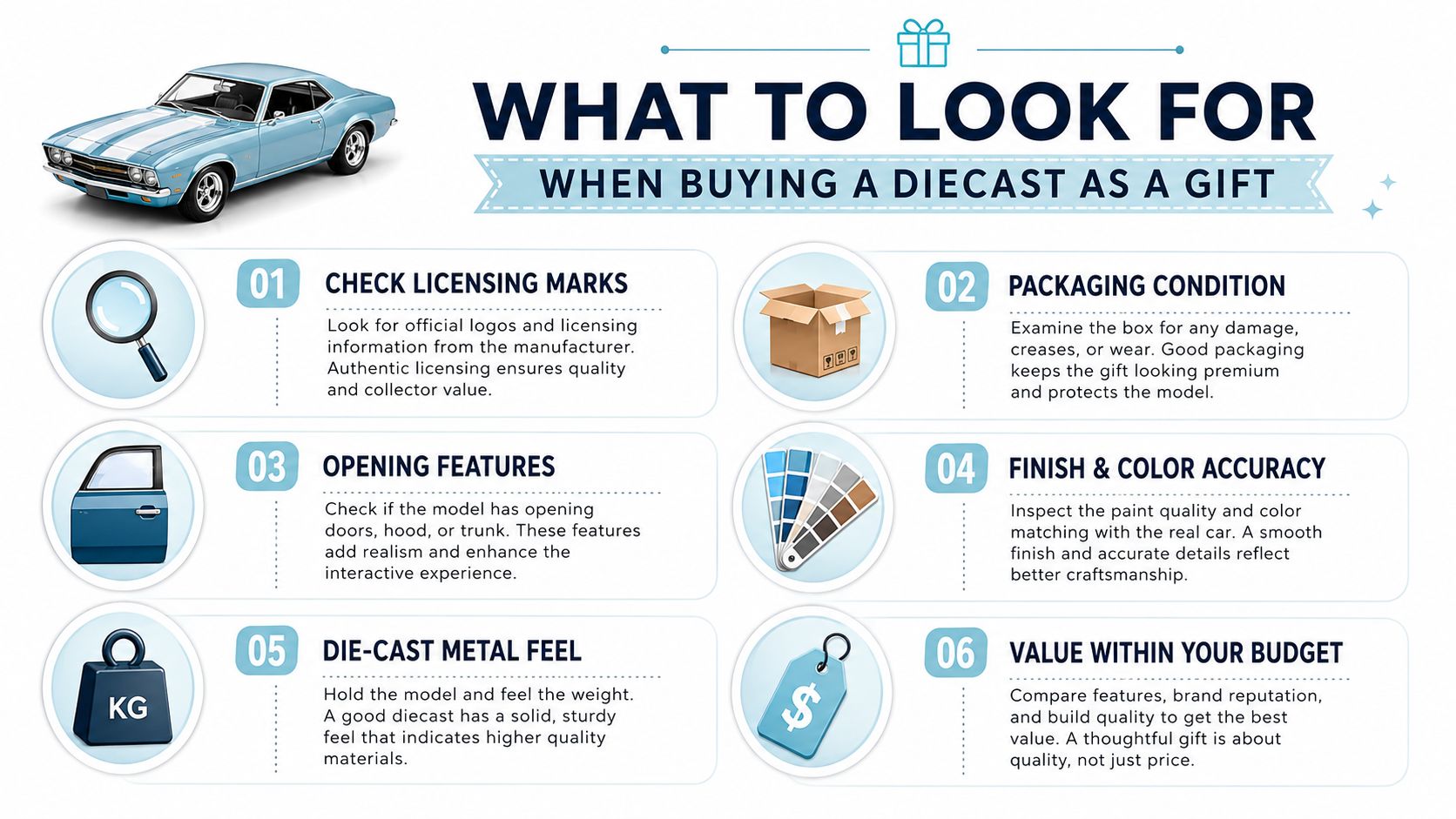
A gift worth keeping usually ticks these boxes:
- Check licensing marks: Look for the Volkswagen branding and any clear approval indicators, because that's the easiest way to avoid a lookalike.
- Inspect the packaging: Crushed corners, loose windows, or torn seals can spoil a present before it's even opened.
- Test the features: Opening doors, working hatches, or pull-back action should feel smooth, not gritty or loose.
- Study the finish: Paint should look even, with clean colour separation and no obvious bleed on two-tone VW vans.
- Feel the weight: A die-cast metal body has a different presence from a light plastic toy, and that difference matters on a shelf.
- Match the budget to the display: Don't overpay for size alone. Spend for licensing and finish first.
Choose the scale the person can actually enjoy
A big model can be brilliant, but only if the recipient has room to show it off. If they live in a tighter apartment or already collect other VW memorabilia, a tidy 1:43 or 1:32 piece can be the smarter gift because it fits into a themed shelf without crowding everything else. That's especially useful when you're shopping for someone who likes the look of a Kombi but doesn't want a model taking over the room.
Why Smaller Scales Can Be Smarter Choices in Australia
A lot of buyers assume 1:18 is always the gold standard. It isn't. In Australian homes, especially where shelf space is limited, a well-made 1:32 or 1:43 can be the better fit because it's easier to build a coherent display without sacrificing the rest of the room.
Smaller doesn't mean lesser
The best smaller-scale pieces still rely on the same fundamentals, licensing, finish quality, and consistent tooling. When those are strong, a compact Beetle or Kombi can look just as satisfying as a larger model from across the room. That's why collectors often treat smaller scales as part of a curated display rather than a compromise.
Australian buyers also need to think about the environment. In humid coastal homes, paint and chrome wear become more visible over time, so a model with solid finish control and sensible storage needs can age better than a larger piece that's harder to keep pristine. The practical result is simple, a smaller premium model can be the smarter long-term buy if you value condition and display discipline.
Value and space work together
Resale value doesn't belong only to large display pieces. Limited-run models in smaller scales can hold value well when the licensing is strong and the release is controlled, because buyers still chase scarcity and finish quality. If you want a deeper primer on the category itself, the diecast model car overview is a handy starting point before you commit to a scale.
If the shelf looks cleaner, the collection usually feels better too.
For Australian collectors building a VW theme, smaller scales let you mix Beetles, Kombis, and surfy special editions without crowding the bonnet line of the whole room.
Building Your Collection and Where to Start
The simplest way to build a good collection is to make three decisions in order. First, choose your scale. Second, decide whether you want a mass-market brand or a premium release. Third, only buy models that carry the licensing and finish quality you'd be happy to display for years.
A varied VW shelf usually works best when it mixes body styles and moods. A Samba Bus, a Beetle, and a Flower Power variant create more visual interest than three nearly identical vans, and that's true whether you're collecting for yourself or buying a present. If you want to browse a broader local selection of Volkswagen diecast models for sale, the diecast models Australia category is a sensible place to compare scale, style, and release type.
A practical way to start
- Pick one scale first: That keeps the shelf coherent and helps you compare models fairly.
- Buy licensed VW pieces only: It's the fastest filter for quality and long-term satisfaction.
- Mix one showpiece and one everyday piece: That balance keeps the collection interesting without draining the budget.
- Choose models that match the owner's taste: A Samba Bus suits a surfy collector, while a Beetle often lands better with someone who loves pure VW heritage.
FAQ
What is the safest scale for a first VW diecast?
1:43 is usually the easiest starting point for compact displays, while 1:24 often feels more gift-friendly because it has a bit more presence.
Are licensed models really worth it?
Yes, because licensing helps separate genuine VW-branded collectibles from generic lookalikes, and that matters for display pride.
Should I always choose the biggest model?
No. Bigger only helps if the finish, licensing, and shelf space all make sense together.
What's the best brand for a Beetle or Kombi gift?
The best choice is the one that matches the recipient's taste, scale preference, and desire for licensed authenticity.
If you're ready to add a properly licensed Beetle or Kombi to your shelf, have a look through Volkswagen Memorabilia and choose the scale and model that feels right. A well-chosen diecast should look good in the box, look even better on display, and feel like a small piece of VW history every time you walk past it.