


You've finished polishing the Kombi in the garage, stepped inside for a cold drink, and noticed the wall above the sofa is still completely bare. The car has character, the room has good bones, but the display stops at the driveway. Metal car wall decor closes that gap, bringing the curves, colours and memories of classic motoring into the everyday parts of an Australian home.
A well-chosen piece can feel like more than decoration. It might recall a first road trip, a family Beetle, a beach-bound Kombi or a sunny afternoon at Volksfest. The trick is choosing the right style, finish, scale and location, especially when Australian sun, humidity and salt air enter the picture.
Why Metal Car Wall Decor Is Having a Moment
Generic wall art can make a room look finished, but automotive pieces give it a point of view. A vintage Volkswagen sign above a workbench, a flat Kombi silhouette beside a record player or a layered Beetle panel in a hallway tells visitors what matters to you before anyone says a word.
The appeal also fits naturally with Australian interiors. Coastal rooms often use bleached timber, woven texture and relaxed colour, while retro and industrial spaces welcome painted steel, aged surfaces and strong graphic shapes. Reflective metals are returning to Australian decorating, but current styling favours balancing them with stone, texture and softer organic forms rather than filling a room with hard shine. Australian decor coverage on 2026 styling reflects that warmer approach.
Collector's view: The best wall piece should look at home in the room, but still make a VW fan stop mid-sentence.
The wider wall-art channel is healthy too. Australian wall-art imports increased 0.84% from 2023 to 2024, with a 2.49% CAGR from 2020 to 2024, according to Australia wall art market data. That doesn't make every metal sign a guaranteed investment, but it does show that decorative wall products sit inside an established homewares ecosystem, not an isolated collector niche.
For VW enthusiasts, the nostalgia has real Australian roots. Beetles first arrived here in 1953, local assembly began in 1954, Volkswagen Australia formed in 1957, and Clayton production continued until 1976, as documented by Museum Victoria's Beetle history. A wall display can therefore celebrate both the shape of the car and the story behind it.
The Main Types of Metal Car Wall Decor
Before buying, identify the kind of object you want on the wall. Most metal car wall decor falls into three useful groups, and each creates a different visual effect.
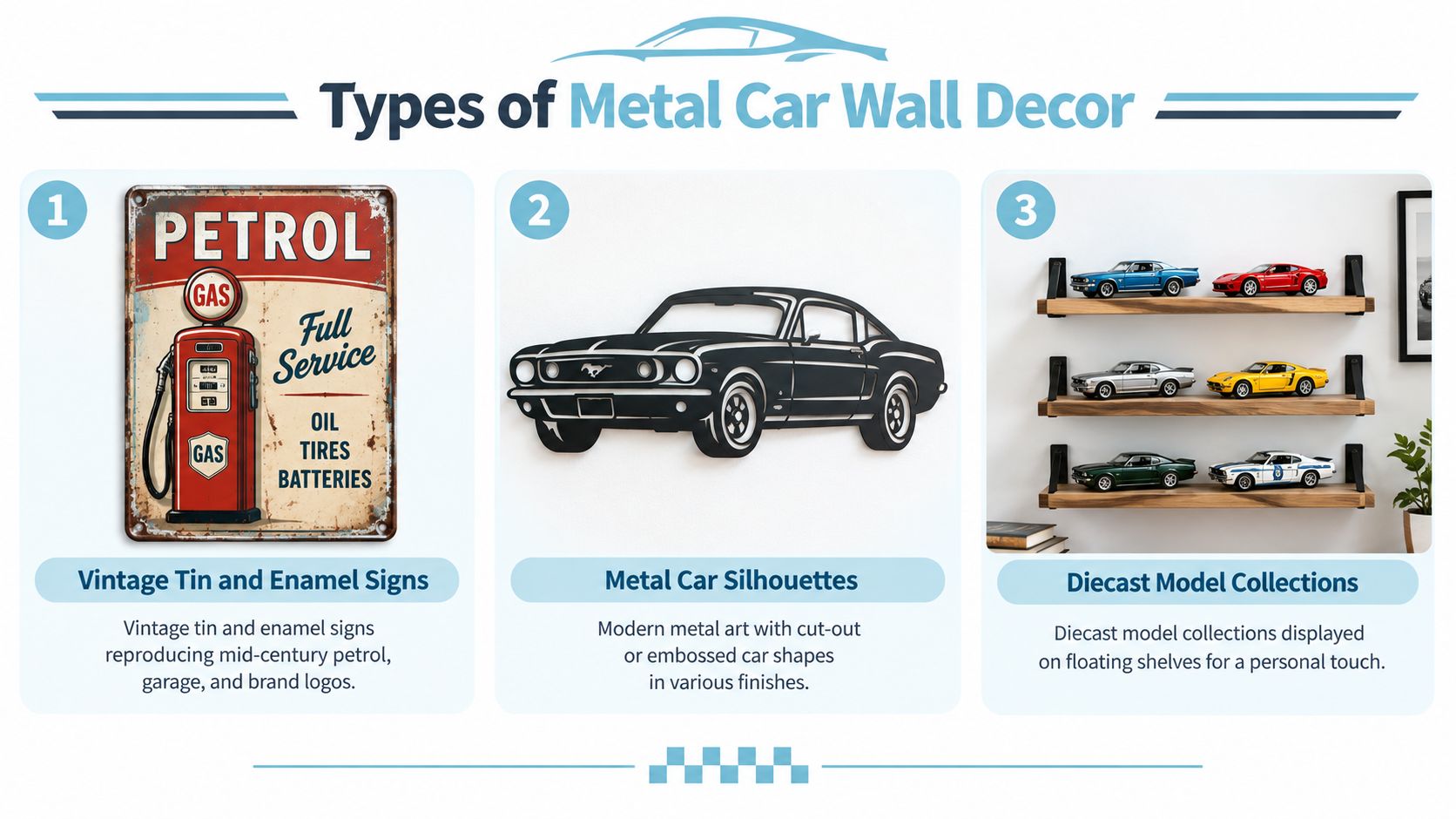
Vintage signs
Tin and enamel-style signs reproduce the language of old petrol stations, garages and motoring brands. Their rolled edges, bold lettering and glossy faces bring instant period charm. A rectangular sign suits a garage, workshop or rumpus room, while a smaller plaque can sit comfortably in a hallway or beside a display cabinet.
These pieces work particularly well when you want nostalgia without adding much depth. They're easy to combine with timber shelving, framed photographs and restored tools.
Flat metal art
Laser-cut and plasma-cut silhouettes offer a cleaner, more contemporary look. A Beetle profile, Kombi outline or simplified wheel design can sit against a pale wall without overwhelming the furniture. Cut-out shapes also create changing shadows as daylight moves across the room, which gives a simple design extra life.
For a coastal interior, a muted blue, white or weathered finish can connect the car theme with surf culture. In a darker man cave, black steel creates a sharper workshop feel.
Dimensional displays
Embossed panels, layered cut-outs, relief designs and wall-mounted diecast arrangements project from the surface. They catch light from different angles and become stronger focal points than a flat sign.
A Kombi Samba Bus diecast displayed on a shallow floating shelf is a good example. It adds genuine three-dimensional detail while leaving the wall itself relatively uncluttered. For classic Beetle references, VW Beetle wall art can provide the visual anchor around which a larger display grows.
Choosing the Right Finish for Your Space
Finish affects appearance, cleaning and service life. A raw steel piece may develop a pleasing rust tone in a dry indoor garage, but that same finish needs more caution near the coast. Powder coating, chrome and printed surfaces each solve a different styling problem.
Australian conditions make the environment especially important. Guidance classifies atmospheric corrosivity from C1, very low, with less than 1.3 micrometres per year of mild-steel corrosion, through to C5 marine, very high, with 80 to 200 micrometres per year in sea-shore or surf exposure. The Australian powder-coating guidance explains why a piece indoors won't face the same conditions as one exposed to salty air.
| Finish | Durability | Coastal suitability | Best room |
|---|---|---|---|
| Raw steel | Develops patina and needs protection | Limited unless sealed and sheltered | Indoor garage or industrial room |
| Powder coat | Tough, wipeable and available in many colours | Stronger choice when the coating system matches the environment | Living room, garage or covered coastal area |
| Chrome | Bright and reflective, but shows marks | Better protected indoors, away from salt spray | Retro lounge or display room |
| Printed metal | Crisp graphics under a protective surface | Depends on substrate and coating quality | Kitchen, hallway, office or themed room |
The technical detail matters more than a product description that says “rust resistant”. AS 4506-2005 covers powder-coating test procedures and performance requirements involving adhesion, gloss, impact, weathering, corrosion and chemical attack, as shown in the AS 4506-2005 standard preview.
Where to Hang Metal Car Wall Decor in Your Home
Start with the room's job. A living room needs balance and conversation, a garage needs clearance around tools and movement, and a coastal space needs protection from direct salty airflow.
In the living room, place a vintage VW sign above the sofa with its centre close to eye level. Floating shelves underneath can hold a few diecast models, while matching pieces on either side of a television or fireplace create a calm, symmetrical arrangement. Don't let every item compete for attention. One hero design should lead, and the smaller objects should support it.
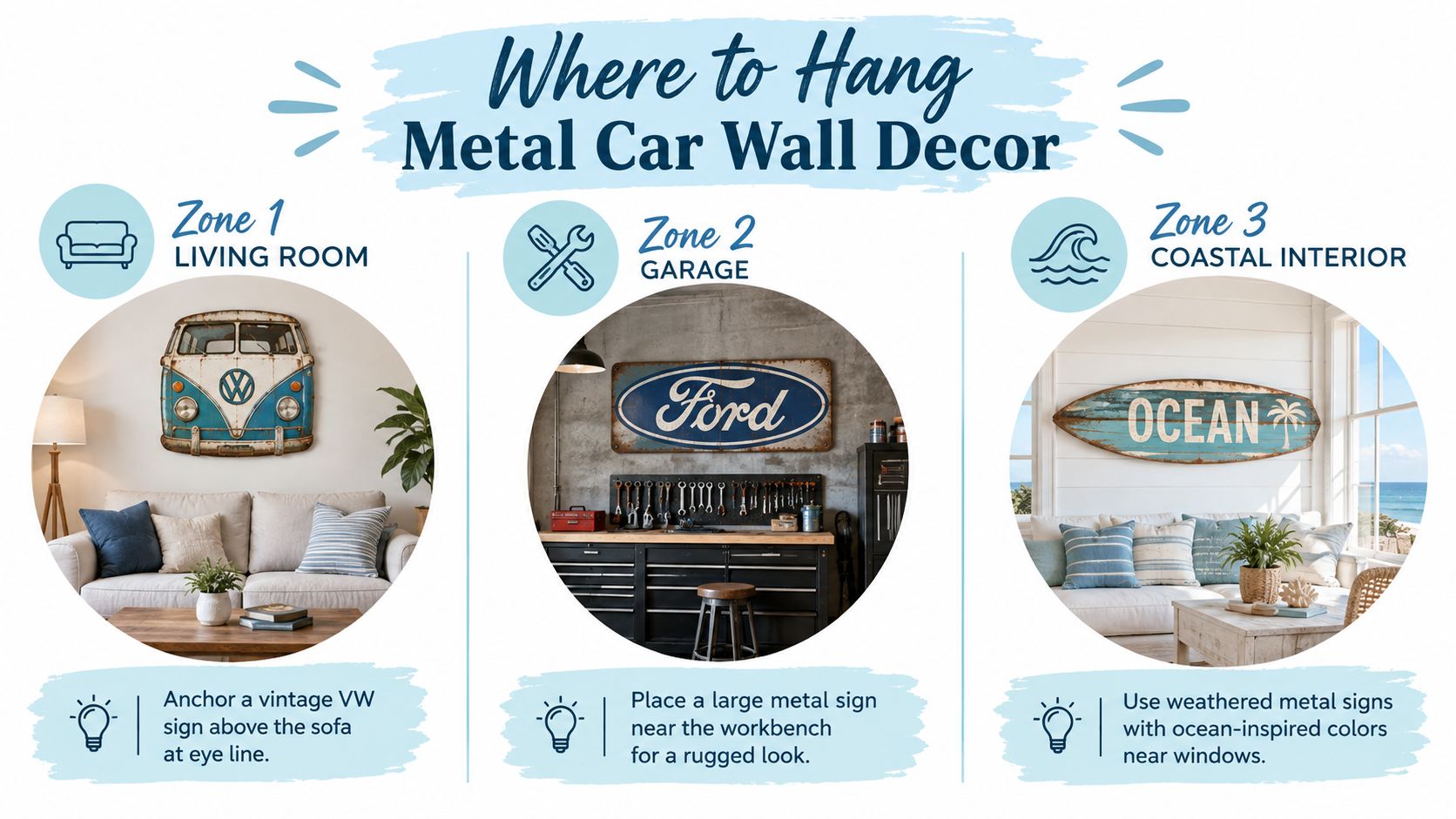
A garage or man cave gives you more freedom. Cluster signs near the workbench, above tool cabinets or beside a parts-cleaning area, but check door swings, shelves and overhead lights before drilling. A large Volkswagen van wall-art display can provide a strong vertical or horizontal counterpoint to a workbench.
For coastal rooms, choose a sheltered interior wall rather than a position where sea breezes hit the surface. Weathered metal looks excellent with white-painted boards, bleached timber and woven baskets, but the harder material benefits from those softer companions.
Grouping without visual clutter
Odd-numbered groupings often feel more relaxed than rigid rows. Mix a flat sign with a dimensional piece or a small diecast shelf, and leave 5 to 10 centimetres between items so each shape can breathe. Keep the bottom edge clear of skirting boards, switches and furniture backs.
Placement rule: Hang the display where you can enjoy the story, not where passing traffic will catch a shoulder or knock a model.
Getting the Size and Scale Just Right
A wall piece can be beautifully made and still look wrong if it's undersized. Measure the usable wall area, not the entire wall, then compare that width with the sofa, bed, workbench or cabinet below it.
For a broad furniture run, aim for art covering roughly two-thirds to three-quarters of the available width. A simple guide is to multiply the usable wall width by 0.66 to 0.75. A larger statement sign in the 60 to 90 centimetre range can suit an open living area, while a 20 to 40 centimetre plaque may work better in a hallway or layered cluster.

Centre the artwork around 145 to 155 centimetres from the floor to the middle of the piece, then adjust for seating and ceiling height. Horizontal signs echo the length of a sofa or bench. Vertical silhouettes suit narrow walls, corners and spaces beside doors.
Collectors also need to separate wall-art scale from diecast scale. Australian guidance places a 1:18 model at approximately 25 to 30 centimetres long, a 1:24 model at 16 to 20 centimetres, and a 1:43 model at 10 to 12 centimetres, with other comparisons available in this Australian diecast size guide. Tape a paper template to the wall first. It's far easier than filling an unnecessary drill hole.
A Quick Buying Checklist Before You Commit
A confident purchase starts before the checkout. Take a photo of the wall, mark the furniture below it and use paper templates to test the arrangement in daylight and evening light.

Run through these checks:
- Measure the space: Record width, height and the distance to skirting boards, switches, door frames and furniture.
- Check the viewing height: Centre the design around your normal eye line, then lower it slightly if people will mostly see it while seated.
- Allow traffic clearance: Keep busy walkways clear, including the infographic's practical 1 metre clearance reminder.
- Match the finish: Choose a protected coating for humid or coastal conditions, and reserve easily weathered raw steel for suitable indoor locations.
- Confirm the mounting surface: Plasterboard, brick and masonry need different fixings, and the hardware must support the item's actual weight.
- Check authenticity: Collectors seeking genuine VW memorabilia should look for officially licensed Volkswagen products rather than generic car imagery.
This short process prevents the common mistakes: a sign that's too small, a finish unsuited to the room or a display mounted where it gets bumped every day.
Caring for Metal Wall Art in Australian Conditions
Dust is the easy part. Salt air, humidity and strong UV exposure create the true test, especially for pieces displayed on verandas, in open garages or near coastal windows.
Indoors, wipe the surface with a clean microfibre cloth as part of your regular housework. If the piece needs more than dusting, use a mild solution and a soft cloth, then dry it thoroughly. Avoid abrasive pads, strong solvents and harsh chemical cleaners because they can dull printed surfaces or damage protective coatings.
Look closely at corners, mounting points and cut edges. Early pitting, bubbling or exposed steel is easier to manage than a large area of corrosion. Chrome needs particular attention because fingerprints and salt residue show quickly, while powder-coated surfaces should be checked for chips that expose the substrate.
A simple care rhythm
- Every quarter indoors: Dust and wipe the surface, then inspect the face and edges.
- Every six months: Check screws, brackets, shelves and wall anchors for movement.
- Each year outdoors or semi-outdoors: Review the clear protective finish and refresh it only with a product compatible with the existing coating.
For coastal homes, a sheltered wall with good airflow is preferable to an exposed exterior facade. AS 4312 helps determine the corrosivity zone, while AS/NZS 2312.1 guides protective coating selection, as outlined in the Australian coating guidance linked earlier. In other words, a good finish starts with the location, not just the colour you like.
Start Your Collection with Volkswagen Memorabilia
A strong display doesn't need to arrive all at once. Start with one piece that carries the most meaning, perhaps a Beetle silhouette, a Kombi sign or a Samba Bus model, then add supporting items as the room reveals what it needs.
The Beetle has a particularly rich Australian story. Clayton-assembled cars reached 80 per cent local content by 1962 and about 95 per cent in the mid-1960s, while the model's market share rose from a little over 1 per cent in 1954 to second only to Holden by 1961, according to the Australian Beetle history recorded by Carsales. ClubVW records that 1960 was the Beetle's most successful Australian year, with 24,388 units sold, and that it ranked as Australia's second-best-selling individual car model behind the FB Holden that year, as detailed in the ClubVW reference timeline.
That heritage gives a wall display its emotional weight. A licensed Volkswagen sign or diecast model isn't just a colour match for the sofa. It connects the room with Australian roads, surf trips, family memories and the community spirit found at events such as Volksfest, VW Nationals and Surf Show & Shine.
For complementary pieces, browse vintage home accessories and build around a single hero item. The right finish, size and placement can turn a blank wall into a small personal museum, without making the room feel like a showroom.
Volkswagen Memorabilia offers licensed VW diecast models, Kombi Samba Bus collectibles, Beetle pieces and coastal-inspired metal decor for homes, garages and thoughtful gifts. Visit Volkswagen Memorabilia to choose a hero piece for your wall, then grow a display that celebrates the Volkswagen stories you've carried for years.