
Beach Wall Art for Bedroom: A Practical Styling Guide

You've made the bed, fluffed the cushions and added the woven throw, but the wall above the headboard still feels unfinished. A small print disappears, a loud nautical sign takes over, and suddenly the room feels more like a holiday rental than a restful Australian bedroom. The fix isn't finding a more obvious beach picture. It's choosing the right scale, palette and mood.

The best beach wall art for bedroom spaces nods to the coast without turning the room into a theme. Think soft horizons, dune colours, weathered texture and one confident focal point. That approach also leaves room for personal details, whether that's a coastal photograph from a favourite trip, a subtle surf reference or a small VW-inspired accent that recalls relaxed beach culture.

Picture the Bedroom You Actually Want

Walk into the room after a long day. The curtains are half-drawn, the bed is made and your eye settles on one broad artwork above the headboard. Instead of competing with the bedding, it pulls together the sand-coloured throw, pale timber and sea-glass cushion. That's the feeling to design towards.

Before browsing prints, make three decisions:

  • Choose the mood: Calm suits pale horizons and soft watercolour. Airy works with white space and washed blues. Nostalgic can include an old surf photograph or a faded coastal palette.
  • Read the existing palette: Note the colours already doing the work. White linen, warm timber and rattan need a different artwork from deep navy bedding or charcoal walls.
  • Identify the anchor wall: The bed usually dominates the room, so the wall behind it should guide the artwork's proportions.

Take a clear photograph of the bed wall in daylight. On your phone or tablet, place two rough test shapes over the image, one modest and one generously scaled. You'll quickly see whether the wall needs a single statement piece, a pair of panels or a smaller arrangement balanced by bedside lighting.

Practical rule: Choose beach wall art for bedroom projects by palette first and subject second. A quiet coastal print in the right colours will feel more considered than a technically beautiful image that clashes with the room.

Australian home décor sits inside a substantial and expanding market. It generated USD 8,708.0 million in 2024 and is projected to reach USD 17,654.8 million by 2030, with a projected 12.7% CAGR from 2025 to 2030, according to Grand View Research's Australia home décor market outlook. Furniture led revenue in 2024, while textiles were the fastest-growing segment, a useful reminder that wall art works best as part of a layered bedroom rather than as an isolated purchase.

For a little inspiration beyond literal beach scenes, browse these coastal home décor ideas and look for the combination that feels most like your home.

What Modern Australian Coastal Wall Art Looks Like

Australian coastal style has grown up. The older version leaned heavily on shells, anchors, fish and bright surf slogans. The more refined interpretation keeps the seaside reference but removes the visual shouting, using muted horizons, abstract water, dune colours and natural materials instead.

A 2026 Australian guide to coastal interior design describes the style as rooted in the natural beauty of the seaside and Australia's beach culture. It also distinguishes current coastal interiors from earlier kitschy, seashell-heavy rooms. That shift explains why today's bedroom artwork often feels calmer and more architectural.

Look for:

  • Oat, dune and oyster: These tones settle easily beside white linen and pale timber.
  • Sage and seafoam: They bring colour without the sharpness of saturated turquoise.
  • Washed navy: Use it as a small visual anchor, especially with darker bedheads.
  • Cloud grey: This works beautifully with silvered driftwood and cool daylight.
  • Soft horizons: A clear line gives the eye somewhere to rest.
  • Visible texture: Brushstrokes, raw canvas, handmade paper and softly bleached timber add depth without clutter.

The strongest pieces suggest the coast rather than depict it directly. An abstract seascape can capture movement and openness while leaving the room feeling like a bedroom. A slow-wave photograph can bring memory and atmosphere without introducing a collection of matching nautical objects.

The bedroom should feel like a quiet coastal morning, not a shop window filled with beach souvenirs.

That distinction matters in Australian homes, where coastal interiors have long been connected with beach culture but now favour a more layered, liveable look. Filter artwork by the colours already in your room, then assess the subject. If the palette is right, the print can carry a coastal feeling even when it contains no obvious shell, boat or anchor.

Sizing Art to the Bed Wall That Dominates the Room

A correctly sized artwork makes the whole bedroom look more organised. An undersized print creates visual fragments, while an oversized piece can feel heavy if it crowds the ceiling or bedside lights. Measure the bed and headboard before you fall in love with a picture.

For practical Australian coastal wall art, 60 to 90 cm pieces work above many beds, while 40 to 50 cm pieces suit gallery walls. For a broader wall span, artwork of 100 cm or more can create a stronger anchor, as outlined in this Australian coastal art sizing guide. The bed remains the starting point, not the artwork's advertised dimensions.

Measure in the right order

  1. Measure the headboard or bed width.
  2. Aim for artwork that occupies roughly two-thirds to three-quarters of that width.
  3. Leave enough space for lamps, sconces and curtains.
  4. Position the art so its centreline feels connected to the bed, not floating near the ceiling.
  5. Step back from the doorway before making the final decision.

The table below turns that method into a useful starting point. Treat the headboard measurements as common planning examples, then measure your own furniture because bed frames vary.

Bed Size Headboard Width Single Piece Width Diptych Total Width Centre Height from Floor
Queen 153 cm 90 to 120 cm 140 to 160 cm 145 to 155 cm
King 180 cm or more 120 to 150 cm 140 to 180 cm 145 to 155 cm

For a queen, one horizontal seascape usually looks cleaner than several small prints. For a king, choose a generous canvas, a wide framed photograph or a diptych with a deliberate gap. Two stacked pieces can work in a room with ceilings above 2.7 m, but a standard-height bedroom usually benefits from one confident shape.

Hang the centre of the work around 145 to 155 cm from the floor, or roughly 15 to 25 cm above the tallest pillow line when the headboard is unusually tall. Use the wall art hangings collection for visual references, but let your actual bed wall determine the final proportion.

Materials and Frames That Handle Damp Coastal Air

Salt-laden air, humidity and regular air-conditioning cycles can expose weak framing quickly. Cheap poster paper curls, unsealed timber changes appearance and ordinary glazing can create distracting reflections near a bright window. Match the construction to the room instead of paying for the same specification everywhere.

A giclée print on 310gsm cotton rag or archival canvas is a strong choice when colour and surface quality matter. Metal or aluminium prints suit rooms with more moisture because the surface handles damp conditions well. Acrylic face-mounted prints give a crisp, contemporary finish, although seafront rooms still need a properly sealed backing.

Compare the main options

Exposure Level Best Art Surface Recommended Frame Glazing
High, close to open windows or seafront air Aluminium, sealed canvas or archival cotton rag Sealed oak, teak or marine-grade finish UV acrylic or museum glazing
Moderate, coastal suburb with air-conditioning Archival canvas or giclée cotton rag Sealed timber or float frame UV acrylic is preferable
Low, inland bedroom Framed print, canvas or paper artwork Finished timber or painted frame Regular glass can be suitable

Raw timber looks attractive, but don't use it near a bathroom-adjacent bedroom unless it has a durable seal. Sealed oak, teak or a marine-grade polyurethane finish gives you the warmth of timber without leaving the frame vulnerable.

Glass remains a good option away from direct moisture, though it adds weight and can reflect windows. Museum glass or Tru Vue UV acrylic is a better investment for artwork exposed to strong daylight. Canvas has another advantage: a float frame in stained pine keeps the artwork visually lifted from the wall and lets the piece breathe.

Choose the protection level according to exposure. An east-facing artwork near a coastal window deserves archival treatment. An inland guest room can be simpler. The frame should support the calm coastal feeling, not become the most noticeable object in the arrangement.

Lighting and Layering Around the Art

Lighting determines whether beach wall art feels rich at night or vanishes after sunset. Start with the artwork in position, then add the light. This prevents the common mistake of placing a fitting first and discovering that its beam lands on the pillows rather than the image.
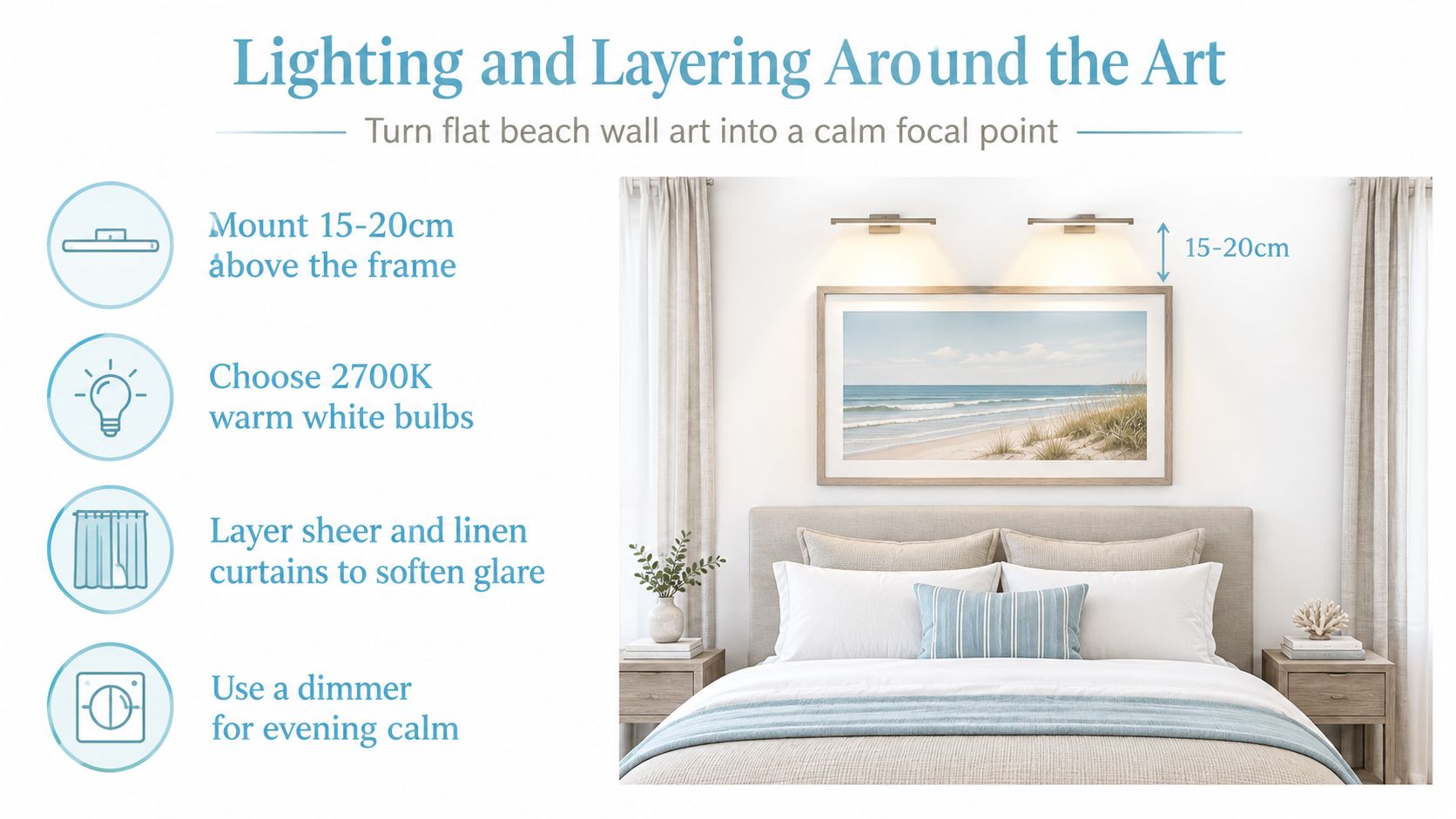
An instructional graphic showing tips for lighting and layering beach wall art above a bedroom bed.

For a single piece, use a slim picture light centred above the frame. For a wider bed wall, two narrow picture lights can sit about one-third in from each edge. Mount the fitting 150 to 300 mm above the top of the frame, then check the beam from the pillow line, as recommended in this Australian wall-lighting guide.

Build the evening layer

  • Picture light: Position it close enough to wash the artwork evenly, but not so close that the top edge becomes overexposed.
  • Bedside lighting: Use warm 2700K light to protect the softness of sand, cream and seafoam tones.
  • Ambient light: Dim the ceiling fixture so the room retains depth rather than becoming brightly uniform.
  • Opposite-wall glow: A gentle uplight or low lamp helps prevent the artwork from becoming a floating island of brightness.

Bedroom sconces generally sit around 500 to 600 mm above the mattress, with at least 400 mm horizontal clearance from the pillow edge. Fixture bodies are commonly positioned around 1.5 to 1.8 m from the floor for a balanced eye-level relationship. Confirm the fitting's beam spread and keep glare out of your direct sightline.

Leave roughly 8 to 10 cm between the headboard and the bottom of the frame when the furniture allows. In a rental, cord covers and removable hooks can keep plug-in picture lights tidy without drilling. Layer sheer and linen curtains to soften harsh daylight, then use the warm evening setting to make the artwork read as atmosphere rather than decoration.

Layering Beach Art With VW and Surf Accents

A coastal bedroom becomes personal when the wall includes a story, not just a colour scheme. The trick is restraint. Let one beach artwork carry the visual weight, then add a few three-dimensional objects that connect with travel, surf culture or old beach-road memories.

A small VW Kombi ornament on a low ledge can work brilliantly beside a framed coastal photograph. The vehicle brings movement and nostalgia, while the artwork keeps the mood grown-up. A single rusted surfboard fin, a glass vessel filled with black sand from a meaningful trip or a framed surf pass from Bells or Noosa can add a personal note without making the room look staged.

Keep the vignette edited

Use a tight palette of bone, bleached teak, sea-glass green and one warm rust accent. Group objects in threes, vary their heights and leave generous negative space around the hero artwork.

The Australian Beetle story gives this kind of nostalgia real local depth. Volkswagen says German migrant Karl Regel and his family brought a right-hand-drive Beetle to Sydney, making it one of the first Volkswagens registered in New South Wales. Volkswagen also records that full Beetle manufacture in Australia ceased after 6 years at the Clayton plant in suburban Melbourne, as explained on the Volkswagen Australian heritage page.

Museum Victoria adds that the first Beetles arrived in Australia in late 1953, production at Clayton began in 1959, local production ended in 1968, and just over 260,000 were made there. Those details make a locally minded Beetle model more than a random retro object. It can represent Australian motoring history while the beach artwork recalls the places where many of us associate these cars with freedom.

Keep the coastal bedroom décor ideas focused on editing rather than accumulation. Rotate the small accents seasonally. If the shelf starts competing with the wall art, remove objects first. Don't add another print to solve a display problem caused by too many accessories.

Your Beach Bedroom Styling Checklist

Use this list before ordering anything. It's deliberately practical because proportion matters more than the exact beach scene you choose.

  • Measure the bed first: Choose art around two-thirds to three-quarters of the bed or headboard width.
  • Set the vertical position: Centre the artwork approximately 150 to 200 mm above the headboard where the furniture allows.
  • Plan a pair carefully: Choose one large piece or a coordinated diptych, with a 40 to 60 mm gap between panels.
  • Select a calm subject: A soft horizon, abstract seascape or restrained beach photograph will age better than a loud nautical slogan.
  • Limit the palette: Pull colours from sand, seafoam, soft white, driftwood and cloud grey.
  • Match the light to the frame: Add picture lights roughly 150 to 200 mm above the artwork, then check the beam from the bed.
  • Soften daylight: Layer sheer and linen curtains to reduce glare and keep the room gentle during the day.
  • Add one natural texture: Rattan, woven fibre or sealed timber is enough to warm the wall.
  • Edit the accents: Cap VW or surf-related objects at three, so the display feels collected rather than themed.
  • Perform the doorway test: Walk back to the entrance and check that the art remains the first calm focal point.
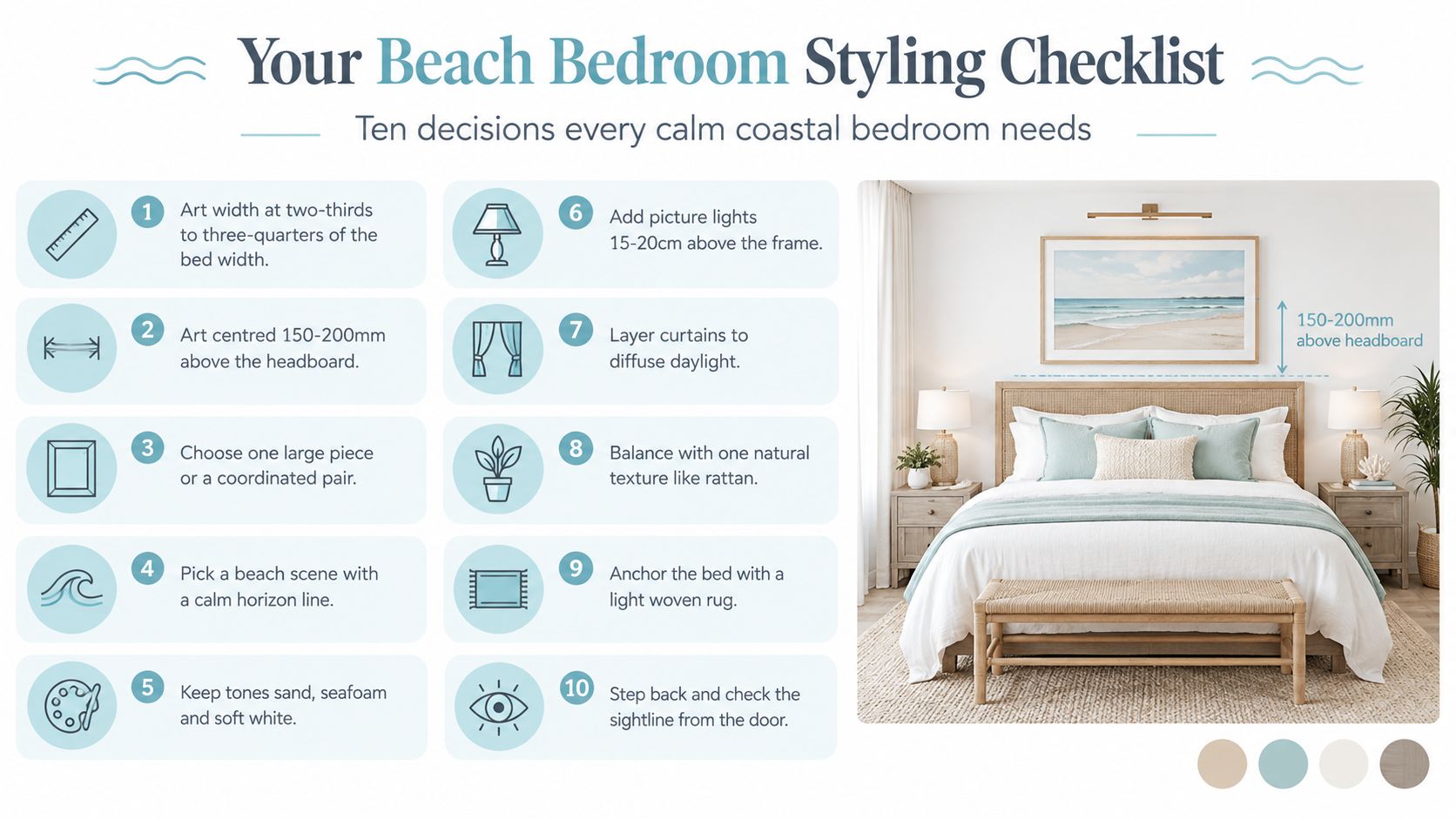
An infographic titled Your Beach Bedroom Styling Checklist showing ten design tips for coastal bedroom decor.

The right starting point is one anchor piece, not a full wall set. Correct sizing will make a modest print feel intentional, while an expensive artwork in the wrong proportion will still look lost. If you're bringing VW or surf memories into the room, let one object carry that story and keep the rest of the styling quiet.

Volkswagen Memorabilia brings together VW-themed gifts, diecast models and coastal home décor for relaxed, nostalgic interiors, including beach-inspired wall pieces and VW accents that suit a carefully styled bedroom. Visit Volkswagen Memorabilia to find one anchor piece for your coastal wall, then build the room around its colour, scale and story.

Coastal Bedroom Decor: Merge Beach & VW Style

Some bedrooms look fine on paper and still feel dead once you step into them. You’ve got the bed, a couple of tables, maybe a nice lamp, and yet the room says nothing about how you live.

That’s the spot plenty of VW lovers end up in. The garage, shed, or display cabinet carries all the personality. The bedroom gets the leftovers. If your best memories involve a Kombi run up the coast, a Beetle parked near the surf, or rummaging through swap meets for the right bit of VW nostalgia, there’s no reason your sleeping space should feel like a generic furniture showroom.

Coastal bedroom decor works brilliantly for that lifestyle because it already shares the same spirit. It’s relaxed, sun-washed, practical, and a little nostalgic. Add Volkswagen character carefully and the room starts to feel less like a styled set and more like a proper retreat you’d want to wake up in.

Bringing the Aussie Coast and Classic VWs Indoors

A lot of blokes and collectors I know have the same instinct at first. They try to “theme” the room. A surfboard in the corner, a few model vans on every shelf, maybe some bold stripes, and suddenly the place feels more like a beach kiosk than a bedroom.

That’s the wrong turn.

The better approach is to treat the room like an old beach shack that’s been lived in for years by someone who happens to love Volkswagens. The coast comes first. The VW story comes through the details.

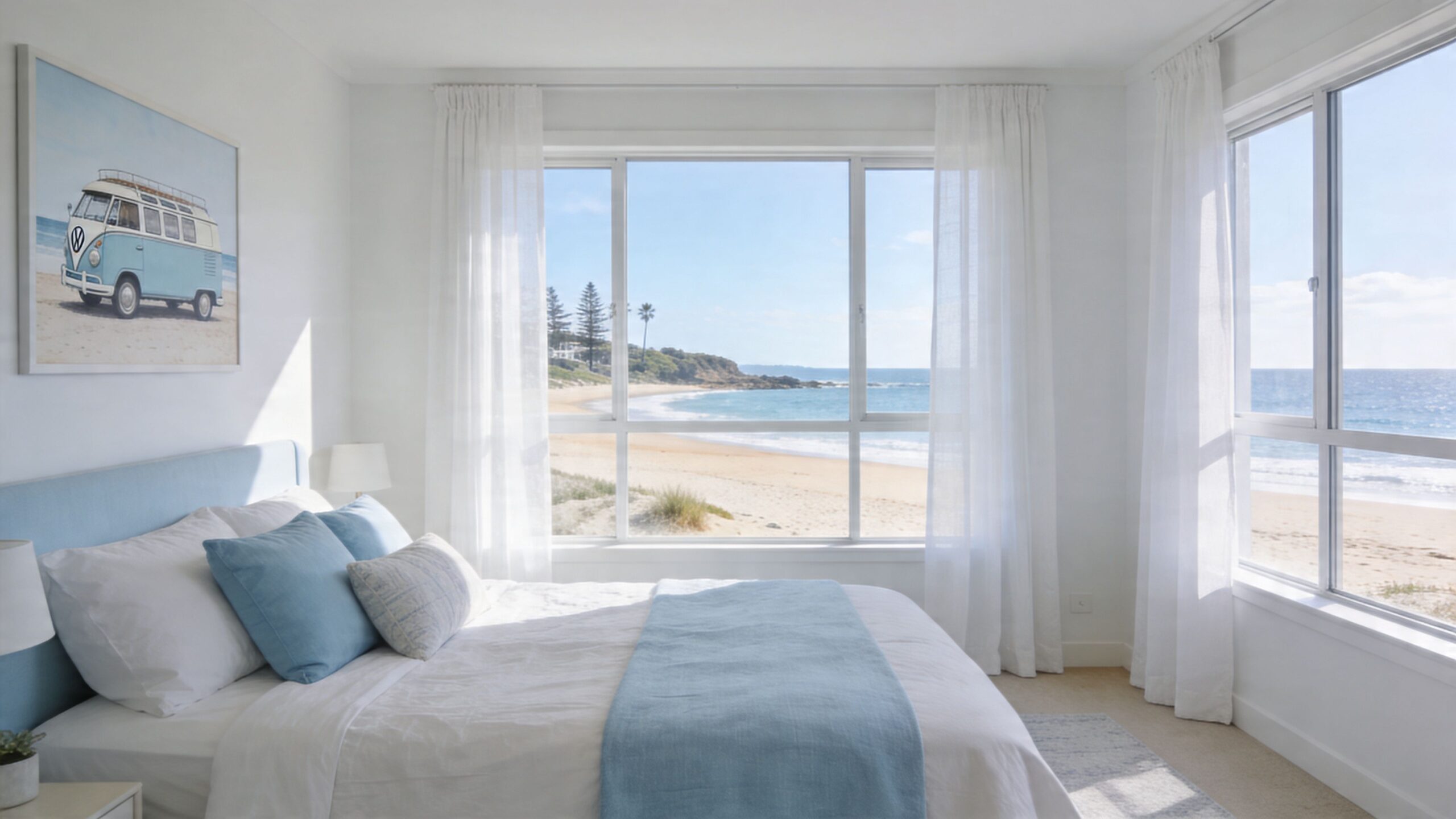
A serene bedroom with a light blue bed theme, white curtains, and panoramic views of a sandy beach.

Start with the feeling, not the collectables

Think about the rooms that stay with you after a road trip. They aren’t packed with “stuff”. They’re light, breezy, and easy to be in. Salt in the air, sun on the floorboards, maybe linen curtains moving with the breeze.

That’s the mood worth chasing.

For coastal bedroom decor, I always come back to a few essentials:

  • Light has to lead. If the room feels heavy, the whole coastal idea falls over.
  • Natural materials matter more than novelty. Timber, linen, jute, rattan. They do more lifting than any themed accessory.
  • VW pieces should look curated. One great Samba Bus model on a shelf beats a dozen random bits spread across every surface.

A good coastal VW bedroom should feel restful first and personal second. If it works the other way around, sleep suffers and the room feels busy.

Where the VW side fits naturally

Classic Volkswagens already belong in coastal spaces. Kombis, especially, sit comfortably with Australian surf culture, beach parking lots, old holiday towns, and that slow-road feeling we all know. Beetles work too, particularly in rooms that lean vintage rather than nautical.

The sweet spot is simple. Use coastal bedroom decor as the shell, then let your Volkswagen history show up in ways that feel collected over time. A framed old rally photo. A diecast bus on a floating shelf. A faded print with surf tones that picks up the room’s palette.

That’s how you bring the Aussie coast and classic VWs indoors without making the room feel forced.

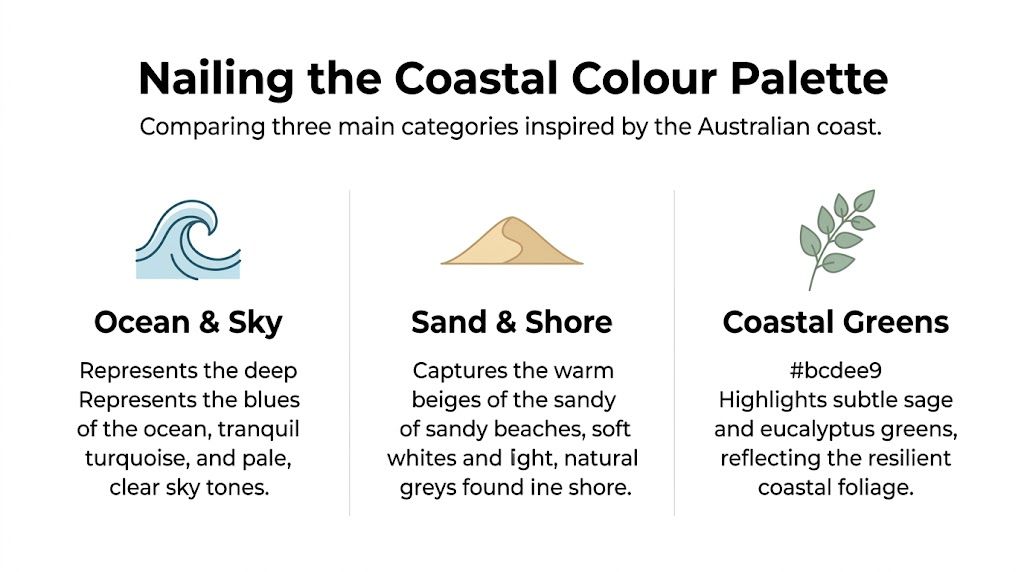
Nailing the Coastal Colour Palette

Colour does most of the heavy lifting in coastal bedroom decor. Get it right and even a basic room starts feeling open and calm. Get it wrong and no amount of linen or driftwood will save it.

In Australia, coastal style isn’t some niche look. It reflects how a lot of us live. With 85% of Australians living within 50 km of the coast, coastal decor has become a dominant trend, and a 2023 Domain Home Trends Report found that 78% of coastal bedroom makeovers used soft neutral palettes while 67% used light timber furniture (A Blissful Nest).

A coastal color palette infographic featuring ocean blue, sandy beige, and soft sage green inspiration.

Build the room from the beach inward

The best palette usually starts with what you’d see standing on an Aussie shoreline.

Palette zone What it should feel like Best use in the room
Soft whites Clean, airy, sunlit Walls, ceiling, larger bedding pieces
Sandy beiges Warm, grounded, easy Rugs, throws, cushions, timber pairings
Muted blues Calm, coastal, not shouty Accent cushions, art, one statement piece
Coastal greens Subtle and natural Small accessories, prints, occasional upholstery

If you want the room to feel bigger, keep the walls in soft white or oyster-toned neutrals. If the room gets harsh afternoon light, a sandy beige or pale greyed white can soften the glare without losing the coastal look.

Don’t make every blue “beach blue”

It's common for people to overcook it. They paint a wall bright navy, add striped bedding, and suddenly the room drifts into pub-bathroom territory.

Muted blue works better than loud blue in a bedroom. Think sea haze, weathered paint, or faded denim. It gives the coastal cue without dominating the room.

For VW fans, this is also where you can sneak in personality. Instead of forcing primary colours everywhere, pull an accent from a vintage Kombi or Beetle in a restrained way:

  • Sea green works well in a ceramic lamp base or a framed print.
  • Burnt orange can lift a cushion or small artwork if the room is otherwise very neutral.
  • Cream and pastel blue suit older VW styling beautifully and sit naturally with coastal tones.

Practical rule: Choose one base neutral, one timber tone, and no more than two accent colours. That keeps the room collected rather than scattered.

A smart way to test your scheme

Before you buy anything big, gather your colours in one spot. Paint swatches, bedding fabric, a timber sample, even a photo of the VW model you want to display. Lay them together in morning and evening light.

That simple test stops a lot of expensive mistakes.

If you want more inspiration for balancing beach tones with vintage character, this guide on coastal home decor colour palette ideas is a handy place to keep the visual direction tight.

Furnishing Your Coastal VW Retreat

Furniture decides whether your room feels like a breezy coastal escape or just a pale room with beach colours. The bones matter.

Heavy dark suites usually fight the whole idea. Glossy modern pieces can feel cold. Coastal bedroom decor works best when the furniture has texture, softness, and a bit of visual breathing room.

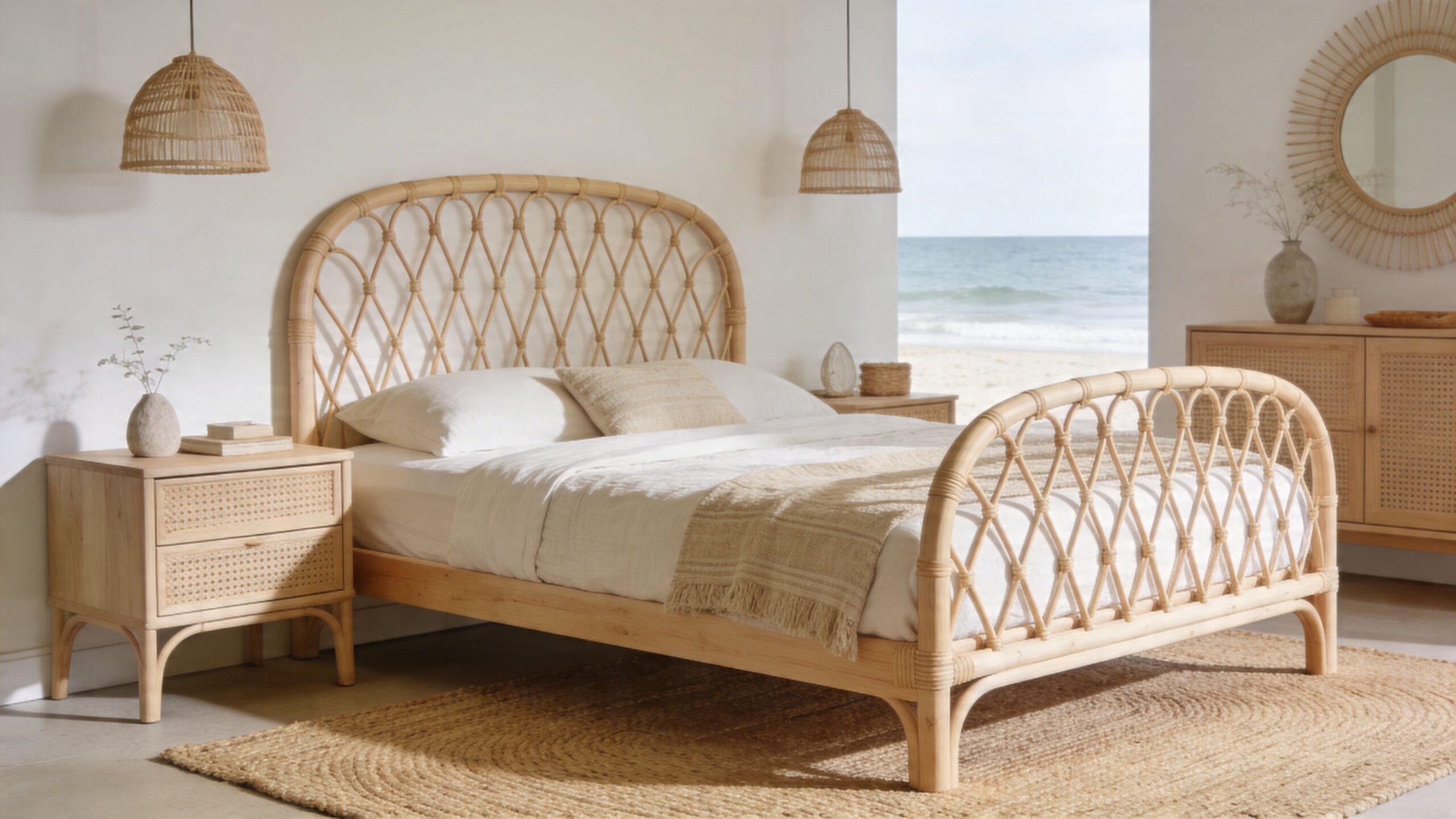
A coastal style bedroom featuring a rattan bed frame, light wood nightstand, and ocean view scenery.

Pick one hero piece first

Most often, that’s the bed.

A rattan headboard, woven bed frame, or simple light-timber bed gives you an instant coastal anchor. Once that’s in place, the rest of the room gets easier to judge. If the bed looks too formal or too bulky, everything around it has to work harder.

A few bed styles that usually work well:

  • Rattan headboards bring texture without adding visual weight.
  • Whitewashed timber frames suit rooms that need brightness.
  • Simple oak or pine beds keep things grounded and don’t compete with memorabilia.

Bedside tables should support, not steal the show. Open-leg designs or lightly built timber pieces tend to keep the room airy. Chunky matching suites can flatten the whole look.

Texture beats decoration

One of the strongest practical lessons in coastal bedroom decor is that texture often matters more than accessories. Australian interior designers report a 92% success rate for jute or sisal rugs in coastal zones for humidity resistance, and a benchmark of 70% texture layering using materials such as jute, linen, and reclaimed timber is linked to the most serene results (Shine Rugs).

That tells you something useful. You don’t need heaps of “coastal” ornaments if the room already feels right underfoot and in the hand.

What works and what usually doesn’t

Here’s the trade-off in plain terms.

Choice Usually works Usually fails
Bed material Rattan, pine, light oak Dark heavy hardwood with ornate detailing
Storage Simple drawers, open shelving, light finishes Bulky glossy suites
Rug Jute or sisal for texture and practicality Plush synthetic pile in humid spaces
Chair or bench Cane, linen, or washed timber Chrome-heavy or ultra-modern pieces

Keep the furniture relaxed

The room shouldn’t look like every item came from the same page of a catalogue. Coastal rooms feel more believable when the pieces are slightly mixed. Maybe the bed is woven, the drawers are painted timber, and the bedside lamps bring in ceramic or cane.

That mismatch is healthy when the colours stay controlled.

A useful check is to stand at the doorway and look at the furniture as a group. If every piece shouts for attention, strip one thing back. If everything disappears, add one textured item with stronger presence, often the headboard or rug.

The room needs enough texture to feel layered, but not so many feature pieces that your eye has nowhere to rest.

For VW collectors, this matters even more. If the furniture is already loud, your diecast models and framed memorabilia won’t read as thoughtful details. They’ll just become more clutter.

Adding The VW Touch That Tells Your Story

This is the bit that separates a generic coastal room from one that actually belongs to you.

The mistake is thinking every Volkswagen item you own deserves a place in the bedroom. It doesn’t. A bedroom isn’t a swap-meet stall. The strongest coastal bedroom decor with VW influence uses fewer pieces and gives them room to breathe.

There’s a real appetite for this crossover. A Jan 2026 Houzz AU poll found that 62% of coastal decor seekers wanted retro car motifs but couldn’t find suitable ideas, and Google Trends AU data showed a 35% rise in “retro van art” searches from 2025 to 2026 (Houzz coastal bedroom ideas).

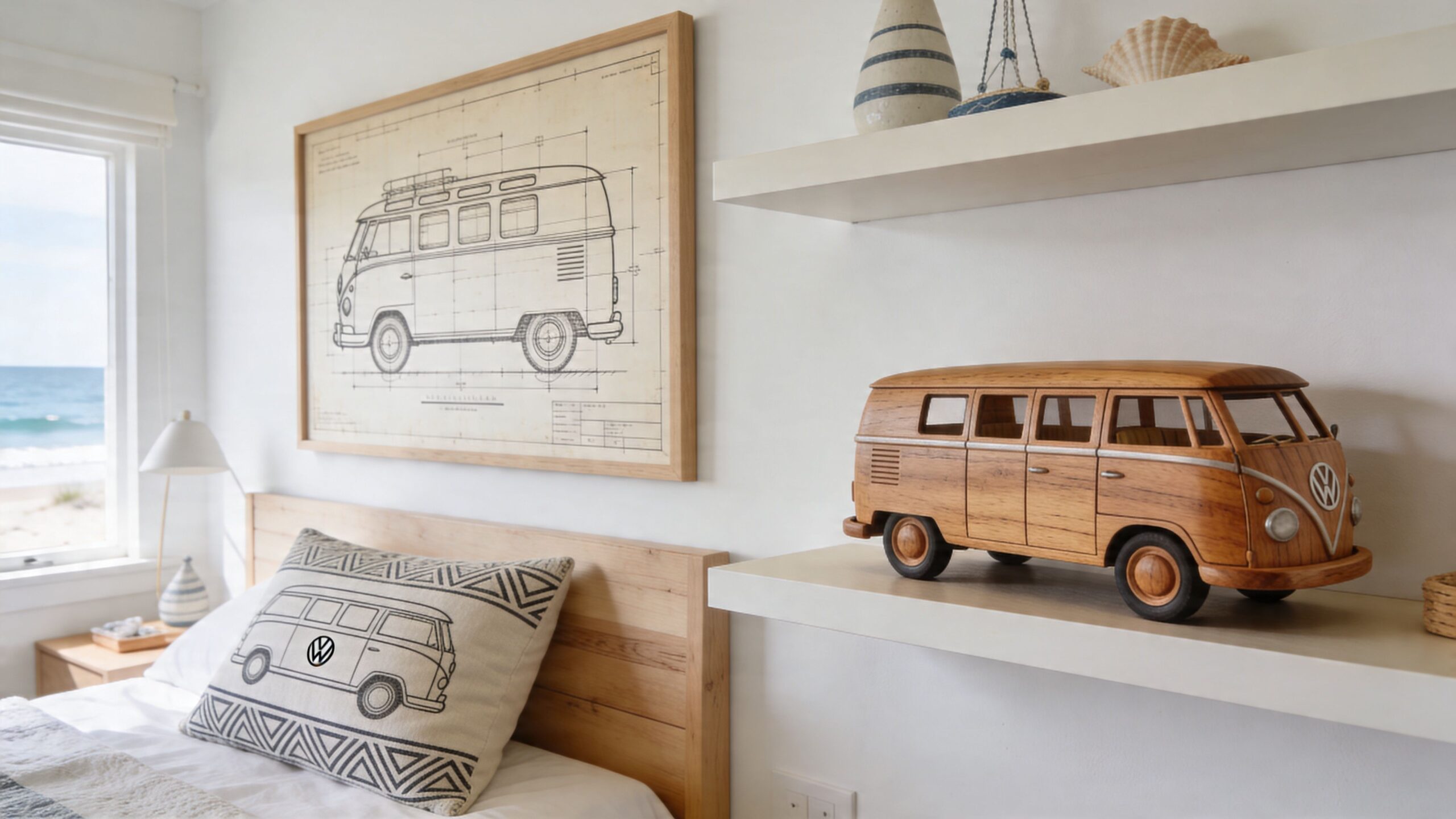
A coastal-themed bedroom featuring Volkswagen van decor, including a framed blueprint, wooden toy model, and decorative pillow.

Treat diecast models like display pieces, not toys

A good diecast Kombi or Beetle can carry a shelf on its own if you style around it properly.

Try a small vignette rather than a row of models. One Samba Bus model, one stack of books, one natural object like driftwood or coral-inspired decor, and one plant. That’s usually enough.

A few combinations that work especially well:

  • Surf shelf. A Kombi model in soft vintage tones, weathered timber behind it, and one framed beach photo.
  • Collector’s bedside display. A single Beetle model on a book stack with a ceramic lamp and no extra clutter.
  • Floating shelf trio. One VW diecast, one shell or stone object, one small artwork.

The restraint is the style.

Match the model to the room mood

Not every VW piece suits every coastal bedroom.

VW item Best room style
1962 Samba Bus diecast Relaxed surf-shack coastal rooms
Flower Power Kombi model More playful, retro coastal spaces
Classic Beetle model Vintage coastal bedrooms with softer tones
VW blueprint or print Cleaner, more pared-back rooms

If your room is calm and neutral, a colourful Kombi can become the feature. If the room already has a few stronger accents, use a cream, white, or pale blue model instead.

Use wall art with more care than you think

Framed VW prints can work beautifully in coastal bedroom decor, but scale matters. One medium print over a dresser often lands better than a whole gallery wall.

Old ad reproductions, surf trip photography, registration plates with patina, and blueprint-style art all tend to feel more grown-up than novelty signs. Keep the frames simple. Timber, white, or muted black usually sits best.

For readers who want to pull together retro accents with home styling pieces, these vintage home accessories show the sort of direction that suits this look without pushing it into kitsch.

A quick bit of moving inspiration always helps spark ideas:

The shelf test I always recommend

Before drilling holes or spreading models around, place your chosen VW items on the bed and remove half of them. Then remove one more.

What’s left is usually closer to the right answer.

If every piece has a story, the room feels personal. If every piece is visible at once, the stories blur together.

That’s the whole point. Your bedroom should hint at years of beach drives, car shows, restorations, and collecting. It shouldn’t scream them all at once.

Layering Textiles and Lighting for That Holiday Feel

A room can have the right paint and furniture and still feel a bit flat. Textiles and lighting fix that. They’re what turn a styled room into one you genuinely want to crawl into each evening.

Keep fabrics breathable and unfussy

For bedding, natural fibres nearly always win. Linen has that slightly rumpled look that suits coastal bedroom decor perfectly. Cotton works well too, especially if you prefer a cleaner finish.

The layered look doesn’t need much:

  • Base bedding in white, sand, or soft blue
  • One textured throw across the foot of the bed
  • Two or three cushions with different weaves rather than loud prints
  • A rug with natural character to stop the room feeling bare

The common trap is over-patterning. Once you’ve got a textured bedhead, a rug, and VW display pieces in the room, bold stripes and busy tropical prints can tip everything into noise.

Curtains should soften the room, not block it off

Heavy drapes fight the whole coastal idea unless you absolutely need full blackout. Sheer linen or light cotton curtains let daylight filter through and make the room feel more alive.

The effect is less about drama and more about atmosphere. Soft filtered light is what gives coastal bedrooms that easy holiday quality.

If you’re into mixing boho softness with beach tones, these boho style room ideas can help with layering without losing the clean coastal base.

Light the room in zones

One ceiling light rarely does the job well in a bedroom. It’s too harsh, and it flattens all the nice texture you’ve added.

Try this instead:

Area Best lighting approach Why it works
Bedside Warm lamp with ceramic, woven, or timber base Makes the room feel settled at night
Reading corner Floor lamp or table lamp Adds a second pool of light
Overall room Soft overhead fitting Useful when needed, not the main mood setter

A woven shade, ceramic lamp base, or timber lamp works especially well because it repeats the materials already in the room.

Soft light makes texture visible. Harsh light wipes it out.

That’s one of the biggest differences between a room that feels like a retreat and one that feels like a spare room with decent furniture.

Conclusion Your Coastal Escape Awaits

A well-done coastal bedroom decor scheme doesn’t need to be fancy. It just needs to feel honest. Light colours, natural materials, breathable fabrics, and a few carefully chosen VW touches can turn an ordinary room into something with real character.

That’s the charm of this look for Volkswagen enthusiasts. It connects two things that already belong together in Australia. Beach living and old VWs both carry that relaxed, slightly nostalgic spirit. Put them together with a bit of discipline and the room starts telling your story without looking staged.

If you’re reworking your own space, keep the order simple. Start with colour. Choose furniture with texture. Layer the bedding and lighting. Then bring in the Volkswagen pieces that mean something to you.

The final result should feel like your own beach escape. Calm enough for sleep. Personal enough to make you smile every time you walk in.

FAQ Your Quick Questions Answered

How can I use coastal bedroom decor in a small bedroom

Keep the palette light and the furniture visually open. White or sandy walls help the room feel less boxed in. Floating shelves work better than bulky cabinets if you want to display a Kombi or Beetle model without eating floor space.

Mirrors can help too, especially opposite a window or beside a dresser, because they bounce light around the room.

What are some budget-friendly coastal styling ideas

You don’t need a big spend to get the look moving. Repaint an old bedside table in a soft coastal shade. Hunt for second-hand rattan, cane, or light timber pieces. Frame your own beach photos or old VW event snaps rather than buying expensive art.

A lot of coastal character comes from texture, not price. New pillow covers, a natural fibre rug, and better curtains can shift the room fast.

How do I protect diecast models in a coastal environment

Humidity is the thing to watch near the coast. If you’ve got valuable or sentimental diecast pieces, a glass-fronted cabinet is the safest option because it reduces dust and moisture exposure.

If you prefer open shelving, make sure the room is well ventilated and keep the display away from damp corners or direct salt-heavy airflow. A soft brush for regular dusting helps, and discreet moisture absorbers can be useful behind shelves or inside cabinets.

How much VW memorabilia is too much for a bedroom

When the room starts feeling like a display room instead of a place to rest, you’ve gone too far. Most bedrooms benefit from a few standout pieces rather than a full collection dump.

Choose the models or prints with the strongest story and rotate the rest seasonally if you like.


If you’re ready to finish the room with the right pieces, have a look through Volkswagen Memorabilia. It’s a great spot for licensed VW diecast, Kombi and Beetle collectibles, and beach-friendly decor accents that suit this laid-back Australian look. Local stock and fast shipping make it easier to style the room without waiting ages, and the range suits both serious collectors and anyone after a thoughtful VW-themed gift.