

A sun-faded Kombi rolled past me on the Great Ocean Road one bright morning, white roof, coloured body, surfboard up top, windows open to the salt air. Everyone turned to look, not because it was loud or flashy, but because a vw travel van still carries the kind of magic modern traffic rarely does.
That feeling is why these vans never really left us. They just changed shape, from road-trip companion to restoration dream to diecast treasure on a shelf.
The Enduring Call of the Open Road
I still reckon the best place to understand a Kombi is not in a museum. It is out in the sun, parked near the coast, with sandy thongs on the grass beside it and someone leaning inside for a thermos or an old wax tin.
The old van does not need to say much. Its shape says enough. Short nose. Friendly face. Plenty of glass. Room for boards, picnic gear, mates, and a plan that only gets clearer once the road starts unwinding.
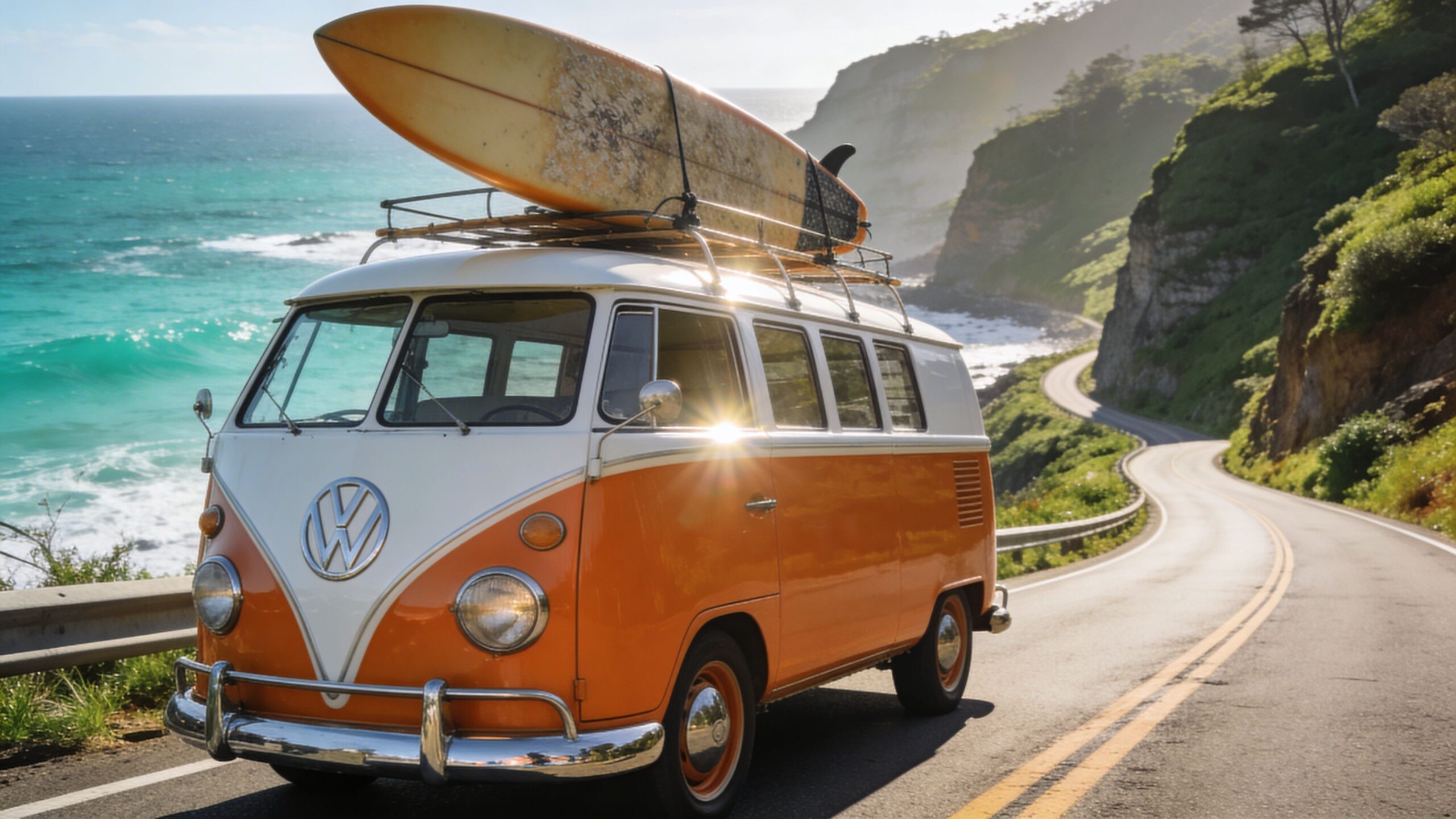
Along Australian coastlines, the vw travel van became more than transport. It became a backdrop to first camping trips, surf weekends, market runs, music festivals, and long drives where nobody minded arriving late. That is also why so many people who may never own a full-size Kombi still feel drawn to the shape, the colours, and the story behind it.
A lot of enthusiasts first fall in love with the idea before they ever touch the metal. They spot a split-screen at a local show. They hear stories from a parent who once slept in one near Byron. Or they stumble across old van-life nostalgia like this look at van life in Australia, and suddenly the appeal clicks.
Why this van still gets under your skin
Some classics impress you with speed. The Kombi wins people over differently.
- It feels welcoming. The face of an old VW van looks cheerful, almost human.
- It invites a slower pace. You do not think about lap times. You think about coast roads and bakery stops.
- It suits Australian memories. Beaches, road trips, hand-painted signs, and a bit of harmless chaos all fit the Kombi beautifully.
A classic VW van does not just remind people of travel. It reminds them of the kind of travel where the journey was the whole point.
That is why the Kombi sits in such a sweet spot. It is practical history, surf culture, design icon, and memory machine all at once.
From Wolfsburg to Wollongong The History of the VW Van
At a country show near Wollongong a few summers back, an old fellow stood beside a dove-blue Kombi and tapped the bonnet with a grin. He said his dad used one for work during the week, then packed the kids in on Friday and headed for the coast. That is the magic of the VW van story. It began in Germany as a practical little hauler and ended up stitched into Australian family lore, then later into the shelves and display cabinets of collectors who wanted to keep a piece of that feeling.
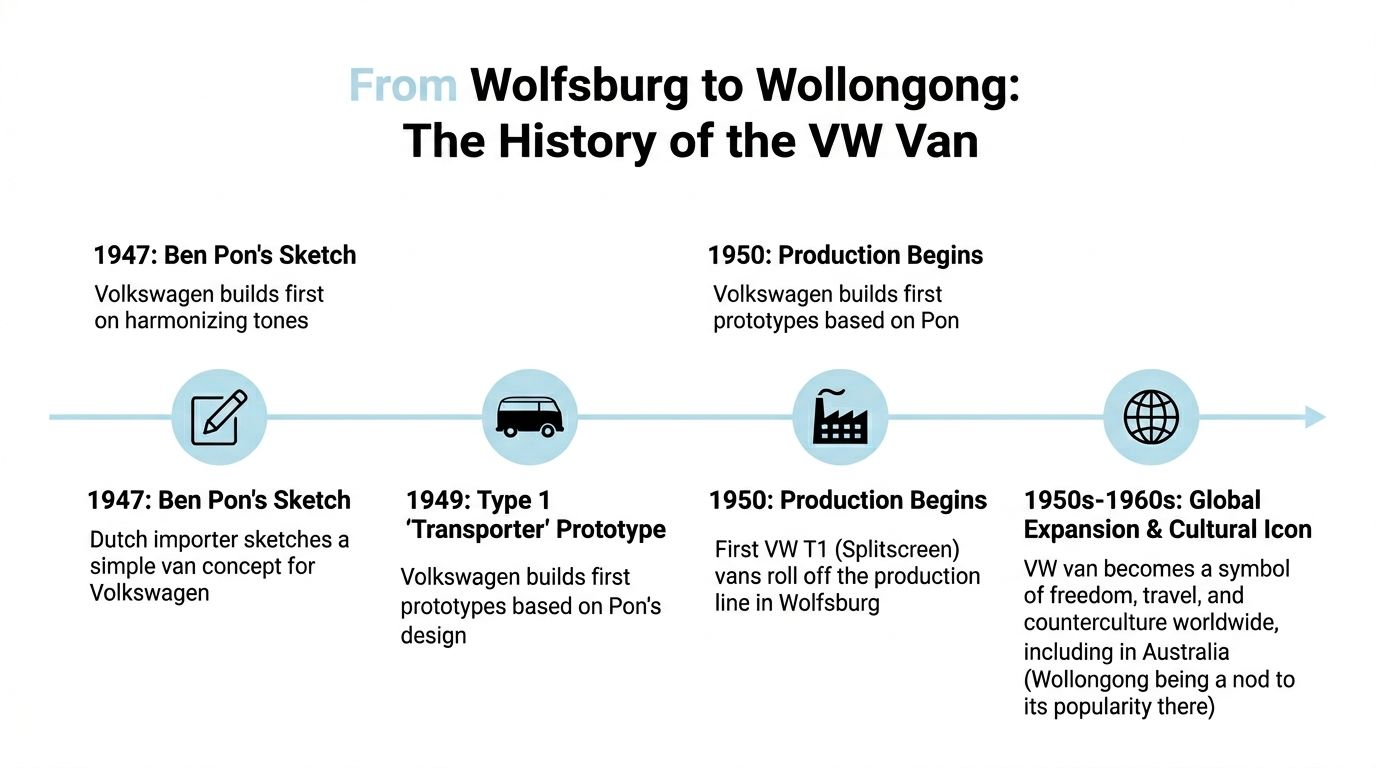
The first spark came in 1947, when Dutch importer Ben Pon sketched a simple van after seeing motorised trolleys at the Wolfsburg factory. That sketch became the Type 2 Transporter, and the first production example rolled off the line on March 8, 1950, in dove blue, with output starting at 10 vehicles per day before rising quickly, as noted in this history of the Volkswagen Type 2 Transporter.
The early years that shaped the legend
What made that first Transporter special was not flash or speed. It was usefulness. A baker could run deliveries in one. A tradie could load tools in another. A growing family could fit everyone inside and point the nose toward a holiday park.
Volkswagen saw demand build fast in those first years, and by October 9, 1951, the company had delivered its 100,000th Transporter. For a van born from a factory-floor sketch, that was a mighty result.
Collectors still chase those early details because they tell the whole story at a glance. The split windscreen, the upright nose, the uncluttered sides, the friendly face. A full-size Kombi turns heads at a servo. A good diecast version does much the same on a study shelf. The shape carries history beautifully.
Why Australia took to it so naturally
The T1, later nicknamed the Splittie, reached Australia in the early 1950s and settled in quickly. It suited the places Australians went. Beach towns. Country roads. Busy suburban trades. Long weekends that started with an esky, a map, and a bit of optimism.
Here, the van earned its stripes through everyday use before it became an object of nostalgia. Builders used them. Families holidayed in them. Local travellers adapted them for sleeping, cooking, and hauling gear. That lived-in history is part of why the VW van now has such strong appeal as memorabilia. People are not collecting a random old vehicle. They are collecting a memory of movement.
The camper side of the story grew early too. Westfalia conversions began in 1951, helping turn the humble Transporter into a machine for roaming. Australian owners and coachbuilders soon put their own spin on the idea with practical interiors and touring setups suited to local conditions. For readers who enjoy that chapter, this look at Volkswagen Transporter camper history is a lovely rabbit hole.
The upgrades that helped it cross long Australian miles
A van does not become beloved in Australia by looking pretty in a brochure. It has to cope with distance.
In 1954, engine displacement increased, helping reliability on longer trips. Production also moved to Hannover that year, opening the door to broader production and more body styles. Those changes mattered here. Australian owners needed a van that could handle work on Monday and a proper run out of town once the weekend arrived.
By then, the Kombi had already become more than transport. It was a working vehicle, a holiday companion, and, years later, a collectible shape people wanted to own in any form they could find, full-size, restored, weathered, or cast in miniature.
| Milestone | Why enthusiasts still care |
|---|---|
| 1947 sketch by Ben Pon | It shows the van began as a clever, human-scale idea |
| 1950 production launch | This marks the birth of the production VW travel van |
| 1951 100,000th delivery | Proof that the design connected early and fast |
| 1954 upgrades and Hannover move | Better durability and broader model variety |
| Early Australian imports | The start of the Kombi’s local identity |
The Kombi gave Australians something rare. A vehicle useful enough for ordinary life and charming enough to become a treasured model long after the original vans had parked up.
Icons of an Era Notable VW Van Models
I still remember a fellow at a car show in Kiama holding a tiny blue-and-white Samba in one hand and pointing to the full-size Kombi he had parked under a gum tree with the other. Same paint break. Same little roof windows. Same grin. That is the magic of the VW travel van story. These machines live twice, first on the road, then on the shelf.
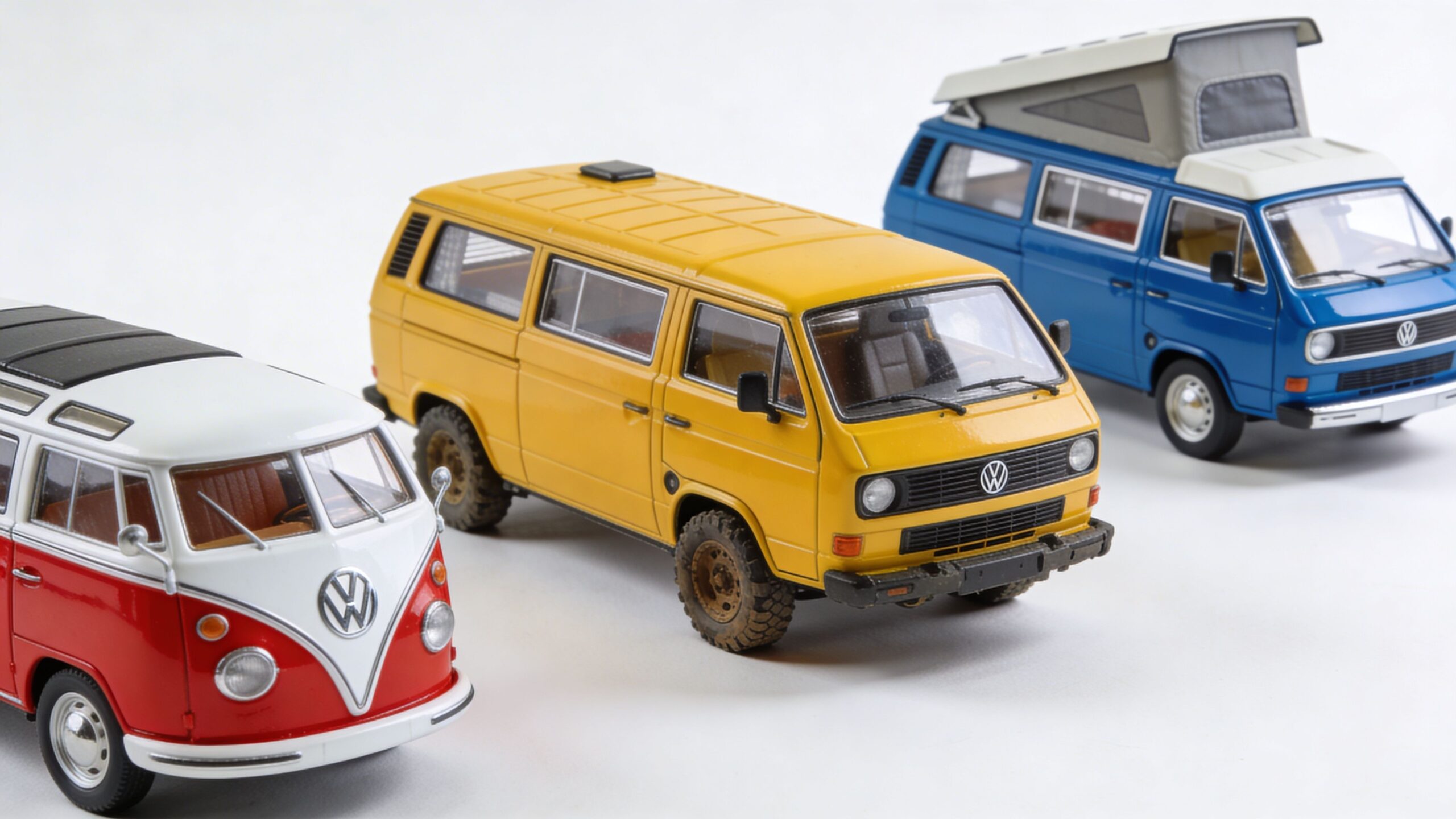
A few models always draw the crowd. The T1 Splittie has that friendly face everybody knows. The Samba Bus brings the sparkle and showroom glamour. The Westfalia-style camper carries the dream of waking up near the beach with the kettle on and the back doors open to the sea.
By 1967, more than 1.2 million T1 units had been produced globally since 1950, a measure of just how far the shape had travelled from German factory floors to Australian roads and, later, to collectors’ cabinets, as described in this history of the VW camper van.
The T1 Splittie
The T1 Splittie looks cheerful even standing still. Its split windscreen, centre bar, and neat V-shaped nose give it a face that no other van quite matches.
That mattered in Australia. Plenty of early vans began life as workers. They hauled tools, bread trays, parts, camping gear, whatever the week demanded. Then a new owner would fit curtains, toss in a mattress, and head north or south as soon as summer arrived. That working-to-wandering life is part of why the Splittie feels so honest. It earned its legend.
Collectors love it for the same reason. In miniature, the silhouette is unmistakable from across the room. Even a small diecast captures the upright nose, simple body sides, and that wonderful split screen.
The Samba Bus
If the Splittie is the people’s hero, the Samba Bus is the show pony that still turns heads before the bonnet on anything else has even clicked shut.
The skylight windows and deluxe trim give it a sense of occasion. You can almost see a family rolling along the Princes Highway, kids peering out the roof glass, picnic basket rattling in the back. On the modern collectors’ table, those same details make the Samba irresistible. Two-tone paint, polished trim, and the famous 23-window arrangement give model makers plenty to work with.
That is why a Samba often becomes the centrepiece. A shelf full of diecast Volkswagens looks good. A shelf with a Samba in the middle looks finished.
The Westfalia-inspired camper
The Westfalia-inspired camper changed the van from transport into a travelling little home. Fold-out tables, compact storage, a place to sleep. Suddenly the trip mattered as much as the destination.
That idea landed beautifully in Australia, where long coastal runs and casual weekends away suited the Kombi’s unhurried pace. Plenty of local vans were not factory Westfalias, of course, but they borrowed the spirit. Timber cupboards built by hand. A little stove wedged in neatly. Curtains sewn by someone’s mum or nan. Every conversion told a personal story, and that same character is what makes camper diecasts so appealing now.
A good camper model does more than show a body shell. It brings back the whole ritual of travel.
Later in the article, there is a useful visual reminder of how these shapes translate so well into miniature collecting.
Why these models became collecting favourites
Collectors usually chase the vans that tell their story in a single glance.
| Model | Signature feature | Why collectors love it |
|---|---|---|
| T1 Splittie | Split windscreen | The clearest early Kombi shape |
| Samba Bus | Deluxe window layout | Rich detail and strong display presence |
| Westfalia-inspired camper | Home-on-wheels concept | Captures the feeling of the trip itself |
The best diecast pieces carry more than paint and proportions. They hold memories of surf checks, roadside brekkies, and long Australian miles. For plenty of enthusiasts, that is the bridge between owning a real VW van and keeping a little piece of the journey close at hand.
More Than a Van A Symbol of Aussie Surf Culture
Dawn at Bells Beach used to have its own little procession. Salt in the air, sand already warming underfoot, and a line of Kombis rolling into the car park with boards strapped high and wax melting softly on the dash. One might be pastel blue with sun-faded curtains. Another would wear primer on one door and a hand-painted surf club sticker on the rear hatch. Before the first set arrived, the vans had already told half the story.
That is how the Kombi found its place here. Australians did not need convincing. The van suited a coastal life built around long drives, cheap weekends, and a loose plan that could change with the swell.
Why surfers and travellers made it their own
At the beach, a Kombi was never just transport. It was changing room, gear locker, lunch spot, and sometimes the bed for the night if the session ran long and the camp ground was full. You could hose the sand out later, stack a couple of mals on the roof, and point the nose toward the next break without much fuss.
That usefulness gave the van character, and character turned into culture.
You saw it in the details. Timber racks knocked together in a suburban shed. Old tea towels hung as curtains. Stickers from Wollongong, Byron, Torquay, Margaret River. A Beetle might have been the fun little runabout, but the Kombi was the mate who brought everyone along. It became part of the scenery at surf comps, beach car parks, and lazy holiday runs up the coast.
Plenty of that feeling still lives on at Australian shows and swap meets. Owners talk about their vans the way surfers talk about a favourite board. Every dent has a place name attached. Every respray hides another chapter. If you want a good example of how that affection carries into collecting, the stories behind classic VW diecast models and memorabilia make the connection plain enough.
The community behind the romance
Anyone who has spent time around old Volkswagens knows the romance comes with skinned knuckles and patient waiting. A bloke in Newcastle might spend months chasing the right indicator housing. Someone in Geelong might find the missing trim piece only after a call from another owner who remembered a dusty box at the back of a wrecking shed. That is the true heartbeat of the scene. People helping people keep these vans on the road.
The surf link matters because it gave the Kombi its most recognisable Australian image. The simpler reason it lasted is this: It welcomed a certain kind of person. The easy-going traveller. The surfer who packed light. The family happy to trade speed for stories.
That same affection explains why the Kombi shrinks so well into a collectible. A diecast Splittie with a roof rack and two-tone paint does more than copy sheet metal. It captures a whole Australian memory. Beach towels on the line, boards rattling overhead, and the long scenic road home with the windows open.
Building Your Collection A Guide to VW Diecast Models
Most of us do not have the shed space, budget, or patience for a fleet of full-size Volkswagens. Diecast collecting solves that neatly. You still get the shape, the colour, the nostalgia, and the grin every time you walk past the display.
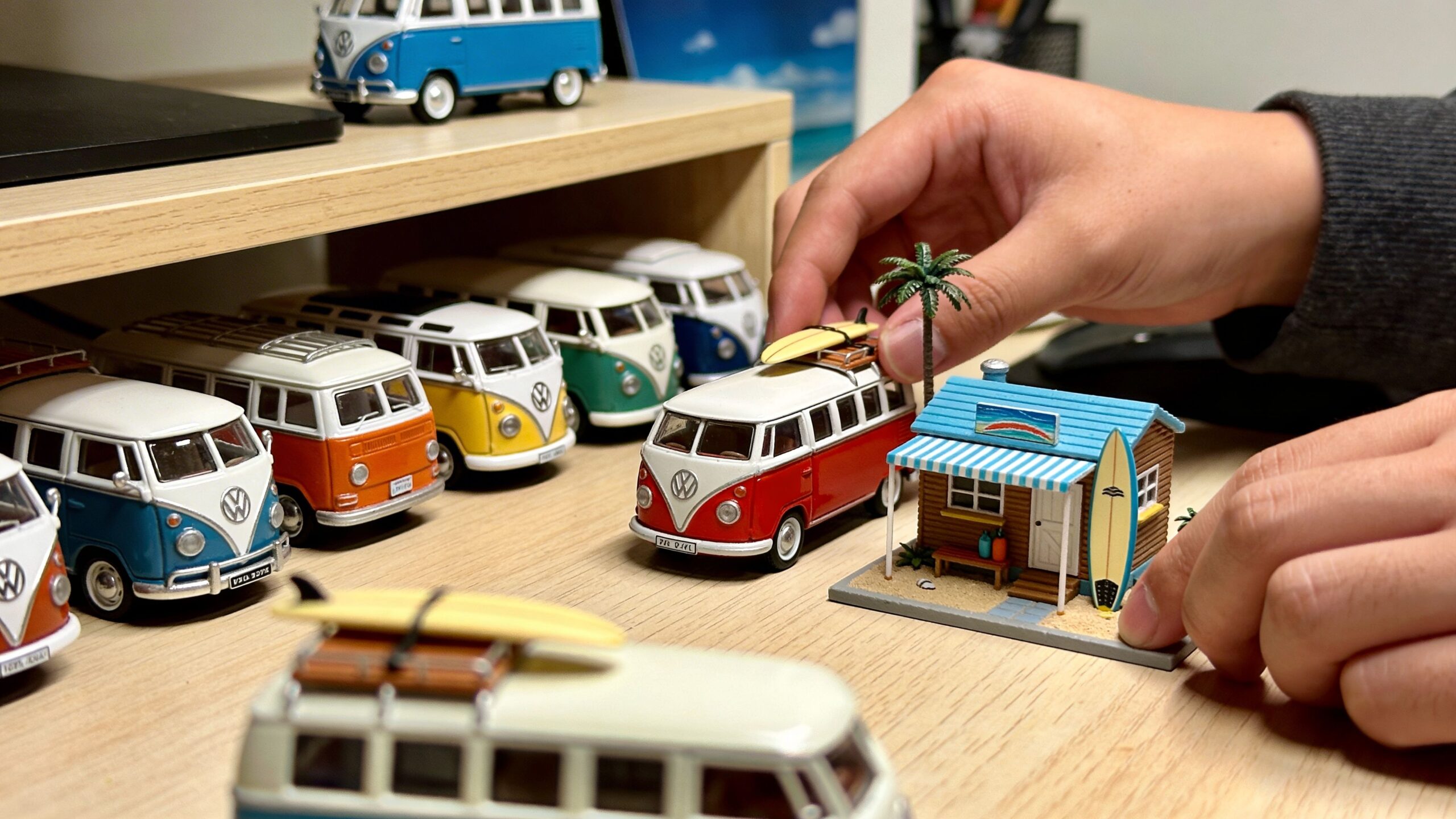
There is another reason diecast resonates so strongly with Kombi fans. Even though the 2024 Volkswagen Transporter Base delivers 250 Nm of torque, collector passion still leans toward the original air-cooled vans because nostalgia and design heritage carry more weight in memorabilia than modern performance figures, as outlined in this 2024 Volkswagen Transporter Base review.
What makes a VW diecast model worth buying
Not every miniature earns a spot in the cabinet. Some look toy-like. Others capture the soul of the vehicle itself.
A good collector piece usually gets these things right:
- Licensed shape accuracy. The nose, roofline, windows, and stance should look unmistakably Volkswagen.
- Clean paintwork. Two-tone Kombis and Beetles need crisp separation, not fuzzy edges.
- Useful detail. Roof racks, bumpers, wheels, mirrors, and interior colours should feel considered.
- Character. A Samba should look deluxe. A surfy van should have charm, not clutter.
For newcomers, reading a bit more about diecast collecting basics helps make the first purchases more satisfying.
Choosing between Kombi and Beetle models
A lot of collectors think they must choose one lane. You really do not.
The best small collections often mix body styles because each model brings a different mood.
| Style | Best for | Display personality |
|---|---|---|
| Kombi or Samba Bus | Coastal, surf, van-life themes | Relaxed, social, colourful |
| Volkswagen Beetle model | Classic motoring nostalgia | Friendly, iconic, timeless |
| Camper conversion models | Travel storytelling displays | Adventure-focused and playful |
If you want a centrepiece, a 1962 VW Kombi or Samba Bus replica is hard to beat. If you want an easy entry point, a Beetle often fits smaller shelves and desks beautifully.
How to start without overthinking it
Collectors usually do better when they buy with a theme in mind. Random purchases can be fun, but a theme gives your display personality.
Three easy approaches work well:
Go by era
Build around early classics. Splittie, Samba, Beetle, and a flower-power style van make a cohesive vintage set.Go by colour
Coastal palettes look great in a home office or living room. Cream, blue, red, mint, and orange all suit VW shapes.Go by story
Pick pieces that remind you of travel. A camper van, a surf van, a Beetle for town days, maybe a bus with a roof rack to tie it together.
The best collection is not the biggest one. It is the one that looks like your own memories and tastes.
What to inspect before you click buy
Inspect before you click buy. Practical buying advice saves disappointment.
- Look closely at windows and trim. Poorly fitted clear plastic or wonky chrome can spoil an otherwise nice model.
- Check wheel stance. A Kombi should sit square and balanced.
- Review scale and shelf space. Larger scales bring more detail, but they need room to breathe.
- Choose local stock when you can. Australian buyers usually prefer avoiding the uncertainty that can come with overseas sourcing, especially for gifts or time-sensitive purchases.
Display ideas that make the collection sing
You do not need a giant cabinet to make Volkswagen diecast models for sale look brilliant at home.
Try these:
- A coastal shelf with a Kombi, a small framed beach print, and a piece of driftwood.
- A desk setup anchored by a Volkswagen Beetle model for a daily hit of colour and nostalgia.
- A mixed-scale cabinet where a larger Samba takes centre stage and smaller vans support it.
- A gift corner where boxed models stay pristine until birthdays or Father’s Day roll around.
Some collectors chase rarity. Others chase feeling. With VW pieces, feeling often wins, and rightly so.
Beyond the Garage Styling Your Home with VW Charm
A Volkswagen-inspired home does not need to look like a workshop. In fact, the best VW decor usually works because it feels lived-in, relaxed, and personal.
A well-chosen Kombi model can do more than fill space on a shelf. It can set the tone for the whole room. The colours bring warmth. The shape adds softness. The nostalgia makes the space feel welcoming rather than staged.
Where VW pieces work best
Living rooms and home offices are obvious spots, but they are not the only ones.
A hallway console can carry a bright little Samba and instantly make the house feel friendlier. A study shelf can use a Beetle model as a splash of colour among books and frames. Guest rooms suit VW decor especially well because the theme feels cheerful without demanding too much attention.
Pairing VW style with coastal decor
The Kombi and the Australian coast are old mates, so the styling connection feels natural.
Try pairing VW memorabilia with:
- Weathered textures such as timber, woven baskets, or whitewashed surfaces
- Beachy accents like shells, soft blues, sandy neutrals, and framed seaside prints
- Retro touches including old travel tins, simple ceramic vases, or vintage-look signs
A bright red or two-tone van can work as the hero piece, while softer decor around it keeps everything balanced.
Why diecast works as decor
A diecast model has an advantage over larger themed decor. It tells the story quickly and cleanly.
One quality piece on a shelf can suggest travel, design history, surf culture, and personal memory all in a glance. That makes it ideal for people who love Volkswagen heritage but still want a tidy, stylish home.
A classic VW model earns its place in a room because it is both object and conversation starter.
Metal wall art and other vehicle-inspired decor can support that look nicely, but the miniature van often does the emotional heavy lifting. It is small, but it carries a big story.
Your VW Journey Starts Here
The Kombi’s journey began with a factory sketch and ended up woven into road trips, surf memories, restoration sheds, show grounds, and collectors’ shelves. Few vehicles travel that far in meaning.
The vw travel van still resonates because it joins useful design with optimism. It looks approachable. It invites adventure. It reminds people that travel does not have to be rushed to be worthwhile.
For some enthusiasts, that journey means chasing a full-size project. For others, it means finding the perfect VW Kombi diecast Australia collectors talk about, or tracking down a Volkswagen Beetle model that brightens a desk or display shelf. Both paths are part of the same affection for Volkswagen shape, history, and spirit.
If you have ever paused at a split-screen at a show, smiled at a Samba rolling past, or searched late at night for Volkswagen diecast models for sale, you already know the pull. The story sticks.
Sometimes owning the dream at full scale is not the point. Sometimes holding a beautifully made version of it in your hand is enough to keep the road alive.
Your VW Van Questions Answered
A bloke at a swap meet in Ballarat once held up a tiny two-tone Kombi and laughed, “Cheaper than restoring the one I sold in 1998, and a lot easier to dust.” That is the heart of these questions. For some Australians, the VW travel van is a machine with sun-faded paint and surf wax in the floor grooves. For others, it is a beautifully made diecast model on a shelf, keeping the same dream alive in smaller form.
What does “vw travel van” usually mean in Australia
In Australian VW circles, “vw travel van” usually points to the Volkswagen Type 2 family. People use it for Kombis, campers, beach vans, and road-trip buses in general. Depending on who is telling the story, it might mean a split-screen T1, a deluxe Samba, or a later camper fitted out for weekends up the coast.
Why is the Samba Bus so collectable
The Samba wins hearts quickly. Those extra skylight windows, the two-tone paint, and that cheerful face give it the sort of presence that stops people in their tracks at shows.
It also carries a bigger story. The Samba came to represent scenic drives, family holidays, surf checks, and the golden age of unhurried travel. In diecast form, all those little visual touches, window lines, trim, roof details, make it one of the most satisfying VW models to collect.
Is a diecast Kombi a good gift for a VW fan
Yes. It suits longtime collectors, former Kombi owners, Beetle lovers, and anyone who wants a dash of vintage VW character at home or in the office.
A full-size van asks for shed space, time, money, and patience. A licensed diecast Kombi gives the same grin in a package small enough for a bookshelf. That is a big part of its charm.
Is restoring a real Kombi easy in Australia
Restoring an original Kombi can be rewarding, but easy is not the word many owners would use. Rust repair, missing trim, specialist parts, and labour bills can turn a simple plan into a long-haul project.
That gap between dream and reality is one reason memorabilia matters. A good model car lets someone celebrate the shape, colour, and memories of a beloved van without spending years chasing panels and seals.
Are classic petrol VW vans still better than the ID. Buzz for rough outback touring
That depends on the trip, the support available, and what you expect from the vehicle. The linked ID. Buzz camper review covering the Australian reliability angle presents the review author’s view that the ID. Buzz camper suits sealed-road touring and lighter adventure use more naturally than hard, remote outback travel.
Classic petrol VW vans have their own limits, of course, but their old-school mechanical simplicity is part of why so many enthusiasts still romanticise the T1 and T2. That affection carries straight into the collectibles market, where the older vans remain the stars of display cases and gift tables.
What should a beginner collect first
Start with the one that makes you stop scrolling.
For plenty of collectors, that is a Samba in cream and red, or a surf-themed Kombi that looks like it belongs outside a weatherboard beach shack. For others, the first spark comes from a Beetle that reminds them of a parent, a first car, or a family holiday photo. Buy the model that stirs a memory first, then pay attention to build quality, scale, and licensing.
If you are ready to bring that road-trip spirit home, explore Volkswagen Memorabilia for officially licensed VW-themed gifts, Kombi and Samba Bus diecast models, Beetle collectibles, and coastal decor that suits Australian enthusiasts, collectors, and gift buyers alike. Local stock and friendly support make it an easy place to find a piece that feels like your own little slice of VW history.