

A Beetle at the far end of the paddock, the bonnet up, the sausage sizzle going, and someone spots that sharp smell of hot wiring. That is the moment a fire extinguisher for cars stops feeling like spare kit and starts looking like the thing that might save a weekend, and maybe the car too. In Australia, private cars generally do not have to carry one, but motorhomes and caravans are different because of extinguisher requirements under ADR 44/01.
For classic VW owners, that practical side matters straight away. A Beetle engine bay, a Kombi cargo area, or a Samba Bus full of treasured trim can turn a small flare-up into a costly mess if the extinguisher is buried under bags or wedged where nobody can reach it in time. If your VW has had modern touring gear added, it also makes sense to check a few related safety points, including the slimline lithium battery safety checklist, so the setup stays sensible as well as nostalgic.
Why Every VW Owner Needs a Fire Extinguisher
A Beetle owner at the far end of a grass field notices smoke curling from the engine lid, and the first thought isn't compliance, it's preservation. That's the heart of it. When you've spent years keeping an old Volkswagen alive, a small, contained fire is not just a safety issue, it's a question of whether the car drives home or goes onto a tow truck.
Car fires can move fast. One Australian safety guide notes they can double in size every 60 seconds (car fire extinguisher guide), which is why the effective strategy isn't heroic firefighting, it's having the right extinguisher within arm's reach and knowing when to back off. The advice is to use it only on something small and contained, then evacuate if the fire is already spreading.
Practical rule: if you'd need to open the bonnet, boot, or rear hatch and the smoke is already building hard, your best move is usually to get everyone clear and call 000.
For VW drivers, the old-school layout changes the stakes. A Beetle's rear engine, a Kombi's tight packaging, and years of road-trip clutter mean a loose extinguisher in the wrong spot can be useless at the exact moment you need it. That's why many owners think of it the same way they think about a good jack, a spare belt, or a clean service book, part of the car's survival kit, not an accessory.
Types of Fire Extinguishers Suitable for Cars
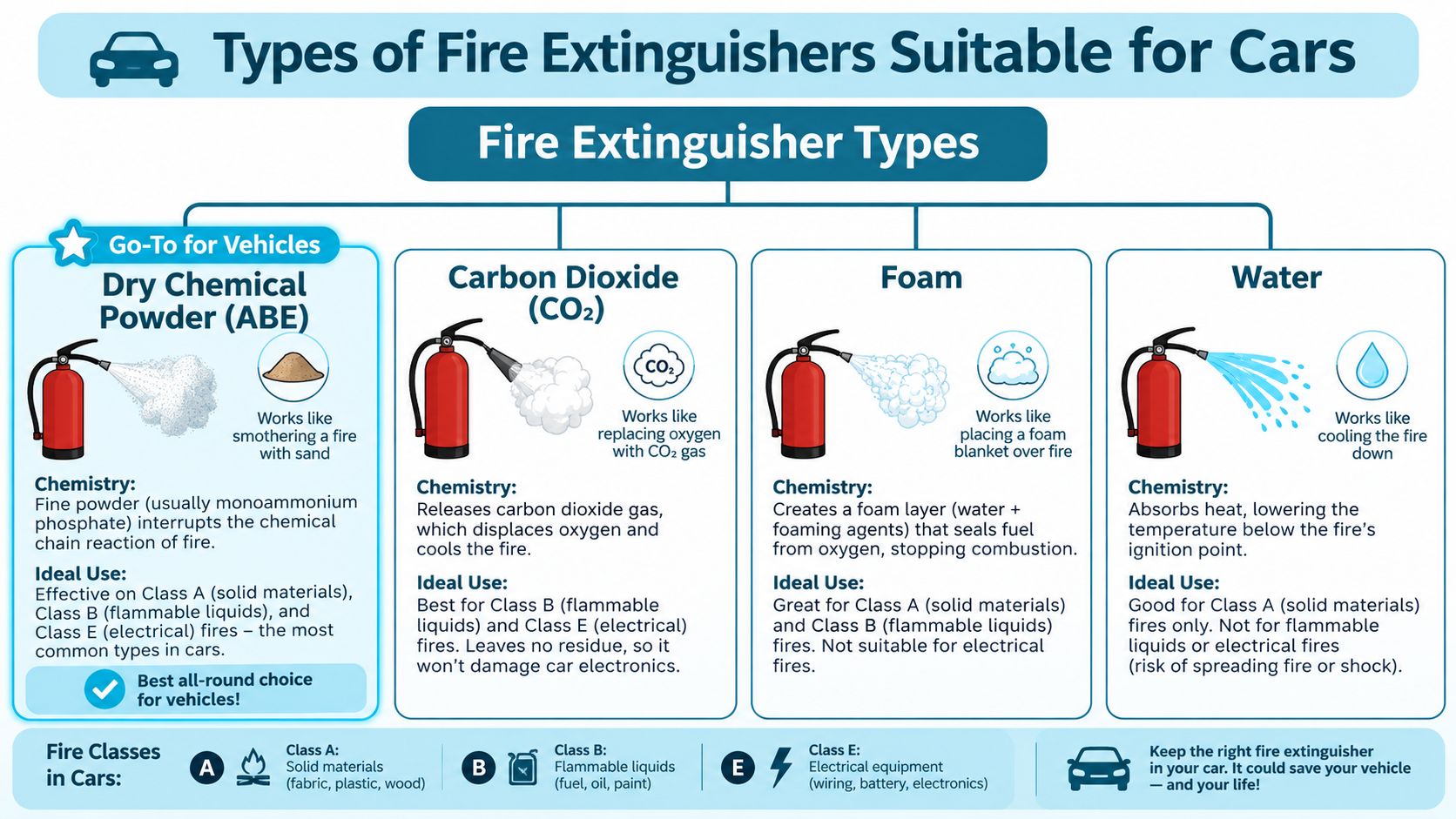
A car extinguisher has to handle a mixed bag of risks. In a VW, that can mean wiring faults, fuel vapour, upholstery, or a hot engine bay, so the agent inside matters more than the label on the front. For Australian vehicle use, dry chemical powder is the common fit because it can deal with several fire types and is easy to keep in the cabin, as noted in Australian vehicle extinguisher guidance.
Dry chemical powder
Dry chemical powder works by interrupting the fire's reaction and covering the flames, a bit like dropping a controlled cloud right over the burn zone. For cars, ABE models are the usual pick because they suit Class A, B and E fires, which covers ordinary combustibles, flammable liquids, and energised electrical hazards. For a Beetle with ageing wiring or a Kombi carrying holiday gear and fuel fumes nearby, that broad coverage makes practical sense. Australian guidance also points to a 1 kg or 1.5 kg dry chemical powder extinguisher as a common vehicle choice because it is compact and suited to the mixed risks found in vehicles (Australian extinguisher market and vehicle context).
Carbon dioxide
CO₂ leaves no powder residue, which sounds tidy, especially around electrical parts or a dashboard full of old trim. It can suit sensitive equipment, but a classic VW usually needs something that covers a wider spread of possible fire sources. In a rear-engined car, a clean gas discharge alone is often a narrower tool than you want on a roadside stop.
Foam
Foam makes a blanket that helps separate fuel from oxygen. That helps on liquid fires, but a vehicle fire is often a mixed problem, not a neat fuel spill in a workshop. For a Kombi loaded up for a surf run, foam is useful in some settings, yet it is not the most flexible choice for the car itself.
Water
Water cools the fire, and on the right material that is exactly what you want. In a car, though, it has limits because it does not suit electrical faults or fuel-related flare-ups, so it is not the practical pick for classic VW touring. If you are dealing with a Beetle engine bay or a Kombi wiring issue, water is usually the wrong tool for the job.
Bottom line: for roadgoing Volkswagens, ABE dry chemical stays the strongest all-round choice because it gives the broadest usable coverage in a small package.
Reading Ratings and Certifications
Australian extinguisher labels can look like a jumble of letters unless you know what to read. The simplest way is to treat the letters as the fire family, and the number as the unit's practical scale. For vehicle use, the important bit is that the extinguisher is built to Australian expectations rather than chosen from generic overseas advice, because AS 2444 is the local reference for portable extinguishers and hose reels, including vehicle applications.
| Extinguisher Class Ratings | Risk Type | Real-World VW Example |
|---|---|---|
| A | Ordinary combustibles | Seat trim, carpet, cardboard service records |
| B | Flammable liquids | Petrol around a fuel line, fuel drips near the engine bay |
| E | Energized electrical equipment | Wiring fault behind the dash, ignition-related electrical issue |
What matters in a classic VW is matching the extinguisher to the kind of problem you're likely to face, not the kind you hope never happens. A Beetle with ageing wiring and a Kombi with long-road-trip fuel heat soak are different from a kitchen or workshop, so the label should reflect vehicle risk, not just general household use.
The certification side is just as important. An extinguisher can look brand new and still be the wrong type, the wrong size, or not suited to the vehicle environment. That's why local compliance matters, and why checking for AS 2444 alignment is a smarter move than trusting a bargain import with a fancy sticker.
Selecting the Right Size for Your VW Beetle or Kombi
A Beetle cabin and a Kombi cabin don't give you the same storage freedom, so size choice is really about access and reach, not just capacity. Australian guidance points to 1 kg to 1.5 kg ABE dry chemical extinguishers for in-car use, with the unit mounted where it's easy to grab, because cargo-area storage slows you down when seconds matter (size and mounting guidance).
Beetle first, Kombi second
For a Volkswagen Beetle model, a 1 kg unit usually makes sense because the cabin is tight, the mounting space is limited, and the aim is quick access rather than extra bulk. A 1.5 kg extinguisher can suit a Kombi better, especially when the van's carrying more gear, more passengers, or a full weekend load of chairs, tools, and camping bits.
Here's the simple comparison:
- 1 kg unit: lighter, tidier, easier to tuck under a seat in a Beetle.
- 1.5 kg unit: more reassuring for longer road trips in a Kombi, with a bit more capacity before the bottle is empty.
- Either size: only works if you can reach it fast without unloading half the interior.
A good rule for VW owners is to think about where your hand naturally goes in a hurry. If the extinguisher sits in the boot under luggage, it might as well be in the garage. If it's under the front passenger seat or another clear, fixed spot, you've got a chance to act before the fire changes shape.
Mounting and Storing in Your VW Safely
An extinguisher that slides around the cabin isn't safety gear, it's a loose object waiting for a sharp stop. Australian vehicle-fire guidance says the unit needs to be quickly accessible from the driver's seat and secured so it can't become a projectile while you're driving. That's the same common-sense approach most VW owners already use for tools, speakers, and spare parts.
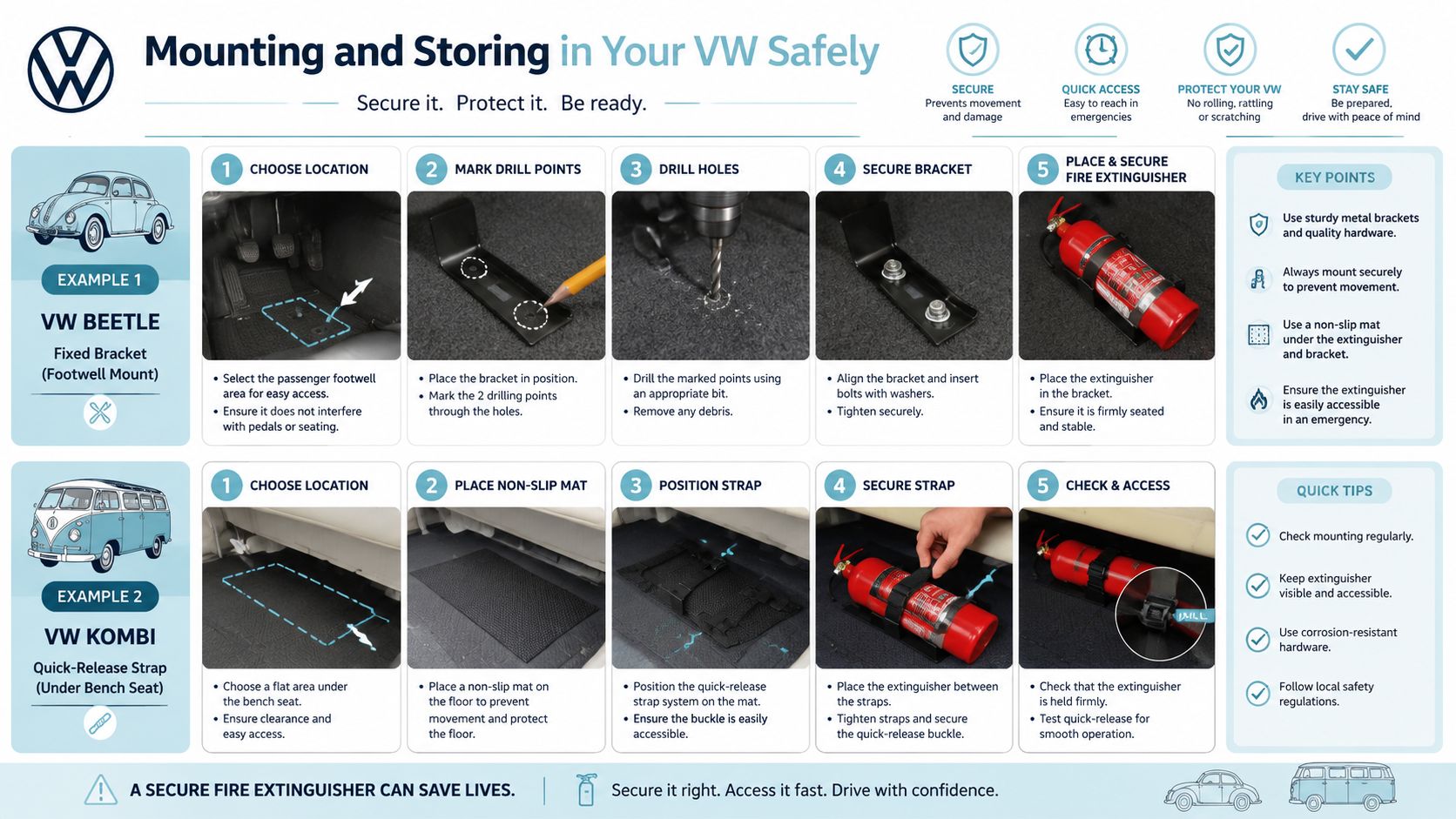
A Beetle and a Kombi need different mounting logic
A Beetle usually works best with a bracket in the footwell or another low, fixed location where the driver can reach it without twisting around. A Kombi gives you a bit more flexibility, so a quick-release strap under a bench seat can work well if it stays firmly clipped and doesn't interfere with passengers or luggage.
The right mindset is simple:
- Choose a rigid mount: use a proper bracket or strap system that keeps the extinguisher from rolling.
- Keep the path clear: don't bury it behind boxes, picnic gear, or spare parts.
- Test the reach: sit in the driver's seat and make sure you can grab it fast.
- Protect the interior: use a neat, fitted solution that suits the car's look without sacrificing function.
A clean mounting point under the front passenger seat is usually better than a prettier spot in the boot.
If you're the sort of owner who likes a tidy cabin, the bracket should feel like part of the car, not an afterthought. A practical accessory approach works nicely alongside restoration thinking, and a mounting idea similar to a high lift jack bracket setup can help you think about secure, fixed storage without cluttering the interior.
Using Your Fire Extinguisher with PASS Method
When a Kombi engine bay starts to flare, the best response is calm, fast, and low to the ground. The PASS method is the standard approach, and it's simple enough to remember even when your pulse is up. Use it only on a small fire you can reach, then stop if it isn't going out quickly.
The sequence is straightforward:
- Pull the pin. Break the seal and get the extinguisher ready.
- Aim at the base. Don't chase the flames at the top, aim where the fire is feeding.
- Squeeze the handle. Start the discharge in a controlled way.
- Sweep side to side. Cover the burning area evenly.
A few practical habits make a big difference. Stay low to avoid smoke, keep a safe distance from hot panels, and don't stand in front of a bonnet or hatch that can throw heat back at you. If the fire doesn't respond quickly, or you can see it spreading beyond a small contained area, get everyone out and call 000.
Practical rule: use the extinguisher for the first minute of a small fire, not for a full engine-bay blaze.
Maintenance and Inspection Tips
A car extinguisher only helps if it's still serviceable when you need it. Check the pressure gauge, the safety pin, and the seal on a regular basis, and give the cylinder a visual look over for dents, corrosion, or anything that looks out of place. If the unit has powder residue, clean the surrounding area so you're not mistaking old dust for a fresh leak.
Your monthly routine doesn't need to be fancy.
- Read the gauge: make sure it's in the normal range.
- Check the pin and seal: they should be intact and secure.
- Look at the cylinder body: watch for wear, rust, or damage.
- Confirm the mount: it should still be tight and not wobbling.
For a classic VW, there's one extra sanity check. Make sure stray powder hasn't coated anything important under the dash or around brake lines, because tidy storage is part of safe ownership. If you keep a restoration diary, service book, or digital log, record each check so you don't lose track of the unit's condition, and if you're using a proper logbook style record, the Volkswagen service book guide is a handy reminder of how neatly a well-kept car history can be organised.
Frequently Asked Questions
Can you service an old extinguisher canister? Sometimes, yes, but only if the cylinder is still in good condition and a qualified service provider says it's suitable. Will powder damage chrome or trim? It can leave residue, so clean-up matters after use. How long does an extinguisher last? Check the service status and replace or service it when the pin, seal, gauge, or cylinder condition tells you it's time. How do you dispose of an expired unit? Take it to a proper service or disposal point, don't just bin it.
If your Beetle, Kombi, or Samba Bus is part of the family, sort the safety kit before the next drive. Visit Volkswagen Memorabilia to browse VW-themed gifts, diecast models, and memorabilia that keep the passion alive while you gear up for the road.