

I once spent a whole Saturday at a swap meet chasing one tiny Beetle part. Not a door, not an engine lid, just the right little switch for a mid-sixties dash, and when it finally turned up in a dusty tray under a trestle table, it felt like striking gold.
That’s the funny magic of volkswagen beetle parts. You start by looking for something practical, then somewhere between the coffee van, the old blokes swapping stories, and the familiar shape of a Bug nose peeking from behind a stall, you realise you’re not only fixing a car. You’re keeping a memory alive.
That Feeling When You Find the Perfect Part
Every Beetle owner knows the difference between buying a part and finding a part. Buying is quick. Finding has a story attached to it.
At Aussie VW gatherings, the best moments often happen away from the polished show paint. They happen beside boxes of used trim, around the back of a shed, or in a wrecker’s yard where a forgotten Bug still has one useful piece left on it. Someone says, “Have a look in that crate, mate,” and suddenly you’re holding the exact semaphore lens, heater knob, or hubcap clip you’ve been chasing for months.
That’s why Beetle restoration gets under your skin. The car is simple enough to understand, but varied enough to keep you humble. Two parts can look nearly identical on the bench and still be wrong for your car. A bumper bracket might sit a touch differently. A carburettor might suit one engine but not another. A tail light housing might fit the guard but not match the year.
Why the hunt matters in Australia
The Australian experience adds its own flavour. We’ve had imported cars, local dealer histories, mixed parts streams, and plenty of old Bugs that have lived hard lives near salt, sun, and rough roads. That means your Beetle may not match a generic overseas guide perfectly.
A local owner often learns fast that the best answers come from three places:
- Club knowledge: People who’ve owned the same year, same body style, or same engine setup.
- Old parts stashes: Garages, farm sheds, swap meets, and specialist VW wreckers.
- Careful identification: Knowing exactly what your car is before you spend money.
Practical rule: Never buy a Beetle part just because it “looks about right”. On a Bug, close can still mean wrong.
The lovely part is that this learning curve is half the fun. You begin to notice details other people miss. The curve of a guard. The shape of a tail light. The difference between a six-volt and twelve-volt component. Once that happens, every Beetle becomes a conversation.
And that same eye for detail changes how you see memorabilia too. A well-made model Beetle or Kombi stops being just décor. You start noticing whether the wheels suit the era, whether the trim lines feel right, whether the colour captures that sunny, carefree VW spirit.
A part is never just a part
A bonnet handle can remind someone of their first car. An oil-bath air cleaner can bring back memories of helping Dad in the driveway. A set of proper rubber seals can mean the difference between a car that feels tired and one that feels loved again.
That’s the charm of the Bug. It turns practical jobs into personal stories.
A Friendly Tour of Your Beetle's Major Systems
You can learn a lot about a Beetle just by standing behind one at a car show while the owner lifts the decklid. Someone points at a bit of tin, another person talks about a stubborn clutch cable, and before long the whole car stops feeling mysterious. It starts feeling logical. That’s one reason these little VWs get under your skin.
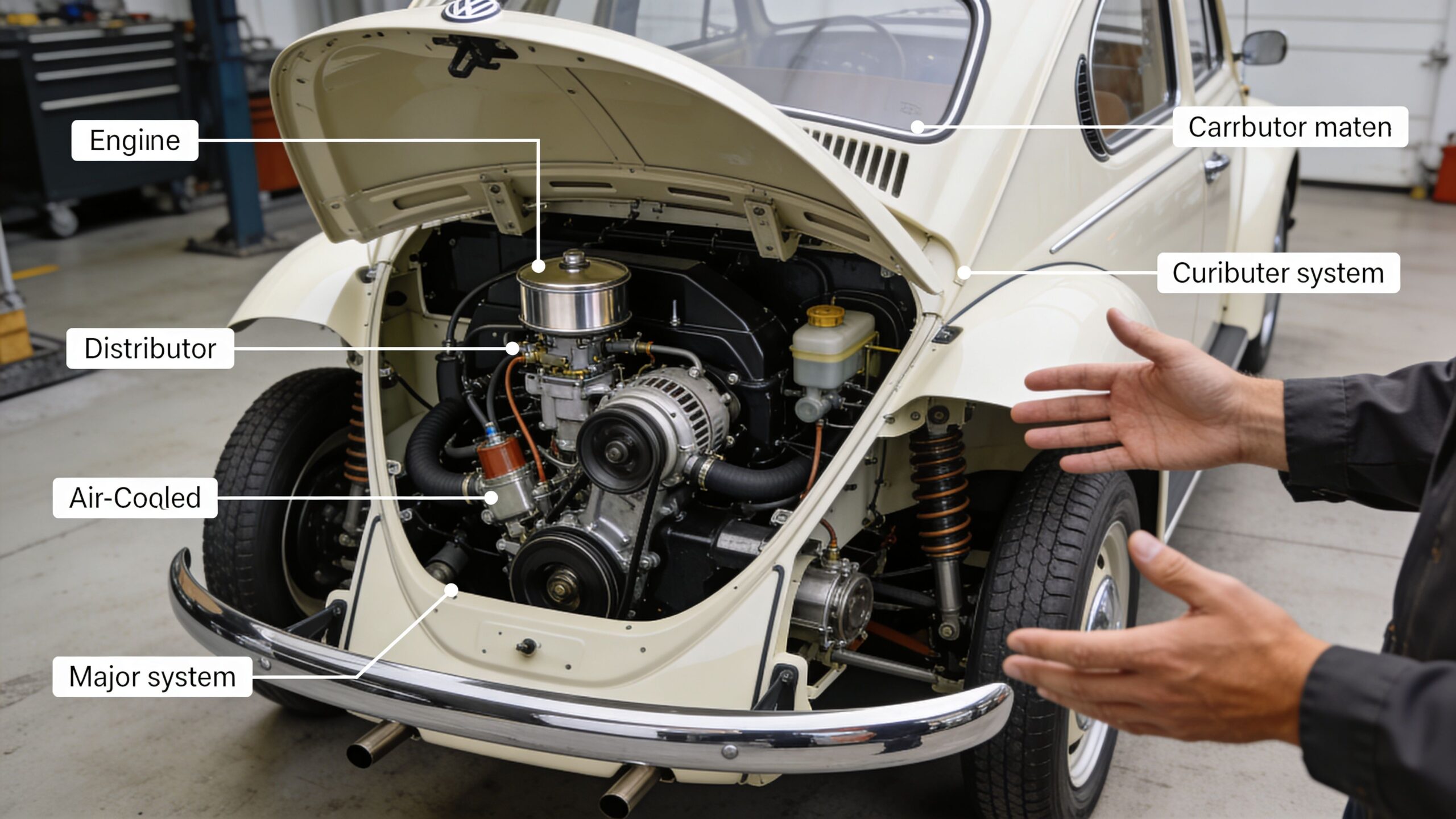
If you’re new to volkswagen beetle parts, it helps to see the Bug as a set of honest, hard-working systems. Each one has a job. Each one leaves clues when something’s off. Once you know the main players, parts catalogues and swap-meet tables become much easier to read.
For a wider look at why the car is shaped the way it is and why people still adore it, have a squiz at this guide to the VW Beetle’s history and character.
The engine and cooling system
At the back sits the Beetle’s trademark air-cooled flat-four. It’s compact, simple, and full of personality. On many earlier Australian cars, especially ones that have stayed close to factory form, you’ll come across small-capacity engines such as the 1192cc unit used in period Beetles. Specifications varied by year and market, which matters in Australia because local cars, CKD assembly, imports, and decades of engine swaps have left plenty of Bugs with mixed identities.
The important bit for a beginner is this. A Beetle engine does not rely on water and a radiator to control temperature. It relies on airflow, and that means all the cooling pieces need to be there and need to fit properly. Fan shroud, cylinder tins, engine bay seals, breast plate tin, air cleaner. They are working parts, not decoration.
A missing rubber seal or the wrong bit of tinware can upset cooling in the same way a missing roof tile lets rain into a house. The car may still run, but it won’t be happy for long.
A few engine parts turn up again and again in conversations with owners:
- Carburettor: mixes fuel and air for the engine
- Distributor and ignition parts: trigger the spark
- Generator or alternator: keeps the battery charged
- Fan shroud and tinware: guide cooling air to the hot spots
- Air cleaner: helps keep dust out, which matters on dry Australian roads
That last point catches plenty of people out. An inland country car that has spent years on dusty roads can wear its engine differently from a coastal car, and a Bug that has lived near salt air may have rusty cooling tins even if the engine itself still feels strong.
Gearbox, clutch, and driveline
The Beetle sends power to the rear wheels through a manual transaxle. Gearbox and differential share one housing, which keeps the layout neat and compact. It’s clever in a plain-spoken, Volkswagen sort of way.
Between the engine and gearbox sits the clutch. The clutch works like a handshake between the two. When that handshake is clean, the Bug pulls away with that familiar cheerful chug. When it isn’t, you’ll feel shuddering, hear complaints during gear changes, or find the pedal suddenly feels heavy or odd.
Common parts in this area include:
- Clutch disc and pressure plate
- Clutch cable
- Bowden tube
- Gearbox mounts
- Shifter bushings and coupler
Australian owners often meet another wrinkle here. A Beetle registered as one year may carry a gearbox, engine, or clutch setup from another, especially if it has been kept going with used parts from wrecker’s yards or club spares over the decades. That isn’t a problem by itself. It just means you check what is fitted before ordering anything.
Suspension, brakes, electrics, and body
The suspension gives the Beetle much of its character. Torsion bars do the springing work, and the result is a ride that feels different from many modern cars. A healthy Beetle feels light on its feet. A tired one starts to wander, knock, or bounce in a way that tells you bushes, ball joints, link pins, or dampers want attention.
Brakes and electrics are where year-to-year differences often become expensive. Six-volt and twelve-volt cars use different components, and Australian-delivered or Australian-complied cars do not always line up neatly with the assumptions in American or British guides. Tail lights, semaphores on very early cars, indicator setups, switches, starter arrangements, and even small wiring details can vary. Local club members and marque specialists are worth their weight in gold here because they’ve seen the odd combinations before.
Then there’s the body and chassis. The Beetle’s separate platform chassis and body shell make repairs possible in a way many modern cars aren’t, but rust still needs a sober look. Floor pans, heater channels, battery tray, front apron, spare wheel well, and body mounts all matter. If those areas are weak, doors may fit poorly, seals may never sit right, and the whole car can feel tired no matter how shiny the paint looks.
Here’s a simple way to sort the car in your head:
| System | What it does | Common parts people chase |
|---|---|---|
| Engine | Makes power and controls heat | Carburettor, tinware, seals, gaskets |
| Transaxle | Sends power to the rear wheels | Clutch parts, mounts, bushings |
| Suspension | Supports the car and manages movement | Torsion components, bushes, pins |
| Brakes | Slows and stops the car | Shoes, wheel cylinders, hoses, hardware |
| Electrics | Starts, charges, lights, and signals | Bulbs, switches, regulators, wiring |
| Body and chassis | Holds everything in shape | Floor pans, seals, trim, channels |
Once you start sorting a Beetle this way, the parts hunt becomes much less foggy. You stop seeing a jumble of old metal and rubber. You start seeing a series of small jobs, each one bringing the car closer to the cheerful, familiar Bug you remember. And if you collect Beetle models too, you’ll notice the same thing there. The right wheels, the right stance, the right trim. The charm lives in the details.
Identifying Your Beetle's Unique DNA
The most expensive Beetle part is the wrong one.
That sounds harsh, but it’s true. Plenty of owners have bought a beautiful bit of trim, a fresh mechanical component, or a reproduction seal kit, only to discover it doesn’t suit their Bug. In Australia, that risk gets sharper because many cars have lived layered lives. Imported, repaired, swapped, rebuilt, titled oddly, or assembled from mixed origins.
If you enjoy spotting details year by year, this 1970s Volkswagen Beetle identification guide is a handy companion.
The three clues that matter most
When I’m helping someone identify a Beetle, I usually start with three things. Not paint colour. Not whatever year the seller says. These three:
- The chassis VIN
- The body cues
- The engine type fitted now
The chassis VIN is your anchor because the body and engine may have changed over time. On Australian-imported cars, that VIN is typically stamped on the frame tunnel under the rear seat. It’s the clearest starting point when the car’s paperwork and appearance don’t quite agree.
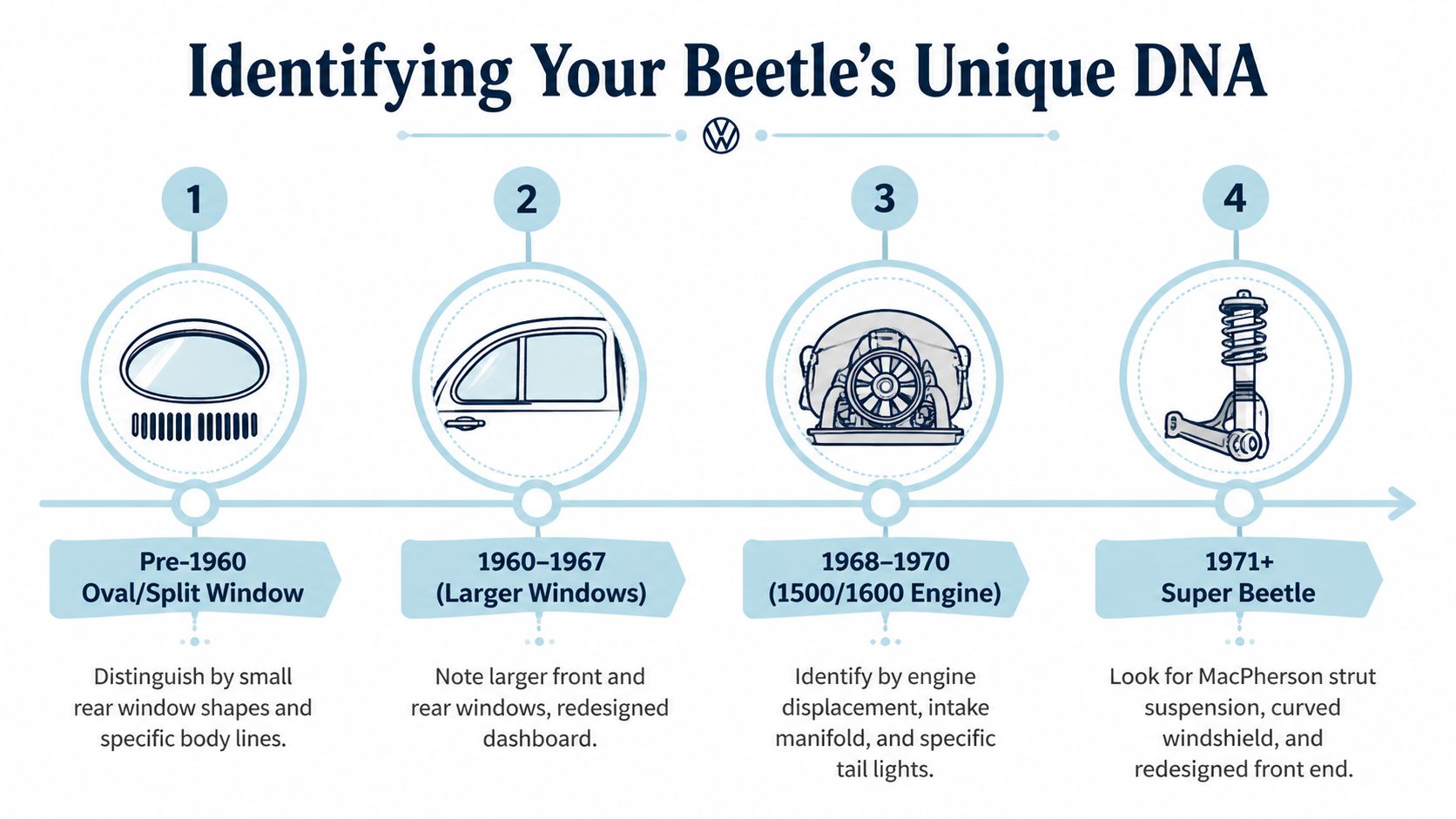
Then come the visual clues. Beetles evolved gently, not dramatically, so the changes can be subtle. Window sizes grew. Dash layouts changed. Tail lights shifted shape. Headlights, bumpers, and front indicators all tell part of the story.
The engine adds another layer. A car may have left the factory with one engine family and now carry something else entirely. That doesn’t make it bad. It just means you must separate what the car is from what engine is in it now.
Why an Australian '67 might want '66 parts
This is one of those classic bugbears that causes head-scratching at swap meets. Some Australian 1966-67 cars are titled as '67, yet need earlier parts in key areas. The verified guidance states that some 1966-67 models titled as '67 require specific '66 parts for their 1131cc engines.
That’s why old hands keep asking, “What’s the chassis number?” before they answer a parts question. They’re not being fussy. They’re trying to save you from buying twice.
Check the car first, the paperwork second, and the seller’s memory third.
Quick Beetle Identification Guide 1954-1976 AU Models
| Model Year(s) | Key Visual Cue | Common Engine | Electrical System |
|---|---|---|---|
| 1954-1959 | Smaller rear window styles on earlier cars, early body details | Early smaller-capacity engines | Often 6-volt |
| 1960-1965 | Larger glass area than earlier cars, evolving dash and trim details | 1200-class engines common | Often 6-volt |
| 1966-1967 | Transitional styling, details vary and some cars blur year lines in AU | 1131cc or later engine depending on car | Changeover period, verify before buying |
| 1968-1970 | Later lights and trim cues, many cars with larger engines | 1500 or 1600 often seen | Commonly 12-volt |
| 1971-1976 | Later front-end and body details, especially on Super Beetle variants | 1600 commonly seen | 12-volt |
That table is a guide, not a verdict. Beetles are famous for mixing eras through repairs and upgrades.
Visual details worth training your eye on
At a glance, these cues can narrow things down fast:
- Rear window shape: Early split and oval-window cars are easy to spot. Later cars open up visually.
- Tail lights: Small early styles feel delicate. Later units are larger and more safety-minded.
- Dashboard layout: Metal dash details, switch placement, and trim treatments can hint at era.
- Bumpers and overriders: Useful clues, though many have been swapped.
- Front suspension type: Super Beetles stand apart here, which helps when ordering front-end parts.
A clever habit is taking your own photo set before ordering. Capture the VIN, engine bay, front suspension, dashboard, tail lights, wheels, and underbody. That way, when a seller asks a question you didn’t expect, you’ve got evidence in your pocket.
When body, chassis, and engine don’t match
Many Bugs have become hybrids over the decades. That’s not unusual in Australia. Owners repaired rust with whatever shell sections they could find. Engines got upgraded. Gearboxes were swapped. Electrical systems were converted.
When that happens, sort the parts hunt into categories:
- Chassis-based parts such as pan-related hardware and some structural items
- Body-based parts such as guards, seals, lights, and trim
- Engine-based parts such as carburettor, tinware, ignition, and exhaust
- Conversion-based parts if the car has been updated from its original setup
That little bit of detective work saves grief later.
The Restoration Priority List Common Wear Items
I have watched plenty of fresh Beetle owners fall in love with the wrong end of the job. They spot a lovely set of hubcaps, dream about colour charts, then discover the brake hoses are older than the Bee Gees reunion rumours.
That is the Beetle lesson. Start with what keeps the car safe, straight, and dry.
A shiny Bug with tired structure works like a surf shack with rusted stumps. It can still charm you from the road, but once you know what is hiding underneath, the romance changes.
Start with safety and structure
The Beetle is simple, which is part of its magic. That simplicity also makes the weak points fairly predictable. On Australian cars, especially ones that have lived near the coast or sat outside through hard summers, the first money usually belongs under the body and behind the wheels.
Put your effort here first:
- Brakes first: Shoes, wheel cylinders, flexible hoses, master cylinder, and the small springs and clips that people forget. If the car does not stop straight and cleanly, nothing else matters yet.
- Rust in the pan and body next: Floor pans, heater channels, battery tray areas, and body mounts deserve a careful poke, not just a quick glance.
- Steering and suspension after that: Worn bushes, ball joints or link pins, tie rod ends, dampers, and the steering coupler can make a Beetle wander like a shopping trolley with one crooked wheel.
- Rubber seals next: Door seals, quarter window rubbers, bonnet and boot seals, and engine bay seals protect the work you have already paid for.
- Cosmetics last: Paint, trim, and brightwork are far more satisfying once the car feels solid on the road.
Workshop habit: If a part affects stopping, steering, or structure, move it to the top of the shopping list.
That order saves money as well as frustration. A tidy respray can wait. Rust repair hidden under fresh paint usually cannot.
The common wear items most owners meet early
Age acts as the mechanic here. Even a well-loved Beetle will ask for certain parts sooner or later, and Australian conditions add their own little twists. Sun cooks rubber. Dust sneaks past tired seals. Cars that spent years in paddock sheds or suburban carports often need the same handful of fixes before they feel trustworthy again.
| Area | Parts that commonly need attention | Why they matter |
|---|---|---|
| Brakes | Shoes, hoses, cylinders, hardware | Safe, confident stopping |
| Chassis | Floor pans, mounts, rust repair sections | Structural integrity |
| Suspension | Bushes, pins, dampers, steering coupler | Predictable handling |
| Driveline | Clutch cable, mounts, shifter bushings | Smooth shifting and take-off |
| Weather sealing | Door seals, bonnet seal, window rubbers | Keeps water and dust out |
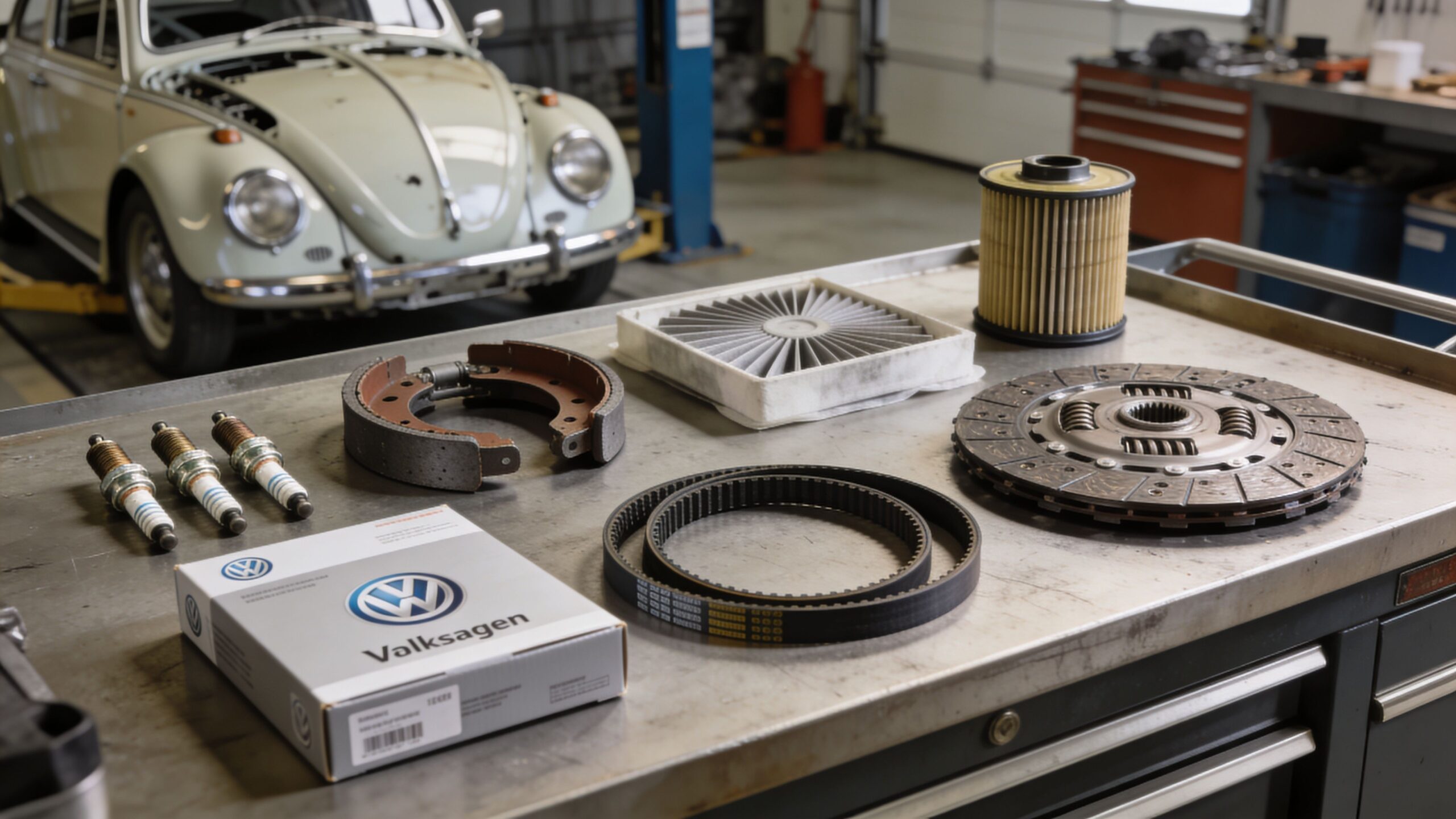
| Engine service items | Plugs, belts, filters, gaskets | Reliability and tune |
If you are new to Beetles, a few of those items deserve plain-English explanation.
The steering coupler is a small disc in the steering system, but it has an outsized effect on feel. When it perishes, the steering can feel vague and slightly spooky. Shifter bushings are another classic. When they wear out, first gear starts playing hide-and-seek. Engine bay seals look humble, yet they help keep hot air out of the engine’s cooling path, which matters a lot in an air-cooled car.
For cars with cracked or sun-damaged interiors, even trim choices can support a practical restoration. A proper vintage Volkswagen dashboard cover can tidy the cabin while you hunt for the right long-term dash solution.
This is a useful visual reminder of the sort of maintenance bits and wear items that often land on the bench during a Beetle refresh:
Good bones beat pretty paint
Australian restorers learn this early. The car that looks a bit scruffy but has a solid pan, decent heater channels, and honest mechanicals is usually the better buy than the glossy one with hidden sins.
Rust repair comes before cosmetics every time. Soft floors, crunchy channels, sagging door gaps, and a body that does not sit square on the pan are not little details. They shape everything else, from how the doors shut to how confident you feel at 90 km/h on a country road.
Then come the driving basics. Fresh brake parts, tight steering, and suspension bushes in good nick will not turn a Beetle into a sports car, but they do make it feel settled, willing, and cheerful. That is the feeling people remember. It is also the feeling diecast collectors chase in miniature. The right stance, the right wheels, the right trim. You can tell when the bones are right.
A Beetle does not need perfection. It needs honesty, and a priority list that respects how these funny little cars were built to be used.
The Great Aussie Parts Hunt Sourcing Your Spares
A Beetle part found in Australia often comes with a story. You hear about a bloke in Geelong with a shelf of early semaphores, then a club mate in Newcastle says the better pair is sitting in a biscuit tin at an old workshop out west. By the time the part reaches your bench, you have learned something about the car, the people around it, and the way Beetle ownership still runs on conversation as much as catalogues.
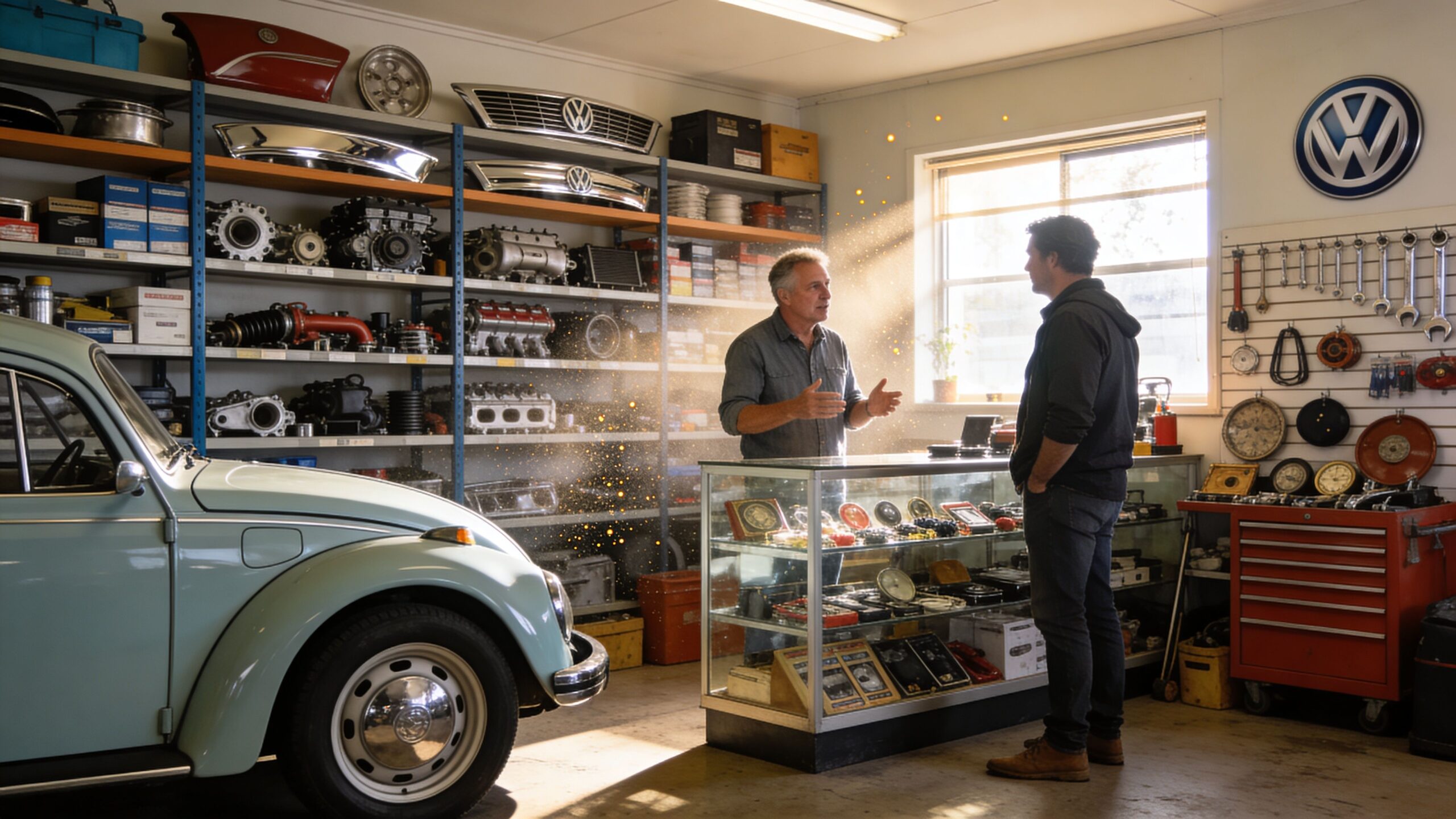
That is the Aussie parts hunt.
Overseas guides often make it sound as if every Beetle owner has easy access to endless shelves of stock. Here, the job is a bit more hands-on. You might buy service items from a supplier in one state, chase a used German hinge from a wrecker's yard in another, and ask your local VW club whether the reproduction switch you found fits an Australian-delivered car.
The four places that usually turn up the goods
A smart search spreads across a few channels, because each one solves a different problem.
Specialist VW wreckers and long-running workshops
These places are brilliant for used original parts, fiddly hardware, and the odd little pieces that never seem to appear in neat online listings. Walk in with photos and part numbers if you can. A good operator often recognises the part before you finish your sentence.VW clubs, swap meets, and Facebook groups with real local knowledge
Australian club networks are still one of the best ways to find honest advice. You learn who rebuilds carbies properly, who has a stash of late-model guards, and which reproduction door handle is worth buying.Established online suppliers
These are handy for brake parts, seals, tune-up gear, cables, and other regular maintenance items. They save time, especially if your Beetle is a driver and you need it back on the road rather than sitting on stands while you chase one perfect old-stock piece.Importers and sellers who understand Australian paperwork
This matters more than new owners expect. If a shipment includes natural materials, grime, or poor paperwork, customs or biosecurity checks can slow everything down. Buying local stock, or using a seller who already handles importing properly, often saves a lot of mucking about.
Interior parts deserve a careful eye too, especially if you are trying to keep the cabin looking period-correct while sorting bigger jobs. These vintage Volkswagen dashboard cover ideas can help you decide what suits the character of the car.
Why Australian buyers need to be a bit more careful
Distance changes the whole equation. Freight is dearer, returns are slower, and the wrong part can sit in a box for weeks before you realise it was listed for a US-market Beetle with different fittings.
Australian-delivered cars can also have their own quirks. Depending on year and assembly details, you may run into differences in lighting, trim, safety equipment, and other market-specific items. That is why chassis numbers, engine numbers, and clear photos matter so much. Ordering by guesswork is like buying shoes by colour alone. Close is not the same as right.
A local seller who knows AU-spec cars can save you from that trap. So can club members who have already fought the same battle.
OEM, NOS, or reproduction?
Newcomers often get tangled here, so let’s keep it plain.
- OEM-style parts follow the original factory pattern and are usually made by a recognised manufacturer or to a known specification.
- NOS, or new old stock, means older unused parts from the period. They often fit beautifully, but age still matters, especially with rubber.
- Reproduction parts are newly made replacements. Some are excellent. Some need trimming, tweaking, or patience.
I treat it like choosing timber for a deck repair. If the piece carries the weight, faces the weather, or sits where everyone can see it, quality matters more. On a Beetle, visible trim, switches, handles, and safety-related parts deserve extra care. A hidden bracket gives you more freedom.
A buying checklist that saves headaches
Before you hand over money, stop and check a few basics:
- What year and spec is the car, exactly? Check VIN, body style, engine, and 6-volt or 12-volt setup.
- Is the part for an Australian-delivered Beetle or an imported model? Ask directly.
- Do I want original appearance, easy function, or both? That answer shapes the whole search.
- Can the seller show clear photos, measurements, or part numbers? Good sellers do this without fuss.
- If it is used, what condition are the threads, chrome, rubber, and mounting points in?
- If it is coming from overseas, am I prepared for delays, inspection, or return hassles?
Half the success comes from knowing what to ask.
The other half comes from patience. That is part of the Beetle's charm in Australia. You do not always get the right part in one click. You find it through sheds, swap meets, workshop shelves, and quiet tips from people who have loved these cars for decades. And when the piece finally turns up, whether it is a real semaphore lens or the perfect tiny detail on a diecast model, it feels earned.
From Real Steel to Diecast Dreams Celebrating the Bug
At a country swap meet in Victoria a few summers back, I watched a bloke spend twenty minutes smiling at a tiny Beetle on a trestle table. He had grease under his nails, sun on his neck, and the look of someone who had spent half his life chasing the right parts through wrecker's yards and club chatter. He picked up the model, turned it in the light, and laughed because the taillights were right for the year.
That is what a real Beetle teaches you.
Once you have wrestled with rusty bumper bolts, cleaned years of dust from an air cleaner, or compared Australian-spec details against imported parts, your eye changes. You stop seeing a diecast as a generic old car. You start spotting whether the stance looks honest, whether the wheel style suits the era, and whether the little trim pieces respect the shape that made the Bug so lovable in the first place.
A good model works like a memory you can park on a shelf.
The full-size Beetle and the miniature one speak the same language. Rounded guards. Cheerful posture. Small details that tell you a story if you know how to read them. For Australian enthusiasts, that story often includes local clues that overseas guides skip past. A car sold here might carry details that differ from the US or UK examples people see online, so a collector who has spent time around Australian Beetles often notices authenticity faster.
That is part of the fun. Restoring sharpens your eye. Collecting rewards it.
Why restorers often become fussy collectors
Time in the shed teaches you to notice the details that give a Beetle its personality:
- whether the wheel trim matches the model year
- whether the paint colour feels true to the period
- whether roof racks, surfboards, flowers, or interior touches suit the car's character
- whether a Beetle or Kombi model captures the sun-faded, beach-holiday feel many Australian VW fans grew up with
A diecast piece becomes more satisfying once you know what you are looking at. It is no longer just a cute desk ornament. It is a little celebration of panel shapes, trim choices, road-trip memories, family photos, and all those Saturdays spent hunting the right part instead of settling for the wrong one.
That is why something like the 1967 Volkswagen Beetle Flower Power with Surfboard can feel so charming. It nods to the playful side of Beetle culture without losing the shape people fell in love with. If you want more of that familiar Bug silhouette lined up on a shelf, the full Beetles collection is a pleasure to browse.
If your taste runs beyond the Beetle, there is plenty of VW nostalgia in miniature:
- Volkswagen diecast models in the main shop
- Kombi and bus favourites in the Volkswagen range
- VW Kombi diecast options for Australian collectors
- More Volkswagen-themed collectibles and gifts are covered in the main shop range noted earlier.
A full-size car gives you the stories. The model lets you keep them in view, even when the garage door is shut and the tools are back on the pegboard.
Your VW Journey Starts Here
A Beetle teaches patience, observation, and a certain cheerful stubbornness. You learn to ask better questions, to trust the VIN over assumptions, and to fix the parts that matter before chasing the shiny bits.
That’s part of why the VW community remains such a pleasure in Australia. People will help if they can. They’ll point you toward a better supplier, tell you when a part number looks off, and celebrate with you when a long-idle Bug finally fires up and settles into that familiar air-cooled chatter.
If you’re restoring one, take your time and enjoy the wins. If you’re still dreaming about owning one, start learning the details now. Every part you recognise and every year cue you spot will make the journey easier later.
And if you love the shape, the colour, the nostalgia, and the surf-and-sun character that classic Volkswagens carry so well, there’s joy in collecting that heritage too. The Bug has always been more than transport. It’s a little piece of optimism on wheels.
Frequently Asked Questions about VW Beetle Parts
Are volkswagen beetle parts still easy to get in Australia
Many common service and restoration parts are still available, especially for the popular air-cooled years. The trick isn’t only availability. It’s correct fit. The right part for your exact car can take more effort than a generic listing suggests, especially if your Beetle has had engine, body, or electrical changes over the years.
What should I check before ordering any part
Start with the basics:
- VIN details: Confirm the chassis number from the car itself.
- Engine setup: Identify what engine is fitted now, not only what the car may have left the factory with.
- Electrical system: Make sure you know whether the car is running six-volt or twelve-volt equipment.
- Photos of the existing part: This helps when comparing brackets, connectors, and mounting points.
If the seller can’t answer fitment questions clearly, pause before buying.
Are German parts better than Brazilian or Mexican parts
Not automatically, but many owners prefer original German parts for fit, finish, and consistency when they can find them. Brazilian and Mexican parts can be perfectly serviceable depending on the component and manufacturer. The better question is whether the specific part is well made and correct for your car.
For visible trim, many enthusiasts chase original or higher-grade items. For service parts, reliability and fit often matter more than country of origin alone.
Should I buy used, NOS, or reproduction parts
It depends on the job.
A used original bracket or switch can be better than a poor reproduction. NOS can be wonderful when it has aged well and suits your car exactly. Reproduction parts are often the most practical path for seals, brake items, and common maintenance needs, provided you buy from a reputable seller.
Why do some Australian Beetles seem different from overseas guides
Because many Australian cars don’t line up neatly with one market’s catalogue logic. Import histories, local assembly influences, repairs, and decades of owner modifications mean your Beetle may carry a mix of features. That’s why local knowledge is so valuable.
What’s the safest first spend on a newly acquired Beetle
Put your first money into braking, steering, tyres, structure, and basic service items. If the car can’t stop straight, steer predictably, and stay structurally sound, cosmetic spending can wait.
A tidy Beetle that feels unsafe won’t get driven. A mechanically honest Beetle gets enjoyed.
How do I avoid disappointment when buying parts online
Use a short method:
- Ask for clear photos
- Confirm measurements or part markings where relevant
- Compare against your own car
- Check return terms before payment
- Buy from sellers who understand old Volkswagens, not just general auto stock
Is collecting VW models worthwhile if I don’t own a real Beetle
Absolutely. Plenty of people start with the nostalgia and later fall for the actual cars. A good model captures the same shape, warmth, and personality that made the full-size Beetle beloved in the first place.
If the Beetle’s charm has got under your skin, Volkswagen Memorabilia is a lovely place to keep that feeling close. You’ll find officially licensed VW-themed gifts, diecast models, and collectible pieces that celebrate the same heritage, colour, and character that make classic Volkswagens so hard to forget.