

A coastal garden can be a tough place to earn your keep. Sandy soil dries quickly, salt-laden winds batter exposed foliage, and plants that look excellent at the nursery can struggle once they meet the full force of an Australian shoreline. Banksia spinulosa ‘Coastal Cushion’ offers a more practical answer, combining a low, spreading form with the flowers and wildlife value gardeners love about banksias.
This isn't a tall feature tree competing with the view. It's a compact native for borders, slopes, path edges and open coastal beds, where horizontal coverage matters more than height. Choose the right position, give it sharp drainage and establish it carefully, and this banksia can become one of the most useful plants in a difficult garden.
Why Banksia Coastal Cushions Are Perfect for Aussie Gardens
A coastal garden can look finished at the nursery, then expose every weakness once salt-laden wind and free-draining sand arrive. The right plant needs to handle those conditions while still earning its space in the design.
Banksia spinulosa ‘Coastal Cushion’ suits that job because its low, spreading growth habit covers ground without creating a tall wind-catching feature. The Australian Plants Society notes that Banksia spinulosa occurs through coastal heath, shrubland, sandstone outcrops and sandy soils across eastern Australia, including parts of New South Wales and Queensland, in its guide to eastern Australian coastal banksias.
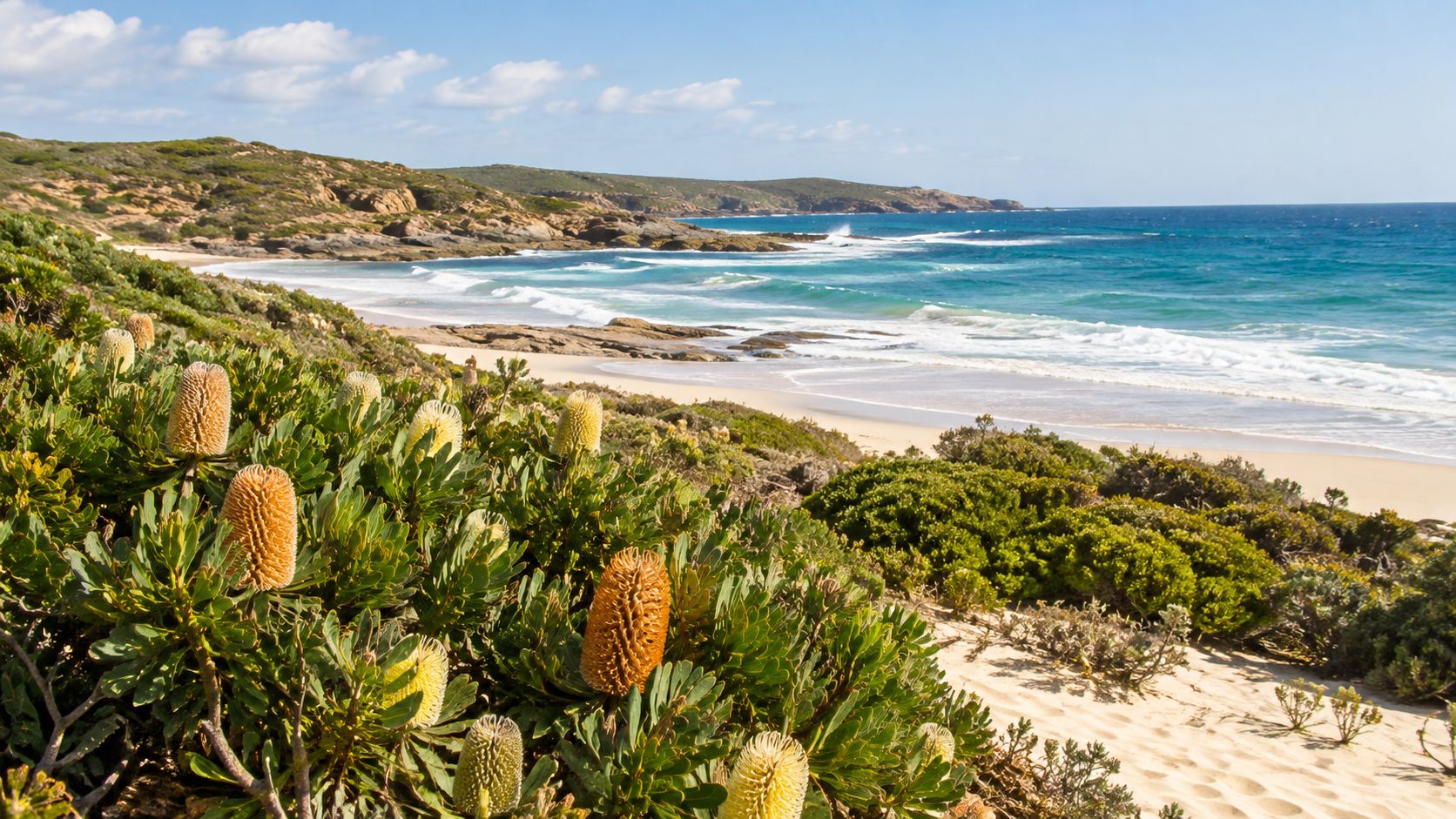
That habit gives it several practical uses. It can soften exposed borders, settle visually into sandy beds and provide low foliage where an upright shrub would block a view. Its dense cover also makes a planted area look more deliberate than scattered, widely spaced specimens.
Flowering brings the recognisable banksia character, with golden blooms adding colour and wildlife interest without requiring the footprint of a large shrub. Use it around paths, on gentle slopes, beside driveways or through open coastal planting schemes.
Treat it as a coastal groundcover-style shrub. It performs best with free drainage and good light, and it still needs sensible establishment care before it can cope confidently with a demanding site.
Understanding Banksia Coastal Cushion Growth and Size
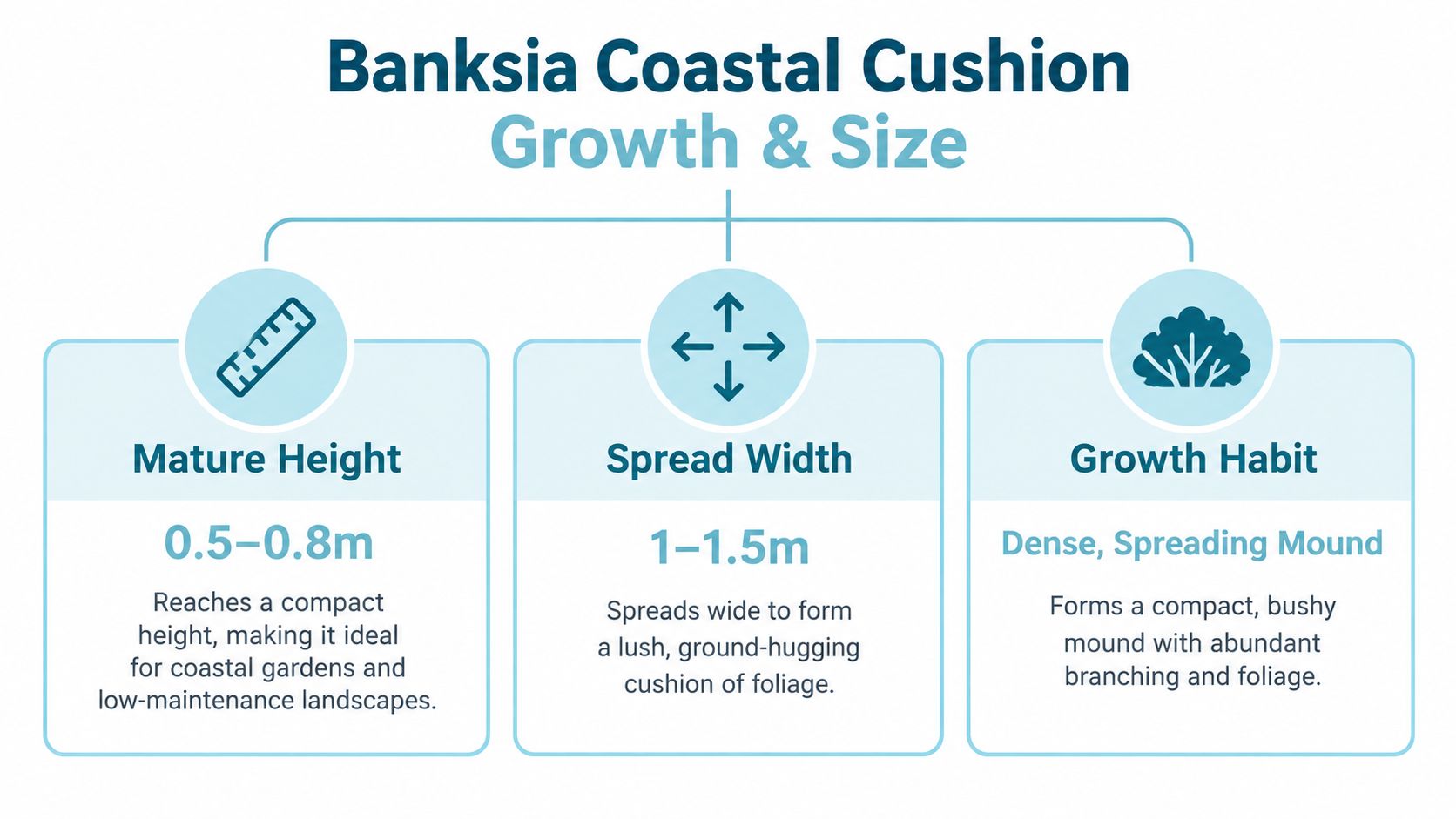
A “small banksia” label can be misleading if you plan only for height. Allow about 0.5–0.8 metres in height and 1–1.5 metres in width, as recorded in Kuranga Nursery's plant reference. The width often determines whether it fits comfortably beside a path, wall or neighbouring shrub.
Coastal Cushion develops a dense, spreading cushion of foliage held close to the ground. At maturity, it usually sits around knee to lower-thigh height for many adults, while spreading across a substantial part of a border. Measure the planting space for the full mature width, not just the size of the pot.
Why the spreading form matters
The rounded, low canopy presents less upright surface than a tall shrub, helping it sit neatly in open coastal gardens. Its foliage also keeps visual coverage across the soil, making it useful for exposed borders, sandy beds and gentle slopes. It softens an edge without blocking windows, views or driveway sightlines.
Use the mature footprint when planning:
- Border spacing: Leave room for the mound to broaden without narrowing a path.
- Slope coverage: Plant across the contour to create a connected sweep of foliage.
- Low screening: Group several plants for texture and definition. Choose a taller species when privacy is the main goal.
- Mixed beds: Set lower companions in front and taller banksias behind to build layers.
This compact scale is a practical advantage. Coastal Cushion brings banksia flowers and native character to smaller gardens while remaining manageable where planting space is limited. Its broad, low habit also suits the open structure common in Australian coastal planting, provided the soil drains freely and the plant receives good light.
Comparing Banksia Coastal Cushion to Other Coastal Banksias
Coastal Cushion suits planting plans that need banksia character without a tall shrub taking over the view. The broader Banksia spinulosa offers more height and stronger upright structure, while Banksia integrifolia is better suited to feature planting, shelter or screening. Choose the compact cultivar for low texture, sideways spread and coverage along exposed edges.
| Variety | Height | Spread | Best For |
|---|---|---|---|
| Banksia spinulosa ‘Coastal Cushion' | About 0.5–0.8 m | About 1–1.5 m | Low borders, groundcover-style planting and exposed edges |
| Banksia spinulosa | Typically 1–3 m, depending on form | Typically 1–3 m, depending on form | A larger native shrub with upright flower displays |
| Banksia integrifolia prostrate form | Low-growing | Broad-spreading | Wide banks, sandy areas and large-scale groundcover |
| Banksia integrifolia | Taller shrub or tree form | Broad canopy | Feature planting, shelter and screening |
The Coastal Cushion measurements are supported by Australian native plant nursery guidance. The Australian Plants Society outlines the species' eastern distribution and coastal habitat. Flowering time still depends on climate, exposure and plant maturity, so local nursery advice is more useful than a fixed calendar.
The practical trade-off is scale. Coastal Cushion gives you a lower, wider planting that keeps sightlines open and works along paths, sandy beds and garden edges. A standard Banksia spinulosa brings greater height and presence, but needs more room and can overpower a small border.
Choose Coastal Cushion where lateral coverage matters. Choose a taller banksia for a backdrop, visual anchor or shelter. Combining them works well when the compact cultivar sits in front, allowing its flowers and rounded form to remain visible.
Where and How to Plant Banksia Coastal Cushions
Start with the site, not the planting hole. Coastal Cushion performs best in full sun to partial shade, with strong light encouraging a dense shape and better flowering. Well-drained sandy soil is ideal, and a raised or gently sloping position is safer than a low pocket where water can linger after heavy rain.
A reliable planting sequence
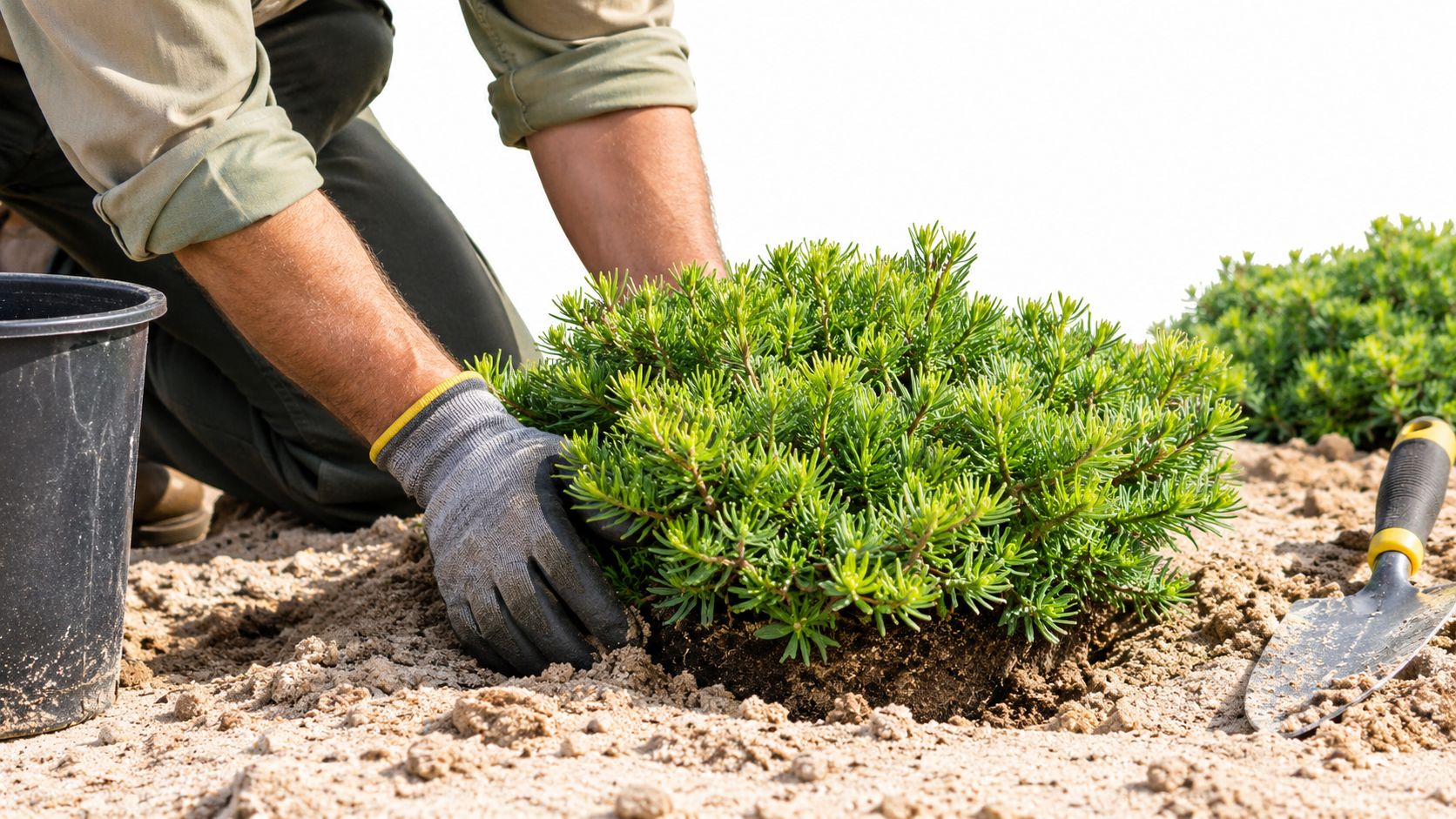
- Mark the mature spread. Use the expected width of 1–1.5 metres to judge spacing from paths, walls and other shrubs.
- Prepare a broad hole. Loosen the surrounding soil so new roots can move outward, but don't create a rich, water-holding pocket in otherwise sandy ground.
- Set the root ball at the correct level. The top of the root ball should sit level with the surrounding soil, never buried beneath it.
- Backfill with the excavated soil. Firm it gently around the roots, removing large air gaps without compacting the bed.
- Water thoroughly. A deep drink settles the soil around the root ball and gives the plant a proper start.
- Protect the establishment period. A temporary screen or nearby windbreak can reduce stress while the plant develops roots.
Avoid placing it in a frost hollow just because it's labelled hardy. Cold air collects in low areas, and a well-drained upper position usually gives a young plant a better chance. For a relaxed coastal styling touch around the garden, coastal home accessories can echo the colours and atmosphere of the planting without competing with it.
Care and Maintenance for Healthy Coastal Cushion Banksias
The first stage needs the most attention. Water thoroughly when the plant is establishing, then allow the soil to drain rather than keeping it constantly wet. Mature plants are more self-reliant, but prolonged dry weather, reflected heat and wind exposure can still increase demand.
Feed cautiously. Banksias are adapted to relatively lean soils, so heavy fertilising can produce soft, excessive foliage at the expense of a balanced plant. If feeding is needed, use a product specifically suited to Australian natives and follow its label rather than applying general-purpose fertiliser generously.
Practical rule: Improve drainage before reaching for fertiliser. A healthy root environment matters more than lush, forced growth.
Prune lightly after flowering or when the plant needs reshaping. Remove damaged stems and shorten uneven growth back to a healthy point, while avoiding harsh cuts into old, leafless wood. Leggy growth usually points to insufficient light, excessive competition or a position that's too sheltered and fertile for the plant's natural habit.
Watch for foliage changes, pest activity and sudden dieback, particularly after periods of wet weather. Good air movement, restrained watering and clean garden hygiene prevent many problems. Keep mulch away from the stem, and refresh it carefully so it protects the root zone without creating a damp collar.
Design Ideas and Garden Applications for Banksia Coastal Cushions
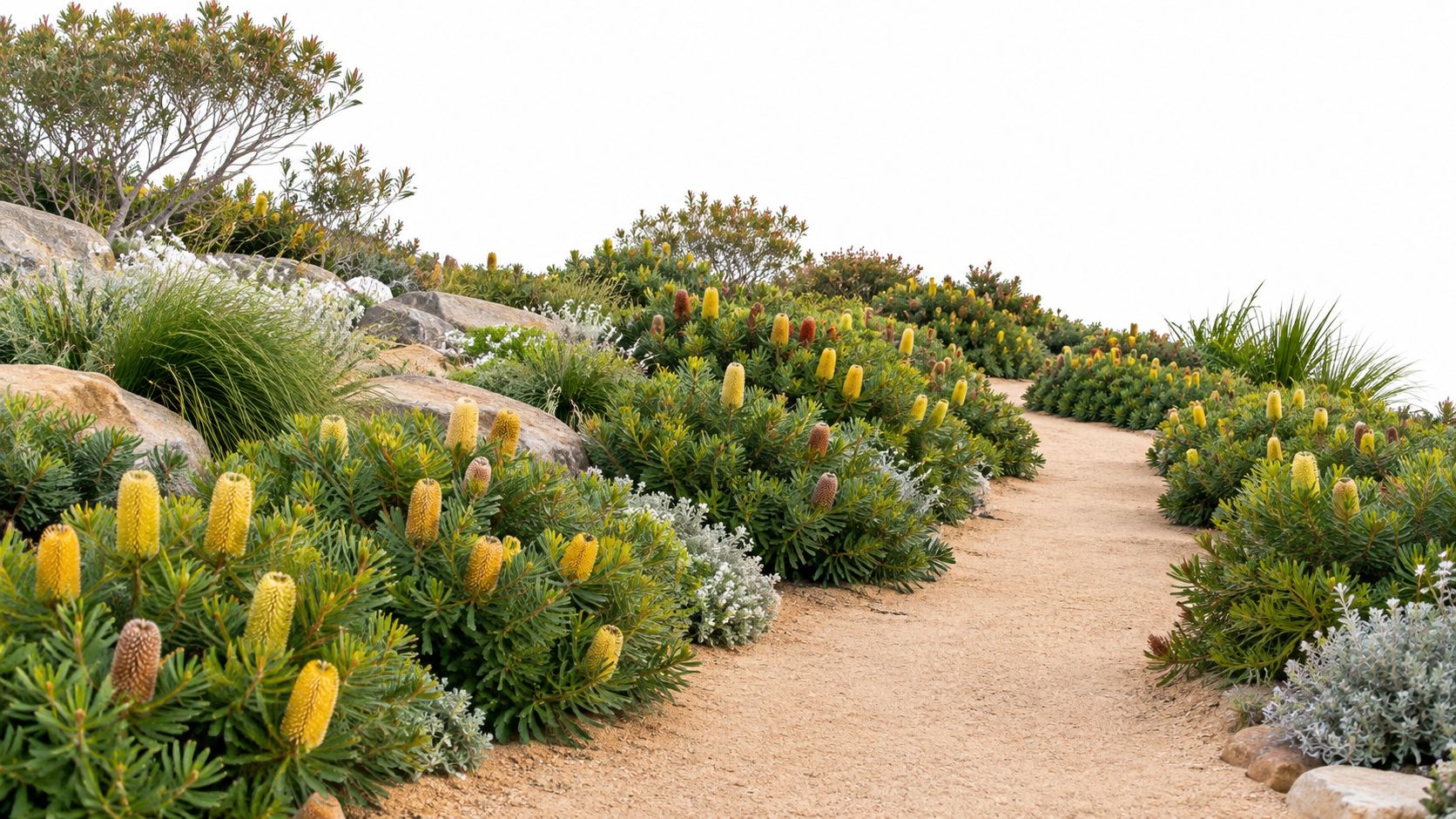
The strongest use for Coastal Cushion is to let it occupy the space that taller shrubs leave exposed. Along a sandy slope, several plants can create a broad green rhythm. Beside a path, the rounded foliage softens the edge without forming a wall. In a mass planting, repeated cushions produce texture while the flowers add warm yellow accents above the foliage.
Combinations that feel at home
Pair the cultivar with plants that share its preference for light and free drainage. Telopeas can provide a stronger vertical flower statement, grevilleas add varied foliage and nectar-rich colour, and coastal wattles contribute a lighter, more open texture. Silver, grey-green and deep green foliage create a convincing coastal palette, especially when set against sandy mulch or stone.
Containers are another option for patios and exposed decks, provided the pot drains freely and the plant isn't left sitting in a saucer of water. Use a quality native-friendly mix, give the root ball room to develop and expect container plants to need closer monitoring during hot, windy spells. A few dried palm leaves can complement a coastal display indoors, while the banksia remains the living focal point outside.
The flowers do more than decorate the bed. Banksias provide nectar that can draw native birds and pollinating insects, giving a small garden a stronger connection to the surrounding area.
A short visual guide can help when you're planning the relationship between path, foliage and flower height:
Where to Buy Banksia Coastal Cushions in Australia
Buy from a nursery that regularly handles Australian natives, especially if you're planting in a coastal or exposed district. Local availability changes by region and season, but Banksia spinulosa ‘Coastal Cushion' is widely propagated, so a reputable native plant nursery may be able to source it even when it isn't on the bench that day.
Inspect the plant before you commit. Look for:
- Healthy foliage: Leaves should be firm and evenly coloured, without widespread browning, spotting or obvious pest damage.
- A stable root ball: The plant should hold together when removed from its pot, but roots shouldn't be tightly circling the container.
- Clean potting media: Avoid stock sitting in sour, waterlogged or persistently saturated mix.
- Balanced growth: A compact, branched plant is generally a better starting point than one that's tall, weak and stretched towards limited light.
- Accurate labelling: Confirm that the label identifies Banksia spinulosa ‘Coastal Cushion', not just a generic dwarf banksia.
Ask the nursery about the plant's growing conditions before taking it home. A specimen raised in bright light and free-draining media will usually transition more smoothly than one moved abruptly from a protected bench into salt wind. If you're buying during a hot or windy spell, transport it upright, keep the foliage protected and plant it promptly rather than leaving it in a sealed vehicle.
There's a particular satisfaction in watching a modest plant settle into a difficult coastal bed, then broaden into the cushion that first attracted you. Choose carefully, plant for drainage and give the roots time to establish. The reward is a durable native with flowers, texture and a genuine eastern-Australian story.
If you enjoy the relaxed coastal character of banksias, explore Volkswagen Memorabilia for VW-themed gifts, diecast models and beach-inspired home décor. It's a friendly place to find a small piece of classic Australian surf culture to complement your garden and coastal living space.