


A seafoam Kombi glides past a beach car park, surfboards strapped to the roof and a little salt haze hanging in the morning air. You're standing beside your own display shelf, perhaps dusting a diecast bus or deciding whether that empty wall deserves a framed surf print, and the connection feels obvious. The VW Kombi retro look belongs just as naturally beside weathered timber and linen as it does in a workshop full of polished chrome.
That appeal comes from more than nostalgia. The Kombi carries real Australian working history, coastal travel memories and a design language that still reads clearly at miniature scale. This guide looks at the heritage behind the shape, the details that make a model convincing, and practical ways to build a collection or lived-in room around it.
Rolling Into the Retro Vibe
Byron Bay is waking slowly. A vintage light-green Kombi rolls along the coastal road, surf racks silhouetted against the sky, while fibro shacks, peeling decals and salty timber textures give the scene its familiar Australian character. The chrome bumper catches a flash of sun, then disappears around the bend towards the beach.
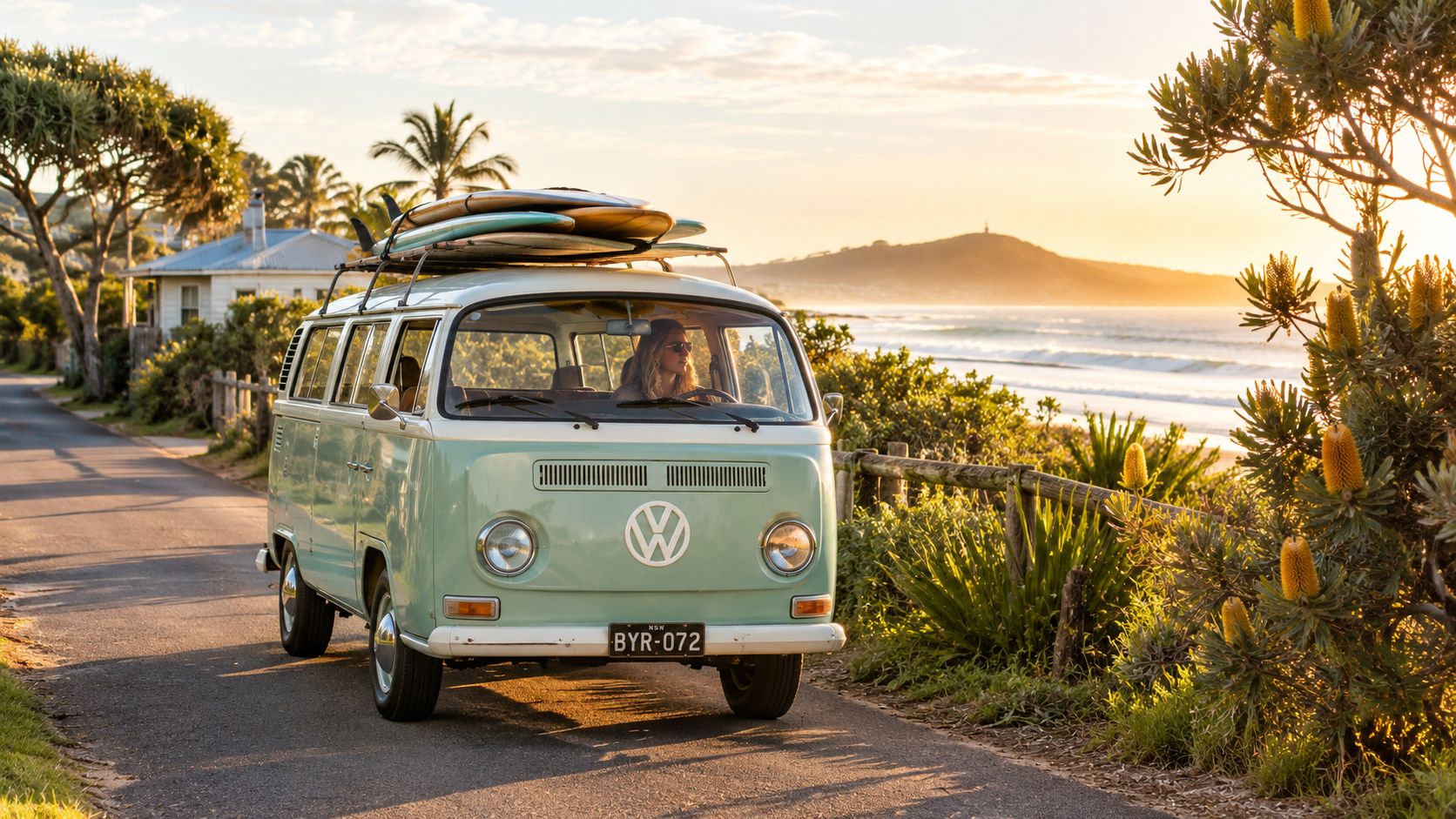
That's the magic of the Kombi. It can look purposeful outside a surf club, hardworking beside a tradesman's shed, or perfectly at home on a modern living-room shelf. The rounded roof, upright windscreen, bright paint and friendly nose don't need much explanation. Even a small Kombi Samba Bus diecast can carry the atmosphere of a long coastal drive.
The strongest retro styling doesn't rely on covering every surface with novelty pieces. It chooses a few recognisable cues and gives them room to breathe.
- Use colour with restraint: Seafoam, cream, faded blue and warm orange create the period feeling without making a room look like a theme park.
- Let texture do some work: Weathered timber, rope, linen, driftwood and aged brass provide the relaxed coastal setting that suits the van.
- Choose meaningful scale: A detailed model bus can become a focal point, while smaller vehicles work as supporting pieces on bookshelves or sideboards.
Practical rule: A good retro display should look like someone lives with it, not like a shop window was tipped into the lounge room.
The same principle applies whether you're restoring a full-size bus, buying a licensed miniature or adding a single accent to a beach house. Look for the design DNA first. Peeling period-style graphics, a bright bumper, split windows and a strong two-tone line will usually say more than a pile of unrelated decorations.
How the Kombi Earned Its Retro Crown
Australia's affection for the Kombi has a solid local foundation. Volkswagen assembled Kombis at the Clayton factory in Melbourne from 1964 to 1977, with most vehicles produced from CKD kits, while the company also used mostly local parts between 1959 and 1968, as recorded in this Australian Volkswagen history of the Kombi. That production story gives Australian collectors a useful starting point. A locally assembled vehicle carries a different connection from a later German import.
The model was never merely a counterculture prop. In Australia, it worked as a commercial van, family vehicle, people-mover and camper base. The 1970s cemented that broad appeal. Surf trips, holiday runs and improvised camper interiors made the Kombi part of everyday leisure culture, while clubs and restoration communities kept the details alive.
The Australian milestones that matter
A few dates help separate genuine heritage from general retro styling.
- Local assembly: Clayton production connected the Kombi with Australian manufacturing and local motoring culture.
- Peak mainstream success: In 1975, 8,974 Kombis were sold in Australia, including Microbuses, making it the model's biggest-selling year in Australian history. The same year, it held 43% of the Australian 1-tonne van market, according to the Club VW Australian history record.
- Production transition: From 1977 to 1979, Volkswagens were fully imported from Germany rather than assembled in Melbourne, and Kombi sales ended in 1980–81 as stock ran out, according to CarsGuide's Australian Kombi history.
- Imported continuation: The T3 Kombi was first imported into Australia in 1982, marking a new chapter after the classic local era.
Volkswagen says the Kombi originated in 1949 and that the model line later reached 11 million units overall, details included in the same CarsGuide history feature. Those milestones explain why collectors care about body style, assembly history, trim and delivery colours. A Split Screen, Bay Window and T3 may share the family name, but they don't tell the same Australian story.
For diecast buyers, heritage knowledge helps you choose deliberately. You might want a Split Screen because it represents the earliest visual language, or a Bay Window because its shape recalls a particular family holiday or surf trip. The best collection usually has a reason behind each vehicle.
Design Motifs That Scream Vintage Kombi
The retro Kombi works because its design is unusually legible. You can reduce it to a few strong shapes and still recognise the vehicle immediately. Early models bring the two-piece split windscreen, round headlights and upright front, while later buses retain the tall cabin, slab-sided body and cheerful, almost toy-like proportions.
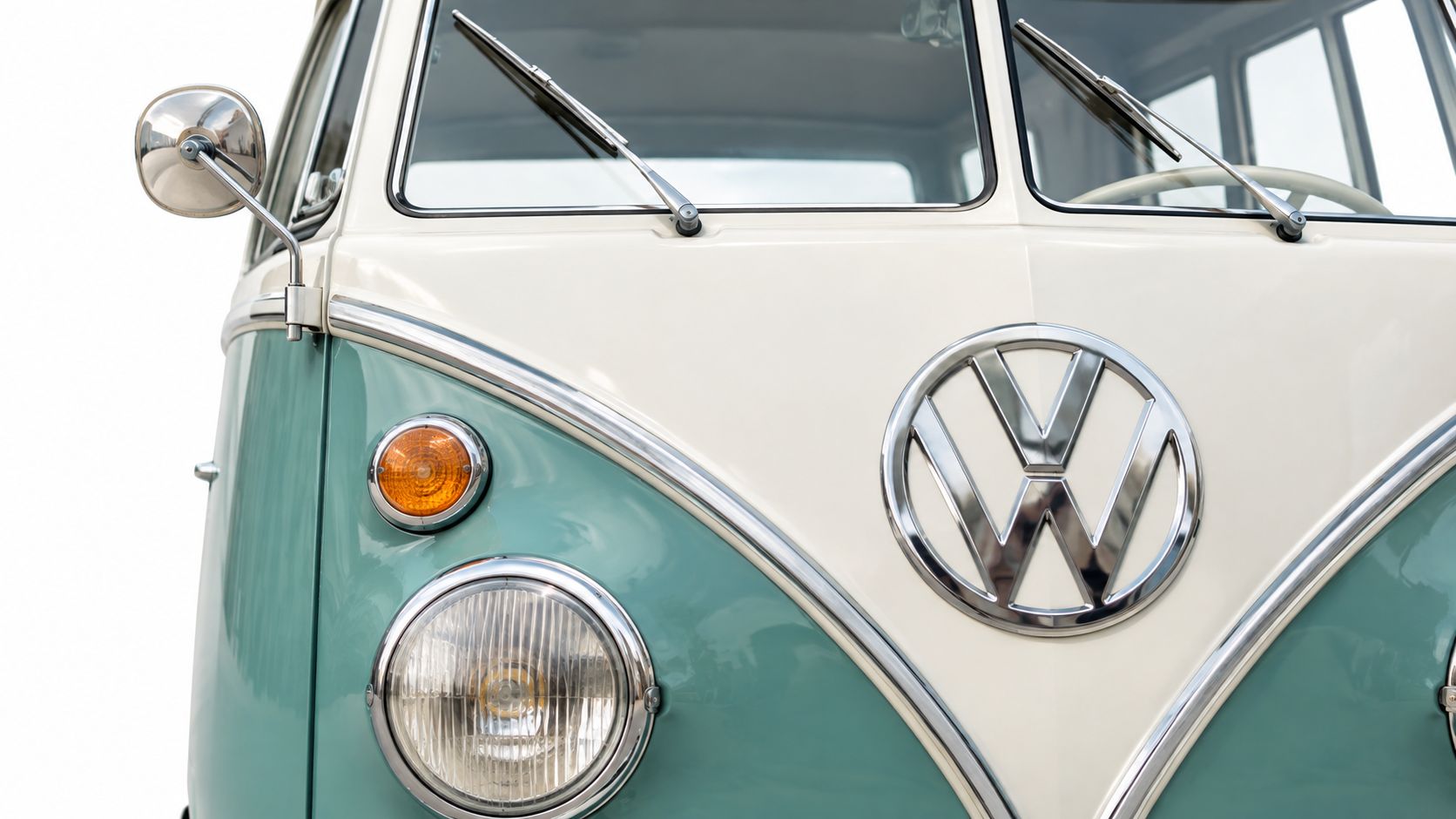
The details collectors notice first
Paint does much of the emotional work. Pastel blue, cream, orange and green immediately suggest an earlier era, especially when a darker or brighter colour forms a clean belt line across the body. Two-tone schemes suit Microbuses and campers particularly well because they emphasise the horizontal shape and make a miniature look more substantial.
Chrome is the next signal. Bumpers, hubcaps and trim lines add small highlights that separate a carefully finished licensed model from a generic van. Look closely at the VW crest, grille treatment, mirrors and lamp surrounds. On a real vehicle, these parts catch changing light. On a diecast model, accurate placement and crisp moulding create the same effect.
Other motifs translate beautifully into home styling:
- Safari-style front windows: These introduce a sense of ventilation, travel and old-school adventure.
- Side stripes and decals: Keep them aligned and period-appropriate rather than mixing graphics from unrelated eras.
- Roof flags and surf racks: Use these as playful accents, but check that they're securely fitted on display models.
- Interior colour: Plaid upholstery, white steering wheels and bakelite-style knobs bring warmth without needing a full vehicle restoration.
A model can be charming without reproducing every detail, but quality becomes clear when you compare the face, wheels, glazing and graphics. Licensed products should have consistent branding and a finish that respects the original proportions. Generic replicas often simplify the windscreen, flatten the body sides or apply decals that feel too modern.
The video below offers another visual look at the cues that make the classic bus so recognisable.
For a coastal room, echo one or two of these motifs rather than copying the entire van. A cream wall, pale-blue model, striped cushion and aged timber shelf can suggest the same world with much more confidence than a room packed with matching logos.
Collecting the Retro Look in Diecast Form
Scale changes the collecting experience more than many first-time buyers expect. A small 1:87 Kombi can sit among books, plants and framed photographs, while a large 1:18 bus demands its own display position. Australian diecast guidance lists typical lengths of 5–6 cm for 1:87, 7–8 cm for 1:64, 10–12 cm for 1:50, 12–15 cm for 1:32, 16–20 cm for 1:24, and 25–30 cm for 1:18 models in this Australian diecast scale guide.
| Scale | Typical size | Detail level | Price range AUD | Best for |
|---|---|---|---|---|
| 1:87 | 5–6 cm | Shelf-level detail | Qualitative budget range | Small displays and mixed scenes |
| 1:64 | 7–8 cm | Compact detail | Qualitative budget range | Casual collecting and gifts |
| 1:50 | 10–12 cm | Strong detail in a compact footprint | Qualitative mid-range | Mixed displays |
| 1:32 | 12–15 cm | Noticeable body and trim detail | Qualitative mid-range | Desks and cabinets |
| 1:24 | 16–20 cm | Display-focused detail | Qualitative premium range | Feature shelves |
| 1:18 | 25–30 cm | Highest visual impact | Qualitative premium range | Serious display pieces |
The same guide notes that 1:50 is popular because it balances detail with compact display size, which makes it a useful middle ground for collectors building a mixed scene. A 1:24 Bay Window has enough presence to show paint separation and surf accessories, while a 1:18 Samba Bus becomes a centrepiece rather than a supporting object.
You'll also see differences in construction. Die-cast metal gives a satisfying weight and usually stands up well to careful handling. Resin can reproduce fine shapes, but it may be better treated as a display object. Opening doors, movable wheels and removable accessories add interest, although moving parts also create more places for dust and accidental damage.
A sensible buying checklist
Before you buy diecast Kombi models, check:
- Scale marking: Look for the scale on the chassis or product documentation, not only the seller's title.
- Licensing: Confirm Volkswagen branding and manufacturer information on the packaging.
- Finish: Inspect glazing, paint edges, wheel alignment and decal placement.
- Display plan: Measure the shelf before choosing a larger model.
- Light exposure: Keep strong sun off painted surfaces to reduce fading.
For Australian collectors, Volkswagen model cars provide a useful category to browse when comparing body styles and display sizes. Local stock also matters. An Australian importer can offer faster domestic shipping and simpler support than an overseas listing, especially when packaging damage or a missing accessory needs attention.
Styling Coastal and Vintage Spaces With Kombi Charm
A coastal Kombi room works best when it feels collected over time. Start with a calm base, such as white walls, pale timber and natural linen, then introduce the bus through colour and shape. A pastel-painted model on weathered timber shelving can become the small flash of personality that stops the room feeling too polished.
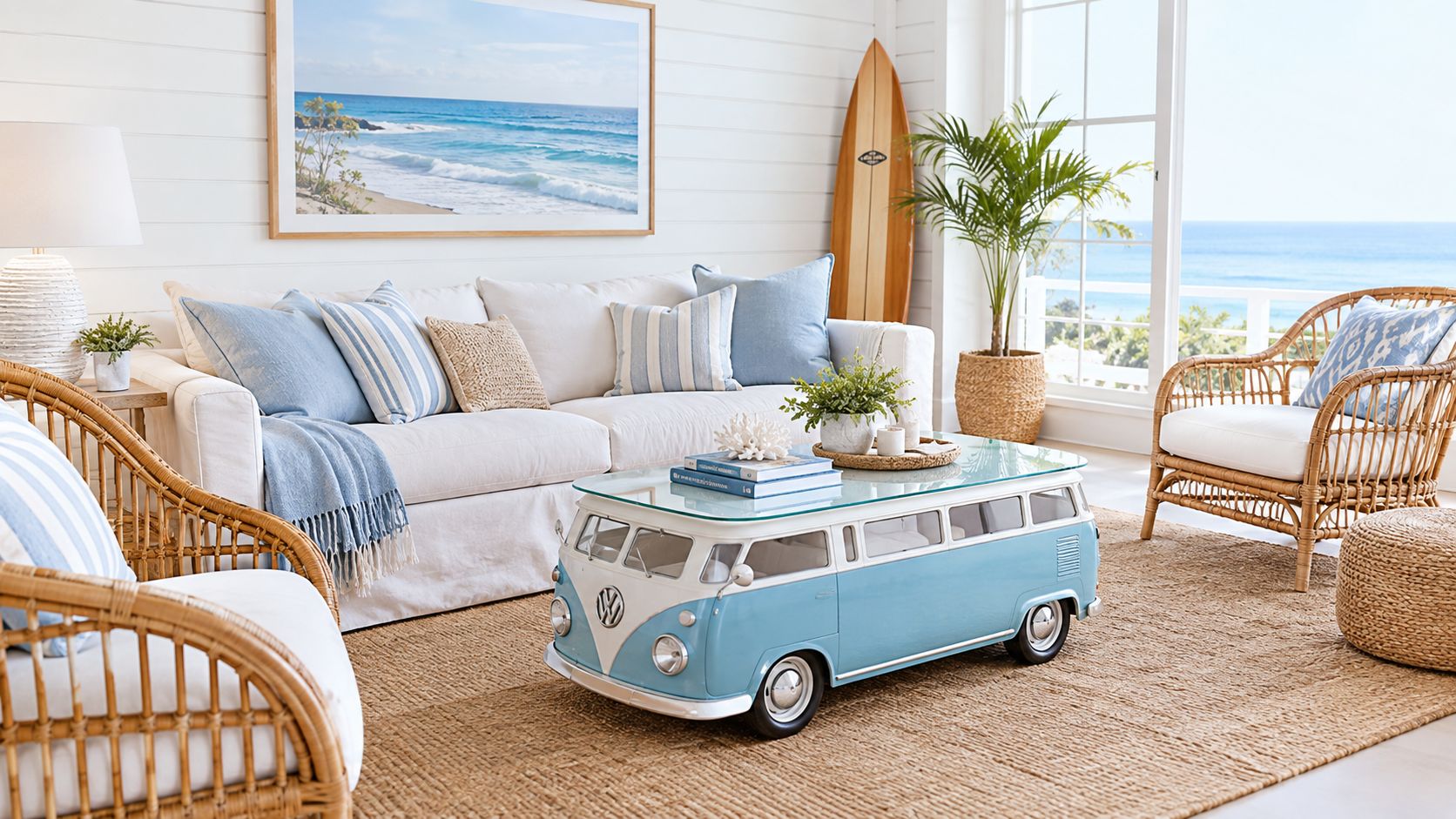
Build the room from large elements to small ones
Hamptons-meets-surf-shack styling gives the Kombi plenty of breathing space. Navy and white striped cushions can echo a bus livery without repeating a logo, while a rattan pendant or warm Edison bulb adds the amber glow associated with old workshop lighting.
Try this sequence:
- Choose the anchor: A framed vintage-style Kombi poster, a large model or a distinctive piece of metal wall decor can establish the room's direction.
- Add natural texture: Pair the display with rope, driftwood, woven baskets, linen and aged brass.
- Repeat one colour: Pull the model's blue, cream or orange into a cushion, vase or small artwork.
- Create variation: Mix a bus shape with surf photography, shells, maps or timber objects rather than using only Volkswagen pieces.
- Leave negative space: A crowded shelf hides the very details that make a model special.
A gallery wall is particularly effective. Place a diecast model in a shadow box beside surf photography, a road map and a small period-style sign. The different formats create movement, while the shared coastal palette keeps the arrangement organised.
The vintage home accessories collection can help when you're looking for complementary pieces rather than another vehicle. The useful question isn't whether every item is officially from the same year. It's whether the materials, colour and mood belong together.
Protect the collection near the coast
Salt air and humidity deserve practical attention. Don't put valuable metal models directly beside an open window, on a balcony, or in a spot exposed to sea spray. A glass cabinet with a soft, dry microfibre cloth nearby is safer than an uncovered shelf in a damp room.
Dust the model gently, holding delicate accessories rather than dragging the cloth across them. Avoid harsh household cleaners, which can mark clear plastic and soften printed graphics. If the room gets strong afternoon sun, use a blind or rotate the display so one side doesn't carry all the exposure.
Mixing Models, Memorabilia and Surf Culture
A convincing Kombi display tells a story instead of just presenting objects. The strongest combinations usually bring together three layers: a vehicle, something from travel culture and a surface with visible age.
A 1:24 Bay Window might sit beside a vintage surf poster, a weathered road map and a tin lunch box. Add a small board-rack sign or surf club badge and the scene starts to suggest a destination, even if the display is in a suburban study. The objects don't need to be rare. They need to feel connected.
Give each vignette a clear setting
A Byron Bay-inspired arrangement could use faded blue, sand, cream and timber. A road-trip shelf might lean into maps, enamel signage and luggage textures. A family holiday display could combine a bright Microbus, old-style picnic pieces and a framed beach photograph.
The trick is to balance authentic finds with good reproductions. Estate sales and weekend markets can turn up genuine-era signage, lunch boxes and badges, but condition varies and provenance isn't always clear. Reproduction pieces are often the practical choice for everyday decorating, especially when you want a clean finish or a matching size.
Surf culture also gives collectors room to personalise a display. Australian artists, local printmakers and beach brands often explore van shapes, travel decals and board culture in their own visual language. Keep those pieces alongside the model, not over it. The Kombi should remain the visual anchor.
For a gift, combine a small bus with a tin sign, a travel-themed accessory or a compact coastal decoration. That feels more thoughtful than giving a random miniature with no connection to the recipient's interests. A collector who already owns several buses may appreciate a themed object that expands the story.
A Volkswagen travel van can work as the starting point for a shelf, office nook or gift bundle. Australian collectors' forums and local VW club communities are useful places to compare casting quality, identify body styles and learn which details enthusiasts value. Just remember that a seller's confidence doesn't replace checking the model, markings and condition yourself.
Retro Kombi Questions Worth Answering
How can I confirm a model's scale?
Check the chassis, underside or manufacturer documentation. A box may say 1:18, but the physical model should also match the expected proportions and length for that scale. The Australian diecast guide's size ranges are useful for a quick sense check, from 5–6 cm at 1:87 to 25–30 cm at 1:18 according to the collector scale guide.
Why do collectors like the 1972 Bay Window?
The Bay Window shape has a strong visual balance. Its broad front, large windscreen and practical camper associations make it instantly readable, while its Australian holiday and surf connections give it emotional weight. Collectors often seek it because it sits comfortably between early Split Screen charm and later practical van styling. That doesn't make every 1972 release more valuable than every other Kombi. Condition, licensing, finish, rarity and personal meaning still matter.
Are licensed Hot Wheels or Matchbox models better than bootleg replicas?
Licensing is an important starting point, not the only test. Licensed models generally give you clearer manufacturer accountability, accurate branding and packaging information. Compare the chassis markings, body proportions, glazing, wheel design and graphics. A cheap generic replica might look appealing in a photograph but often loses the small details that create the retro character.
What makes a thoughtful gift pairing?
Pair the model with something that supports its story. A compact bus can sit alongside a tin surf-rack sign, a coastal print, a travel accessory or a small piece of vintage-style decor. Match the gift to the recipient's space. Someone in an apartment may prefer a smaller scale, while a dedicated collector might welcome a larger feature piece.
Should a display cabinet be insured?
If your collection becomes financially significant, speak with your insurer about how collectibles are covered. Keep purchase records, photographs, packaging and model details organised. The relevant threshold depends on your policy, so don't assume household contents insurance automatically covers a cabinet or collection valued above A$2,000.
Can I restore yellowed plastic windows with Retr0bright?
Retr0bright baths are discussed in restoration circles, but they can produce uneven results and may affect surrounding paint, decals or trim. Remove the glazing only if you understand how it's secured, test on an inconspicuous area and avoid experimenting on a valuable licensed model. For a miniature, gentle cleaning and careful storage are usually safer than aggressive restoration.
Keep the finish honest: A clean, well-preserved model with original graphics is usually more appealing than a heavily modified piece that loses its period character.
Use a soft microfibre cloth for dust, keep models away from direct coastal sunlight and rotate seasonal displays so the same paintwork isn't exposed continuously. For metal pieces near the coast, enclosed storage offers better protection than an open shelf beside a window.
If you're ready to build a display with genuine retro character, explore the licensed VW memorabilia collectibles, Kombi Samba Bus diecast models, Beetle miniatures and coastal decor at Volkswagen Memorabilia. Browse the Australian shop for local stock, faster domestic shipping and friendly help choosing a piece that suits your shelf, gift list or beach-house style.