

Saturday arvo, the table's nearly set, someone's rinsing salad greens, the sea breeze is drifting through the screen door, and you're standing there with that familiar little decorator's dilemma. Do I lay a runner? Use placemats? Mix both? Or have I just made this harder than it needs to be?
That's exactly where a table runner and placemats set earns its keep. Instead of pulling bits from three cupboards and hoping the colours get along, a coordinated set gives you a ready-made foundation that looks considered without feeling fussy. It's a bit like parking a tidy old Kombi beside a weathered beach shack. Different elements, same mood, and suddenly the whole scene makes sense.
For Australian homes, that matters more than people admit. We don't all entertain the same way. Some tables host fish tacos and kids' water glasses on a Tuesday. Others need to handle Christmas lunch, a coastal rental reset, or a relaxed dinner after a day at a VW show. There's also a genuine gap in practical advice around what works for local table sizes and entertaining styles, especially if you're weighing up crosswise runner styling or trying to choose between woven natural fibres and easy-care synthetics. That feels especially relevant while home styling trends lean towards layered texture and natural palettes, even as household goods retailing showed only modest growth, with household goods retailing up 2.3% in June 2025 and broader retail volume growth at 0.3% in the June quarter 2025 in reporting cited by Home Beautiful's entertaining and styling coverage.
Introduction to Table Runner and Placemats Sets
A good set takes the guesswork out of that last-minute table panic. You're not wondering whether the placemats clash with the runner, or whether the whole thing looks too formal for fish and chips wrapped in paper on the deck. The pieces already speak the same visual language.
Why a matched set feels easier
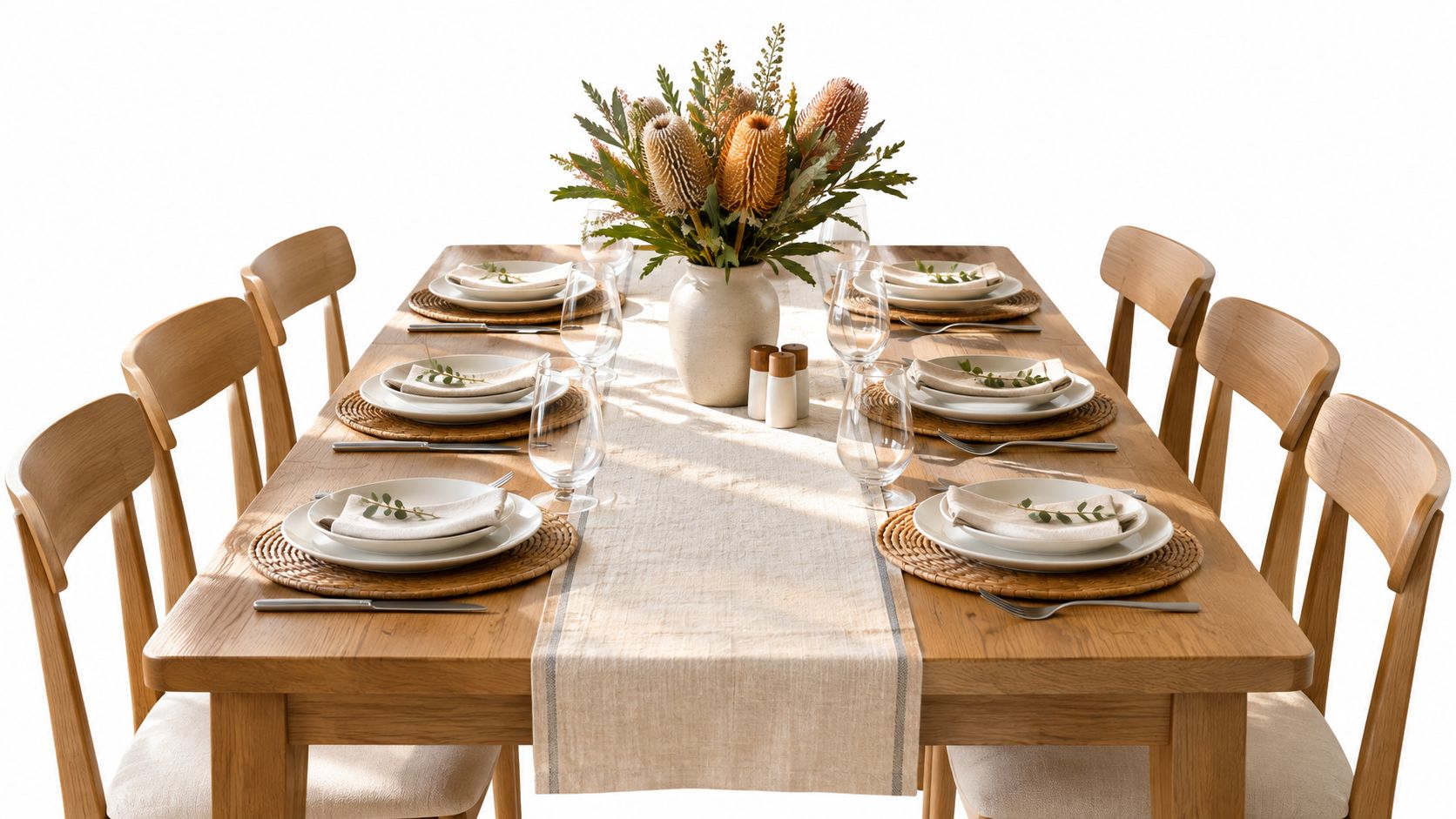
Think of the runner as the road down the centre of the table, and the placemats as the neatly marked parking bays. One guides the eye. The other gives each person their own space. Together, they create order without making the table feel stiff.
That's why bundled sets appeal to both decorators and gift buyers. You get colour harmony, texture consistency, and a cleaner starting point for styling candles, serving bowls, shells, or even a cheerful retro touch if your home leans surfy and nostalgic.
Practical rule: If you want your table to look calm, start with pieces that already coordinate, then add only one or two accent ideas on top.
Why this category matters in Australia
It's also not some tiny niche. In Australia, the broader table linen market was valued at about $39 million in 2024, with imports at about 661 tons, up 13% year on year, and forecasts cited for the category point to continued growth through 2035, including projected volume of 1.7K tons and projected nominal value of $60 million according to IndexBox's Australia table linen market overview. Table runner and placemat sets sit within that same table-linen category.
That tells you two things. First, Australians are still buying these products. Second, choice matters, because there's plenty on the market and not all of it suits the way people live.
Here's where people usually get stuck:
- Material confusion means a beautiful set may be annoying to clean.
- Sizing mistakes leave the runner too stubby or the placemats hanging over the edge.
- Styling overload makes the table feel crowded when all you wanted was relaxed and welcoming.
- Care surprises show up after the first wash, when shrinkage or waviness turns up.
A little know-how fixes most of that.
What a Table Runner and Placemats Set Includes
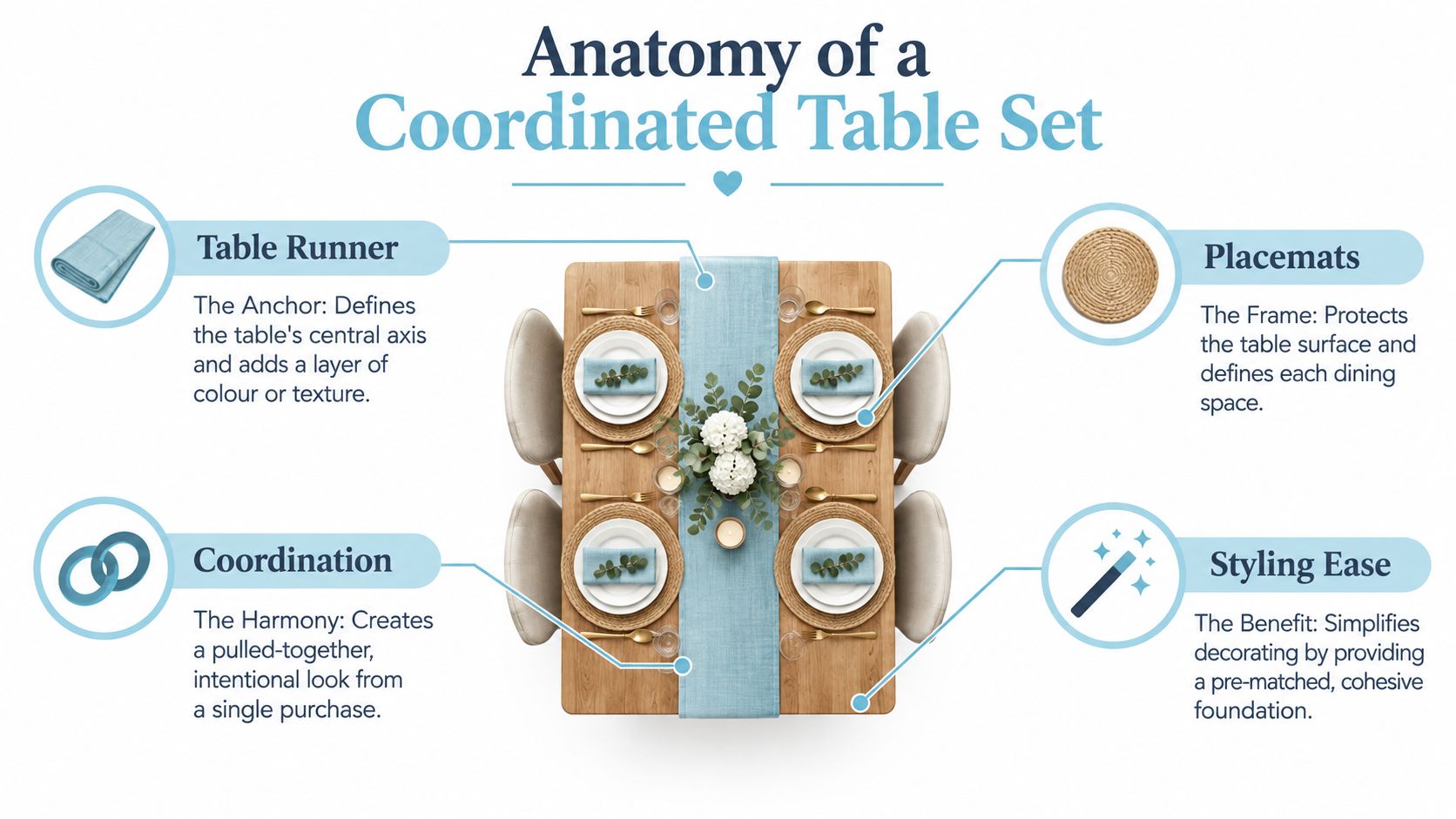
A coordinated set usually has two jobs. The runner anchors the middle of the table, and the placemats frame each seat. If you think of a framed vintage Kombi print on the wall, the image draws attention, but the frame makes it feel finished. Same story here.
The basic pieces
Most shoppers will come across a few common combinations:
| Set element | What it does | Best for |
|---|---|---|
| Table runner | Adds a central line of colour or texture | Long dining tables, console tables, buffet styling |
| Placemats | Protect the surface and define each setting | Everyday meals, family dining, casual entertaining |
| Matching finish or weave | Ties the pieces together visually | Cohesive styling with less effort |
| Optional extras like napkins or rings | Add polish if you want a fuller look | Celebrations or gift sets |
Some sets are fully bundled. Others are “matched separates”, where the runner and placemats are sold individually but designed to work together. Bundled options are simpler. Matched separates can help if you need more flexibility around seat numbers.
How the pieces work together
The runner usually sits lengthways through the centre. It softens a bare tabletop and gives your serving pieces a home base. The placemats sit at each place setting and create little islands for plates, cutlery, and glasses.
That combination solves a common decorating problem. A runner alone can look lovely but unfinished once people sit down. Placemats alone can feel practical but a bit scattered. Used together, they balance the centre and the edges.
The runner gives the table direction. The placemats give it rhythm.
What to check before you buy
Don't just look at the colour first. Check these details:
- Piece count matters if your dining table seats more people than the set covers.
- Material consistency matters because a cotton runner with stiff synthetic placemats can feel mismatched even if the colours match.
- Edge finish tells you a lot. Neat hems, binding, braiding, or clean woven borders usually age better than flimsy glued finishes.
- Intended use matters. Everyday family dining asks for something different from a styled spare-room table.
This is also where practical shopping in Australia comes in. Table linen is recognised as its own textile category in trade and customs, and in the Australia and Oceania cotton table-linen market, Australia consumed about 2.4K tons or 71% of regional volume and produced about 1.5K tons or 61% of regional output in 2024, while import value sat at about $11 million versus only $150K in exports, according to IndexBox's Australia and Oceania cotton table-linen market analysis. In plain English, Australians buy a lot of table-linen products, and many of them come in from elsewhere, so quality can vary widely.
Choosing Materials That Suit Australian Homes
Material choice changes everything. It affects how the set feels in your hands, how it sits on the table, how forgiving it is after a spilt drink, and whether it suits a beach house, a busy family kitchen, or a more dressed-up dining room.
Everyday ease versus relaxed texture
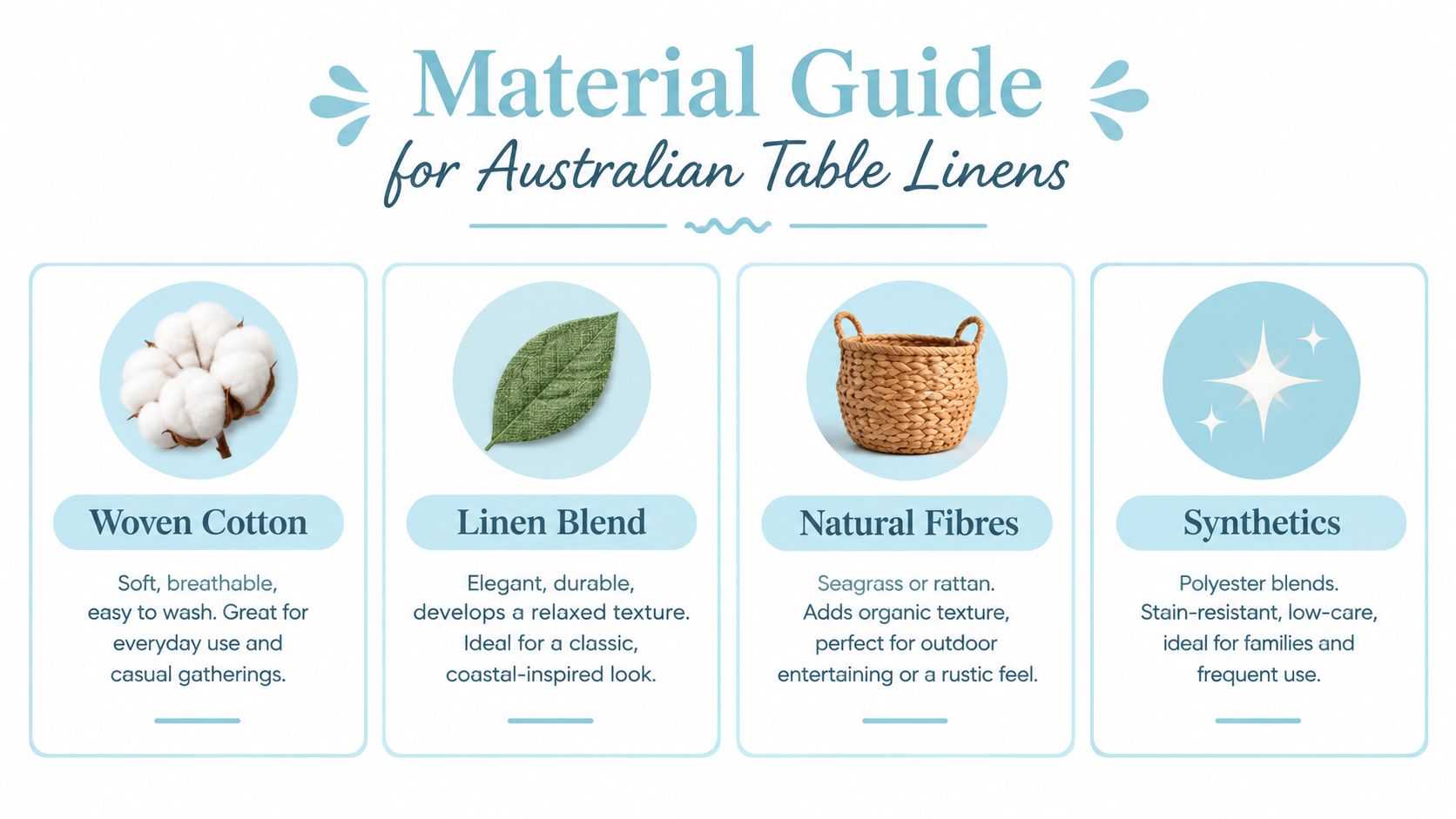
If you want an easy starter option, woven cotton is usually the least intimidating. It feels soft, folds neatly, and often works for both weekday meals and casual entertaining. Cotton also tends to suit homes where the table gets used properly, not just admired from across the room.
Linen blends bring more texture and a softer, sun-washed look. They fit beautifully with coastal interiors because they don't need to look crisp to look good. A crease in linen often reads as character, not failure, which is handy if your home has that barefoot, salty-air energy.
Natural fibres and low-fuss synthetics
Then you've got natural fibres such as seagrass, maize, or rattan. These give a table instant warmth and a lovely layered look, especially if your style sits somewhere between beach cottage and old surf club charm. They're often brilliant for placemats because they add shape and structure.
That said, natural fibres come with trade-offs. They can be less forgiving around oily splashes, strong dyes, or long damp spells if they're stored carelessly. If your entertaining style includes lots of saucy family dinners or younger kids, you might prefer a more forgiving material for everyday use.
For lower maintenance, synthetics and synthetic blends can be the sensible pick. They often cope better with frequent wipe-downs and can feel less precious during busy meals.
A quick material comparison
| Material | Look and feel | Everyday practicality | Best fit |
|---|---|---|---|
| Woven cotton | Soft, familiar, casual | Easy-going for regular use | Family tables, simple styling |
| Linen blend | Relaxed, textured, airy | Good if you don't mind a lived-in finish | Coastal homes, long lunches |
| Seagrass or rattan | Organic, structured, tactile | Better for dry use and lighter mess | Outdoor settings, beachy interiors |
| Synthetics | Smooth or woven-look, often more uniform | Often easiest to live with | High-use dining, low-fuss households |
For shoppers drawn to earthy texture, a jute table runner shows the kind of grounded, natural look many coastal homes are after.
Material shortcut: Choose the set that suits the mess and maintenance you actually live with, not the fantasy version of your dining room.
One more point matters here. Australian shoppers often want sustainable-looking pieces, but the trade-offs don't always get explained well. Natural and tactile materials have strong appeal, yet online decor categories can still be patchy and trend-driven. Reporting from eCommerceDB's Australia decorations market page notes the decorations eCommerce market is projected to decline at a -1.0% CAGR from 2025 to 2029, which is a useful reminder not to buy for trend alone. Buy for use, feel, and how your home really functions.
Sizing Your Set for Every Table Shape and Length
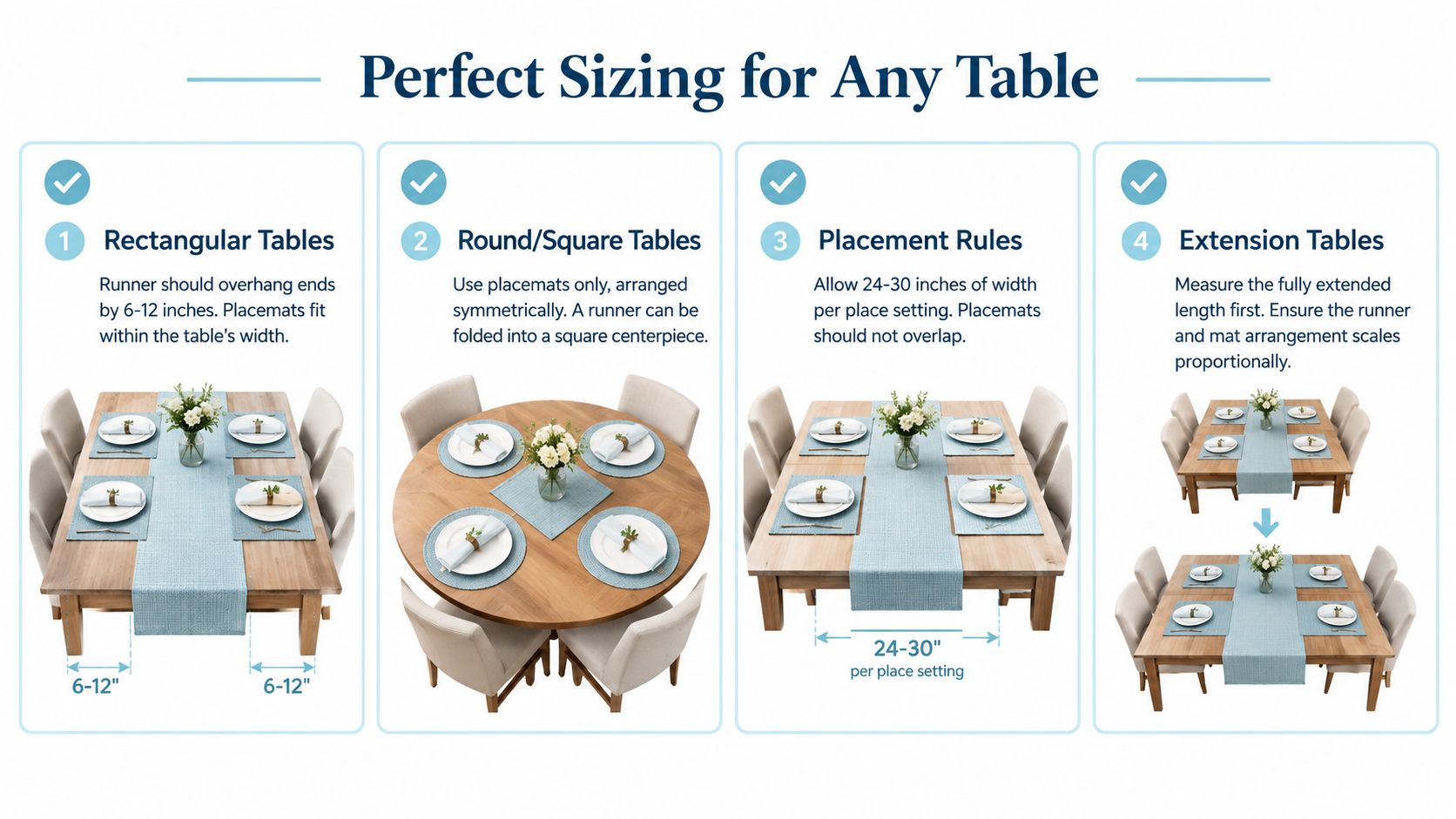
Sizing is where plenty of lovely purchases go wrong. A runner can be the right colour and the wrong length. Placemats can look great online, then swallow a small table or crowd everyone's elbows once dinner is served.
A simple way to test before you buy
Grab a tape measure and some painter's tape. Mark out the footprint of the runner down the centre of the table, then tape out each placemat where a person would sit. You'll spot problems quickly.
Look for three things:
- Centre breathing room so serving dishes can still land without wobbling on edges
- Comfort at each seat, especially near table legs or armchairs
- Clear table edge lines, so nothing hangs awkwardly or looks cramped
This sizing walkthrough is handy if you'd like to see a visual example in action.
What works on common Australian tables
Rectangular tables are the easiest. A runner usually looks best when it extends past the tabletop at both ends rather than stopping short in the middle. That little overhang gives the table a more settled look.
Round or square tables are different. Sometimes placemats alone are enough. If you still want a runner effect, a shorter runner or folded textile used as a centre feature can work better than a long strip trying to force a shape that isn't there.
Extension tables need honest measuring. Don't buy for the compact version if you regularly open it up for guests. Measure it in the size you use when entertaining.
The overlooked crosswise runner idea
This is the part many shoppers don't get explained. A runner doesn't always have to run lengthways. On a smaller table, placing a runner crosswise can create two dramatic place settings opposite each other, almost like oversized placemats with extra flair.
That works especially well for:
- Breakfast tables for two where you want a bit of polish without filling the middle
- Narrow apartment dining tables where full placemats feel crowded
- Styled occasional tables in beach homes or holiday rentals
Use crosswise styling when you want intimacy, not volume. It suits two-person settings and keeps the centre open for a bowl, lantern, or simple vase.
Common mistakes to avoid
A few sizing errors come up again and again:
- Too-short runners look accidental, like they've shrunk or been borrowed from another room.
- Oversized placemats can push glasses and cutlery too close to the edge.
- Ignoring chair count leads to sets that work in photos but not when everyone sits down.
- Forgetting serving space leaves nowhere for dishes, breadboards, or shared plates.
If your table hosts real meals, not just styling moments, always test with plates and glasses in place.
Styling Ideas for Coastal and VW Inspired Tables
A table runner and placemats set gives you the base note. The styling around it creates the personality. For coastal homes with a VW-soft spot, the sweet spot is usually relaxed texture with one or two nostalgic touches, not a full theme park.
The coastal base that always works
Start with a calm foundation. Sand, white, oat, faded blue, driftwood, or sea-glass tones are easy companions. Add texture before you add colour. Linen-look runners, woven placemats, ceramic plates, and a bit of timber do a lot of heavy lifting.
Then keep the centre low. A shallow bowl of shells, a small cluster of candles, or a simple vase works better than anything too tall or too busy.
If you like beachy decorating details beyond the dining table, dining table decor ideas can help you think about how the whole setting connects with your room.
Adding a VW note without making it kitschy
The classic Volkswagen mood is freedom, road trips, surfboards, and cheerful old-school colour. You can nod to that without plastering logos everywhere. A table can feel VW-inspired through palette and spirit alone.
Try combinations like these:
- Surf club casual with a neutral runner, woven mats, white plates, and a soft pop of turquoise or sun-faded red
- Flower Power retro with a plain natural base and one brighter accent, such as orange napkins or a playful bud vase
- Samba Sunday lunch with crisp placemats, polished cutlery, and a tidy centrepiece that feels celebratory but still easy-going
The trick is restraint. One nostalgic object on a sideboard, a retro photo frame nearby, or colours borrowed from classic Kombi paintwork can carry the theme.
A VW-inspired table should feel like a road trip memory, not a merchandise shelf.
Three easy styling formulas
Here are three reliable mixes that suit real Australian entertaining:
Family weeknight
Use wipeable or low-fuss placemats, a simple runner, and no centrepiece beyond a serving bowl. This keeps things practical and still pulled together.Outdoor coastal lunch
Choose textured placemats, a runner with movement, and sturdy tableware. Let the natural fibres do the decorating so the setting still works if the breeze picks up.Festive catch-up with friends
Keep the base neutral, then bring in a brighter accent through napkins, glassware, or a few low candles. That way the set remains useful year-round.
Negative space matters, too. Leave some breathing room. A table looks more inviting when not every centimetre is trying to perform.
Care Instructions That Keep Your Set Looking New
A pretty set isn't much use if it goes wavy, stiff, or patchy after one wash. Care starts before the first spill. It starts with reading the label and buying a material whose care routine suits your real life.
What Australian care labels need to tell you
In Australia, textile household goods such as table runner and placemats sets should carry durable care labelling that follows the Consumer Goods (Care Labelling) Information Standard 2023. For washable items, the label must identify the appropriate wash process, and if an item can't be washed or dry-cleaned, the label must clearly warn you and state the correct care treatment, as outlined by the Australian mandatory care labelling standard.
That's not admin for admin's sake. Care instructions affect shape retention, finish, and service life. Wrong laundering can lead to shrinkage, edge waviness, and print or coating failure.
Damage often comes from heat, not dirt
A lot of table sets look sturdy until heat gets involved. Laminated backs, water-repellent finishes, embroidered borders, and bonded layers can all react badly to harsh washing, bleach, or aggressive tumble drying.
Australian guidance also allows care instructions to be given in English or recognised symbols, with standard symbols covering washing, bleaching, drying, ironing, and professional care according to the ACCC care labelling guide for clothing and textiles. If you're not used to reading symbols, it's worth learning the basics once. It saves ruined finishes later.
A practical care routine
- For spills, blot first. Don't grind the stain in with a wet cloth.
- For washable fabric runners, follow the stated wash method rather than guessing a gentle cycle will be fine.
- For woven natural-fibre placemats, spot clean carefully and let them dry flat and fully before stacking.
- For ironing, use only the heat level the label supports, especially on coated or decorated finishes.
- For storage, keep pieces flat or gently rolled where possible, and don't trap dampness between stacked mats.
Store your set as carefully as you style it. Most shape problems start in the laundry or the cupboard, not on the dining table.
If you hate ironing, don't buy a set that demands crisp pressing to look good. Linen blends and textured weaves can be much more forgiving.
Gifting and Shopping Smart for Bundled Sets
A table runner and placemats set makes a strong gift because it feels useful and thoughtful at the same time. It suits housewarmings, birthdays, holiday gifting, coastal rental refreshes, and even collector households where the person already has “enough stuff” but still enjoys pieces with character.
What smart buyers look for
Good bundled sets usually reveal their quality in small details. Check whether the edges are neatly finished, whether the weave sits flat, and whether the materials make sense for the recipient's lifestyle. A beach-house owner may love natural texture. A family with younger kids may thank you for something easier to wipe down.
If you're shopping with a nostalgic VW eye, look for details that complement that world rather than competing with it. A set doesn't need a giant graphic print to feel on-brand with a surfy, retro, road-trip home. Often the better gift is something textural and versatile that sits beautifully alongside Beetle, Kombi, or Samba-inspired decor already in the home.
Why local buying helps
For Australians, local stock has obvious advantages. Faster shipping is handy when the gift date is close, and it's easier to ask practical questions about materials, colour, or styling if support is local. That matters even more for gifts, because returns and replacements are always more pleasant when you're not chasing answers across time zones.
Presentation helps too. Add a note about where the set might work best, such as weekend breakfasts, outdoor lunches, or summer entertaining. It makes the gift feel considered rather than generic.
A short gift guide by occasion
| Occasion | Best set style |
|---|---|
| Housewarming | Neutral runner with versatile placemats |
| Beach house gift | Natural-fibre or coastal-texture set |
| Family entertainer | Low-fuss, easy-care materials |
| Retro decor lover | Relaxed tones that pair with VW-inspired pieces |
If you're pairing home styling with a broader beachy or nostalgic gift, beach house gifts are a natural companion category to browse.
For the best buy, think like a collector for a moment. Be specific about what you want. Colour, texture, finish, and use case matter. That mindset mirrors advice from Australian diecast collecting guides, which recommend being precise about the exact details you're after rather than buying vaguely and regretting it later. It's surprisingly good advice for home decor too.
If you love the easygoing mix of coastal styling and classic VW nostalgia, Volkswagen Memorabilia brings those worlds together with VW-themed gifts, diecast models, and beach-inspired decor that sit beautifully in relaxed Australian homes. From surfy accents to collectible Kombi and Beetle pieces that add character near the dining space, it's a lovely spot to find something personal, practical, and full of heritage.